## Diagram: Autonomous Discovery Workflow
### Overview
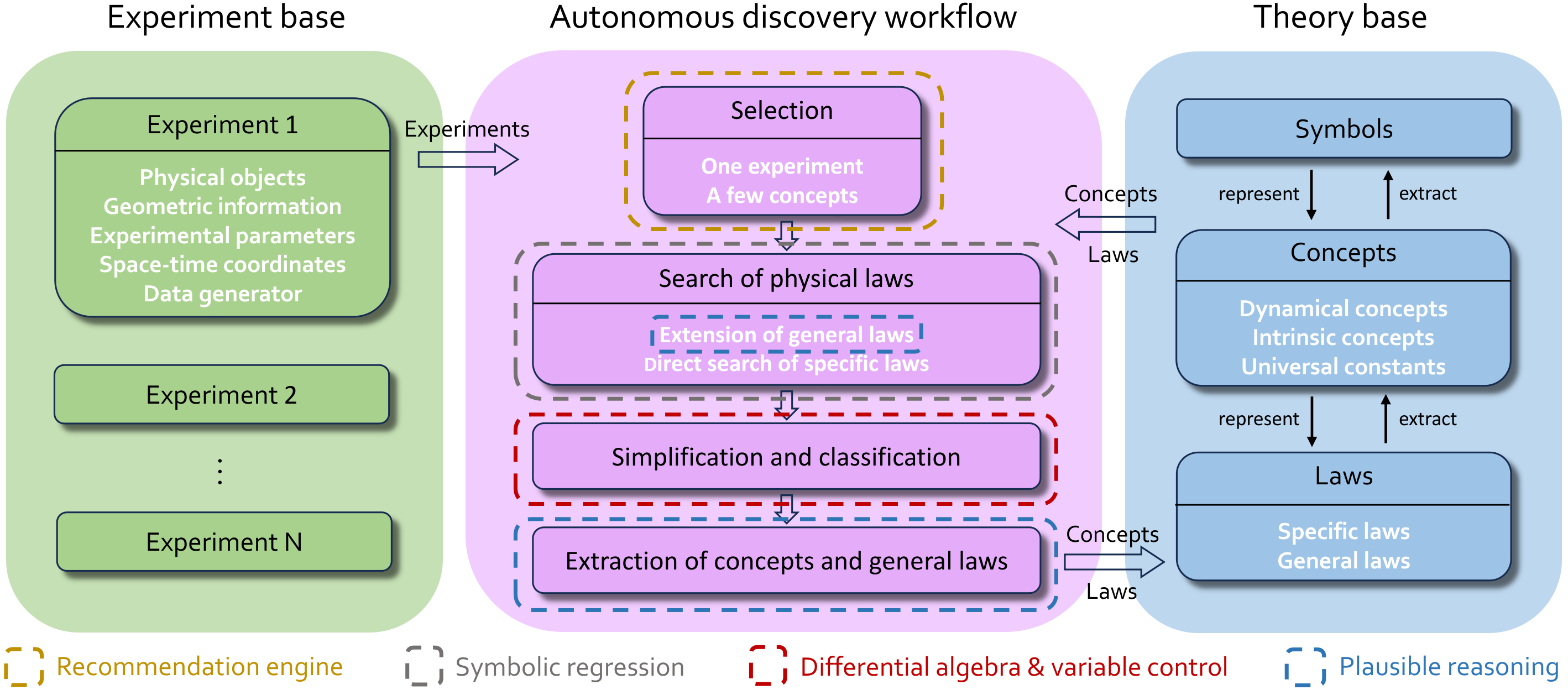
The image presents a conceptual framework for an "Autonomous discovery workflow." It is organized into three distinct vertical columns representing the flow of information from experimental data to theoretical knowledge. The diagram illustrates a closed-loop system where experimental data is processed through an automated workflow to generate or refine theoretical concepts and laws, which in turn inform the discovery process.
### Components/Axes
The diagram is divided into three main regions:
1. **Left Column (Green Background): "Experiment base"**
* Contains a stack of experiment blocks (Experiment 1, Experiment 2, ..., Experiment N).
* **Experiment 1** is detailed with the following sub-labels: "Physical objects", "Geometric information", "Experimental parameters", "Space-time coordinates", "Data generator".
2. **Center Column (Purple Background): "Autonomous discovery workflow"**
* Contains four stacked processing blocks, each enclosed in a distinct dashed border.
* **Top (Yellow dashed border):** "Selection" (contains "One experiment", "A few concepts").
* **Upper-Middle (Grey dashed border):** "Search of physical laws" (contains "Extension of general laws", "Direct search of specific laws").
* **Lower-Middle (Red dashed border):** "Simplification and classification".
* **Bottom (Blue dashed border):** "Extraction of concepts and general laws".
3. **Right Column (Blue Background): "Theory base"**
* Contains three stacked blocks representing theoretical hierarchy:
* **Top:** "Symbols".
* **Middle:** "Concepts" (contains "Dynamical concepts", "Intrinsic concepts", "Universal constants").
* **Bottom:** "Laws" (contains "Specific laws", "General laws").
* Bi-directional arrows connect "Symbols" to "Concepts" and "Concepts" to "Laws," labeled "represent" (downward) and "extract" (upward).
**Legend (Bottom):**
The legend maps the dashed borders in the center column to specific methodologies:
* **Yellow dashed box:** Recommendation engine
* **Grey dashed box:** Symbolic regression
* **Red dashed box:** Differential algebra & variable control
* **Blue dashed box:** Plausible reasoning
### Detailed Analysis
**Flow and Connectivity:**
* **Input:** An arrow labeled "Experiments" points from the "Experiment base" (Left) to the "Autonomous discovery workflow" (Center).
* **Internal Workflow:** Vertical arrows connect the four blocks in the center column, indicating a sequential process: Selection $\rightarrow$ Search of physical laws $\rightarrow$ Simplification and classification $\rightarrow$ Extraction of concepts and general laws.
* **Feedback/Interaction:** Two-way arrows labeled "Concepts" and "Laws" connect the "Autonomous discovery workflow" (Center) to the "Theory base" (Right). This indicates that the workflow both utilizes existing concepts/laws and contributes new ones back to the theory base.
**Methodology Mapping:**
* **Selection:** Utilizes a **Recommendation engine** (Yellow).
* **Search of physical laws:** Utilizes **Symbolic regression** (Grey).
* **Simplification and classification:** Utilizes **Differential algebra & variable control** (Red).
* **Extraction of concepts and general laws:** Utilizes **Plausible reasoning** (Blue).
### Key Observations
* **Hierarchical Abstraction:** The "Theory base" is structured hierarchically, moving from abstract "Symbols" to "Concepts" and finally to "Laws." The bi-directional arrows suggest a continuous refinement process where symbols represent concepts, and concepts are extracted from laws, and vice versa.
* **Modular Workflow:** The center column breaks down the discovery process into four distinct computational tasks, each associated with a specific algorithmic approach (Recommendation, Regression, Algebra, Reasoning).
* **Data-Driven Loop:** The system is designed to ingest raw experimental data (left) and output structured theoretical knowledge (right), with the workflow acting as the bridge.
### Interpretation
This diagram depicts an **automated scientific discovery pipeline**, likely representing an AI-driven system designed to perform physics research.
* **The "Closed-Loop" Nature:** The interaction between the "Autonomous discovery workflow" and the "Theory base" suggests a system that does not just output static results but iteratively updates its own theoretical understanding. By extracting concepts and laws, the system improves its ability to perform future "Selection" and "Search" tasks.
* **Methodological Rigor:** The specific assignment of techniques (e.g., "Symbolic regression" for searching laws, "Differential algebra" for simplification) suggests a highly structured approach to AI-driven science. It implies that the system treats scientific discovery as a formal optimization and classification problem rather than a purely generative one.
* **Peircean Investigative Logic:** The flow mirrors the scientific method:
1. **Abduction (Selection):** Choosing which experiments to run based on current knowledge.
2. **Induction (Search/Simplification):** Finding patterns (laws) in the data.
3. **Deduction (Extraction):** Formalizing these patterns into concepts and laws that can be tested again.
* **Significance:** This architecture is characteristic of modern "AI for Science" (AI4Science) frameworks, which aim to accelerate scientific discovery by automating the transition from raw experimental observations to fundamental physical laws.