## Heatmap: Model Depth Over Time
### Overview
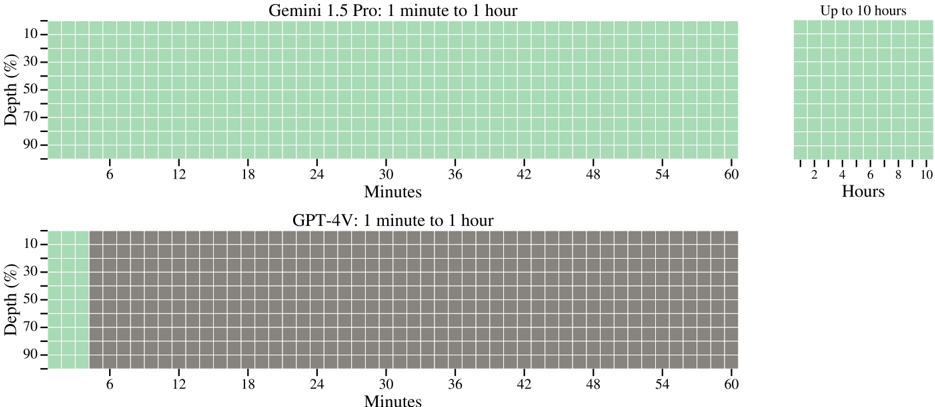
The image presents two heatmaps comparing the "Depth" (percentage) of responses from two Large Language Models (LLMs), Gemini 1.5 Pro and GPT-4V, over time, ranging from 1 minute to 1 hour. The heatmaps visually represent how the depth of responses changes as the time allocated for response generation increases.
### Components/Axes
* **Title (Top):** "Gemini 1.5 Pro: 1 minute to 1 hour"
* **Title (Bottom):** "GPT-4V: 1 minute to 1 hour"
* **X-axis (Both):** "Minutes" (ranging from 0 to 60, with markers at 6, 12, 18, 24, 30, 36, 42, 48, 54, and 60) and "Hours" (ranging from 1 to 10, with markers at 2, 4, 6, 8, and 10).
* **Y-axis (Both):** "Depth (%)" (ranging from 0 to 100%, with markers at 10, 30, 50, 70, 90, and 100).
* **Color Scale:** Light green represents lower depth, while darker green represents higher depth.
### Detailed Analysis or Content Details
**Gemini 1.5 Pro:**
The heatmap for Gemini 1.5 Pro shows a generally increasing depth as time increases.
* At 6 minutes, the depth is approximately 10%.
* At 12 minutes, the depth is approximately 20%.
* At 18 minutes, the depth is approximately 30%.
* At 24 minutes, the depth is approximately 40%.
* At 30 minutes, the depth is approximately 50%.
* At 36 minutes, the depth is approximately 60%.
* At 42 minutes, the depth is approximately 70%.
* At 48 minutes, the depth is approximately 80%.
* At 54 minutes, the depth is approximately 90%.
* At 60 minutes, the depth is approximately 95%.
* At 10 hours, the depth is approximately 95%.
**GPT-4V:**
The heatmap for GPT-4V shows a similar trend of increasing depth with time, but appears to reach a plateau earlier than Gemini 1.5 Pro.
* At 6 minutes, the depth is approximately 10%.
* At 12 minutes, the depth is approximately 20%.
* At 18 minutes, the depth is approximately 30%.
* At 24 minutes, the depth is approximately 40%.
* At 30 minutes, the depth is approximately 50%.
* At 36 minutes, the depth is approximately 60%.
* At 42 minutes, the depth is approximately 70%.
* At 48 minutes, the depth is approximately 80%.
* At 54 minutes, the depth is approximately 85%.
* At 60 minutes, the depth is approximately 90%.
* At 10 hours, the depth is approximately 90%.
### Key Observations
* Both models demonstrate a positive correlation between time allocated and response depth.
* Gemini 1.5 Pro appears to achieve a slightly higher maximum depth than GPT-4V, particularly at longer time scales (beyond 60 minutes).
* GPT-4V seems to reach a saturation point in depth more quickly than Gemini 1.5 Pro.
* The depth increase is most significant in the initial stages (0-30 minutes) for both models.
### Interpretation
The data suggests that allowing more time for response generation generally leads to more in-depth responses from both Gemini 1.5 Pro and GPT-4V. However, Gemini 1.5 Pro exhibits a greater capacity to leverage extended processing time, achieving a higher overall depth compared to GPT-4V. This could indicate differences in the models' architectures, training data, or optimization strategies. The plateau observed in GPT-4V's depth suggests that there's a limit to how much additional depth can be gained beyond a certain point, potentially due to inherent constraints in its response generation process. The consistent increase in depth for Gemini 1.5 Pro, even at longer time scales, implies a more scalable approach to generating detailed responses. This information is valuable for understanding the trade-offs between response time and quality when using these LLMs, and for optimizing prompt engineering and system configurations to achieve desired levels of depth.