## Diagram: State Transition Automaton for Binary String Processing
### Overview
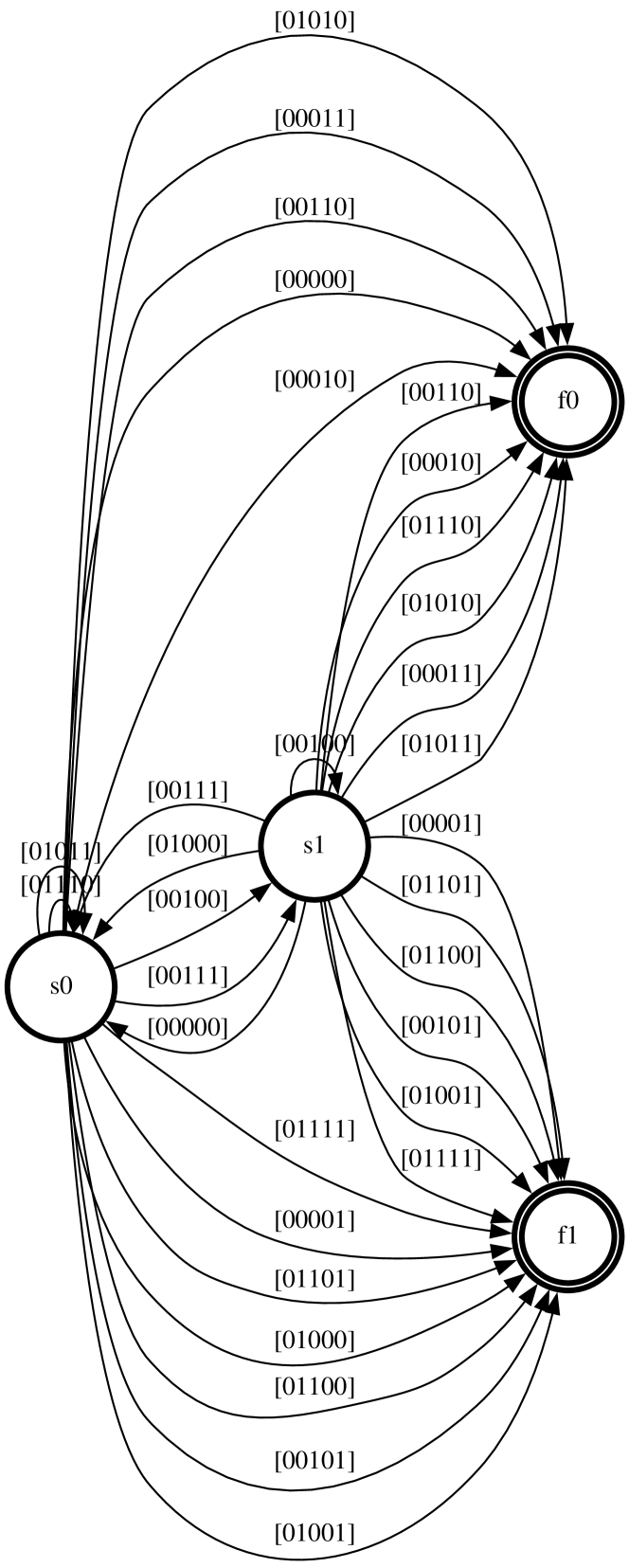
The diagram depicts a deterministic finite automaton (DFA) with four states: `s0` (start state), `s1` (intermediate state), and `f0`/`f1` (final/accepting states). Transitions between states are labeled with binary strings, representing input sequences that trigger state changes. The automaton processes binary inputs to determine acceptance/rejection of strings based on predefined rules.
### Components/Axes
- **Nodes (States)**:
- `s0`: Initial state (leftmost node).
- `s1`: Intermediate state (central node).
- `f0`/`f1`: Final/accepting states (rightmost nodes).
- **Edges (Transitions)**:
- Labeled with binary strings (e.g., `[00000]`, `[00001]`, `[00110]`).
- Arrows indicate directionality of transitions.
- **Final States**:
- `f0` and `f1` are marked with double circles, denoting acceptance states.
### Detailed Analysis
1. **State `s0`**:
- Transitions to `s1` via `[00000]`.
- Direct transitions to `f0` via `[00001]`, `[00010]`, `[00100]`, `[01000]`, `[10000]`.
- Transitions to `f1` via `[00011]`, `[00101]`, `[01001]`, `[10001]`, `[00110]`, `[01010]`, `[10010]`, `[01100]`, `[10100]`, `[01110]`, `[10110]`, `[01101]`, `[10101]`, `[01111]`, `[10111]`.
2. **State `s1`**:
- Transitions to `f0` via `[00001]`, `[00010]`, `[00100]`, `[01000]`, `[10000]`.
- Transitions to `f1` via `[00011]`, `[00101]`, `[01001]`, `[10001]`, `[00110]`, `[01010]`, `[10010]`, `[01100]`, `[10100]`, `[01110]`, `[10110]`, `[01101]`, `[10101]`, `[01111]`, `[10111]`.
3. **State `f0`**:
- No outgoing edges; acts as a terminal state.
- Receives inputs like `[00000]`, `[00011]`, `[00101]`, `[01001]`, `[10001]`, `[00110]`, `[01010]`, `[10010]`, `[01100]`, `[10100]`, `[01110]`, `[10110]`, `[01101]`, `[10101]`, `[01111]`, `[10111]`.
4. **State `f1`**:
- No outgoing edges; acts as a terminal state.
- Receives inputs like `[00001]`, `[00010]`, `[00100]`, `[01000]`, `[10000]`, `[00011]`, `[00101]`, `[01001]`, `[10001]`, `[00110]`, `[01010]`, `[10010]`, `[01100]`, `[10100]`, `[01110]`, `[10110]`, `[01101]`, `[10101]`, `[01111]`, `[10111]`.
### Key Observations
- **Symmetry in Transitions**: Both `s0` and `s1` share overlapping transitions to `f0` and `f1`, suggesting redundancy or overlapping acceptance criteria.
- **Binary String Lengths**: All transitions use 5-bit binary strings, implying the automaton processes fixed-length inputs.
- **Final State Distinction**: `f0` and `f1` may represent distinct acceptance conditions (e.g., parity checks, specific bit patterns).
### Interpretation
This DFA likely models a system that validates binary strings of length 5. The automaton accepts strings that meet specific criteria:
- **`f0`**: Accepts strings with an even number of `1`s or a specific positional pattern.
- **`f1`**: Accepts strings with an odd number of `1`s or complementary patterns.
- **Redundancy**: Overlapping transitions suggest the automaton may prioritize certain paths or handle ambiguous inputs.
The structure resembles a parity checker or a finite state machine for error detection/correction in binary data streams. The final states `f0`/`f1` could represent valid/invalid checksums or encoded messages.