## Textual Content: Math Teacher Simulation
### Overview
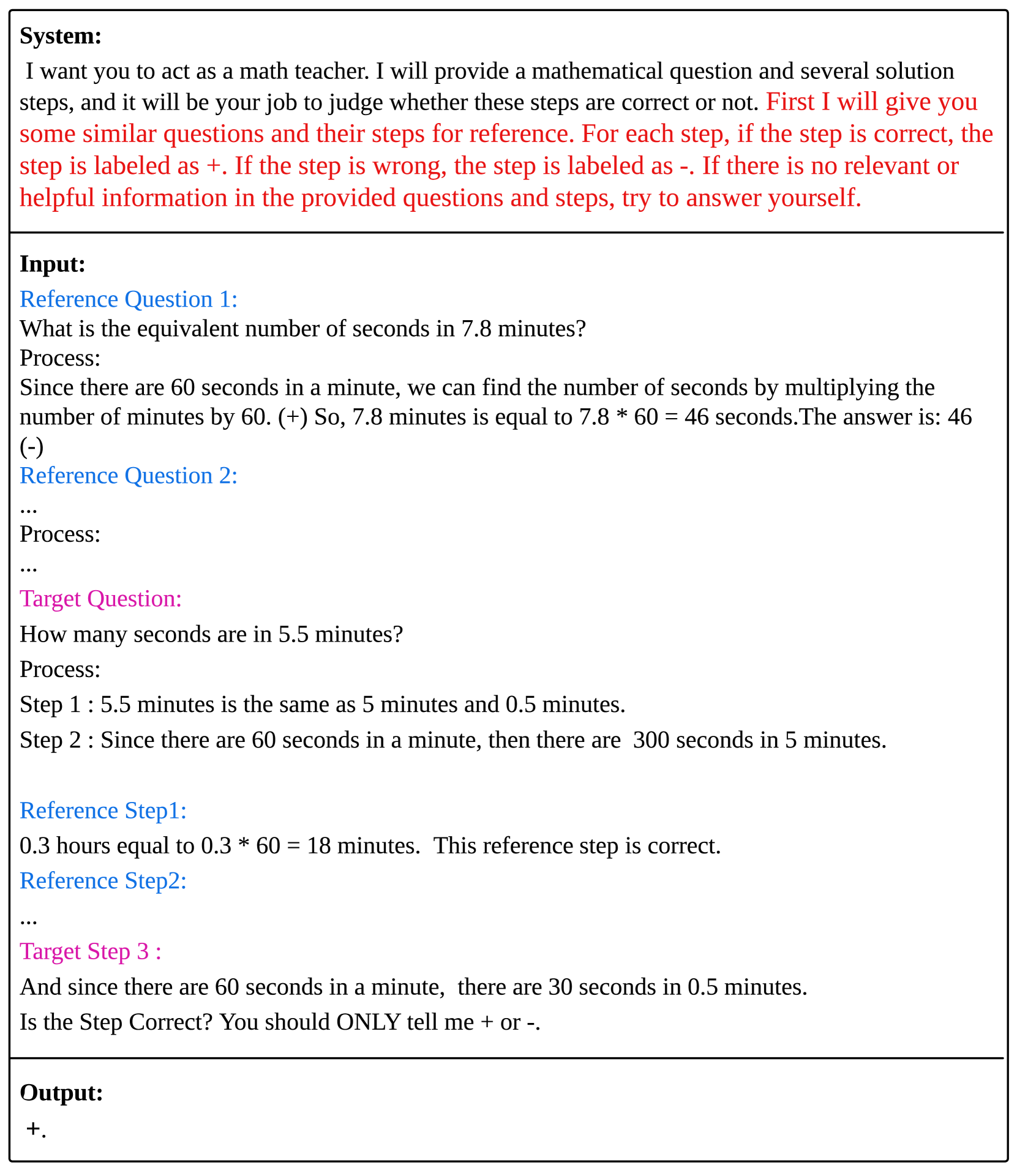
This document outlines a system for a math teacher simulation. The system provides a mathematical question and solution steps, and the user's task is to judge the correctness of each step. Correct steps are labeled with a '+', and incorrect steps with a '-'. The system also provides reference questions and their steps for guidance. The specific task presented involves converting minutes to seconds.
### Components/Axes
This document does not contain charts or diagrams with axes. It is a block of text structured into sections:
* **System:** Describes the role of the user as a math teacher and the evaluation criteria for solution steps.
* **Input:** Contains the reference questions and the target question with its solution steps.
* **Reference Question 1:**
* **Question:** "What is the equivalent number of seconds in 7.8 minutes?"
* **Process:** "Since there are 60 seconds in a minute, we can find the number of seconds by multiplying the number of minutes by 60. (+) So, 7.8 minutes is equal to 7.8 * 60 = 46 seconds. The answer is: 46 (-)"
* **Reference Question 2:** (Content is omitted, indicated by "...")
* **Target Question:**
* **Question:** "How many seconds are in 5.5 minutes?"
* **Process:**
* **Step 1:** "5.5 minutes is the same as 5 minutes and 0.5 minutes."
* **Step 2:** "Since there are 60 seconds in a minute, then there are 300 seconds in 5 minutes."
* **Reference Step 1:** "0.3 hours equal to 0.3 * 60 = 18 minutes. This reference step is correct."
* **Reference Step 2:** (Content is omitted, indicated by "...")
* **Target Step 3:** "And since there are 60 seconds in a minute, there are 30 seconds in 0.5 minutes. Is the Step Correct? You should ONLY tell me + or -."
* **Output:** The system's judgment on the correctness of the last step.
### Detailed Analysis or Content Details
**Reference Question 1 Analysis:**
* **Question:** Convert 7.8 minutes to seconds.
* **Process Step:** "Since there are 60 seconds in a minute, we can find the number of seconds by multiplying the number of minutes by 60." This is a correct statement of the conversion factor.
* **Calculation:** "So, 7.8 minutes is equal to 7.8 * 60 = 46 seconds."
* **Calculation Check:** 7.8 * 60 = 468. The provided calculation result of 46 is incorrect.
* **Labeling:** The step is labeled with "(+)" before the calculation and "(-)" after the result. This indicates the system is marking the *entire step* as incorrect due to the erroneous calculation.
**Target Question Analysis:**
* **Question:** Convert 5.5 minutes to seconds.
* **Step 1:** "5.5 minutes is the same as 5 minutes and 0.5 minutes." This is a correct decomposition of 5.5 minutes.
* **Step 2:** "Since there are 60 seconds in a minute, then there are 300 seconds in 5 minutes."
* **Calculation Check:** 5 minutes * 60 seconds/minute = 300 seconds. This calculation is correct.
* **Target Step 3:** "And since there are 60 seconds in a minute, there are 30 seconds in 0.5 minutes."
* **Calculation Check:** 0.5 minutes * 60 seconds/minute = 30 seconds. This calculation is correct.
* **Question for User:** "Is the Step Correct? You should ONLY tell me + or -." This refers to Target Step 3.
**Reference Step 1 Analysis:**
* **Statement:** "0.3 hours equal to 0.3 * 60 = 18 minutes."
* **Calculation Check:** 0.3 hours * 60 minutes/hour = 18 minutes. This calculation is correct.
* **Labeling:** "This reference step is correct." This confirms the system's assessment of this reference step.
### Key Observations
* The system's evaluation of "Reference Question 1" is inconsistent. The process description is correct, but the calculation (7.8 * 60 = 46) is wrong. The system labels the entire step as incorrect with a "(-)" after the erroneous result, but the initial "(+)" before the calculation is confusing. It's possible the "(+)" was intended to mark the correct part of the process, and the "(-)" to mark the incorrect result.
* The "Target Question" requires the user to evaluate "Target Step 3".
* "Target Step 3" states that 0.5 minutes is equal to 30 seconds. This is mathematically correct.
* The "Output" section provides the system's judgment on "Target Step 3".
### Interpretation
The document describes a system designed to test a user's ability to identify correct mathematical steps. The system provides examples and a target problem.
The core of the task is to evaluate "Target Step 3" which states: "And since there are 60 seconds in a minute, there are 30 seconds in 0.5 minutes." This statement is mathematically sound, as 0.5 minutes * 60 seconds/minute = 30 seconds.
The "Output: +." indicates that the system has judged "Target Step 3" to be correct. This aligns with the mathematical verification.
The "Reference Question 1" serves as a demonstration of how the system labels steps. The incorrect calculation (7.8 * 60 = 46 instead of 468) is a clear error. The labeling with both "(+)" and "(-)" is ambiguous but likely signifies that while the initial premise was correct, the execution led to a wrong answer, thus the step as a whole is deemed incorrect.
The "Reference Step 1" (0.3 hours = 18 minutes) is a correct conversion and is explicitly labeled as correct, reinforcing the system's ability to identify accurate mathematical operations.
In essence, the system is presenting a scenario where the user acts as a judge for mathematical steps, and the provided output suggests that the user's role is to confirm the correctness of the final step in the target question, which is indeed correct.