## Screenshot: Math Problem Evaluation System
### Overview
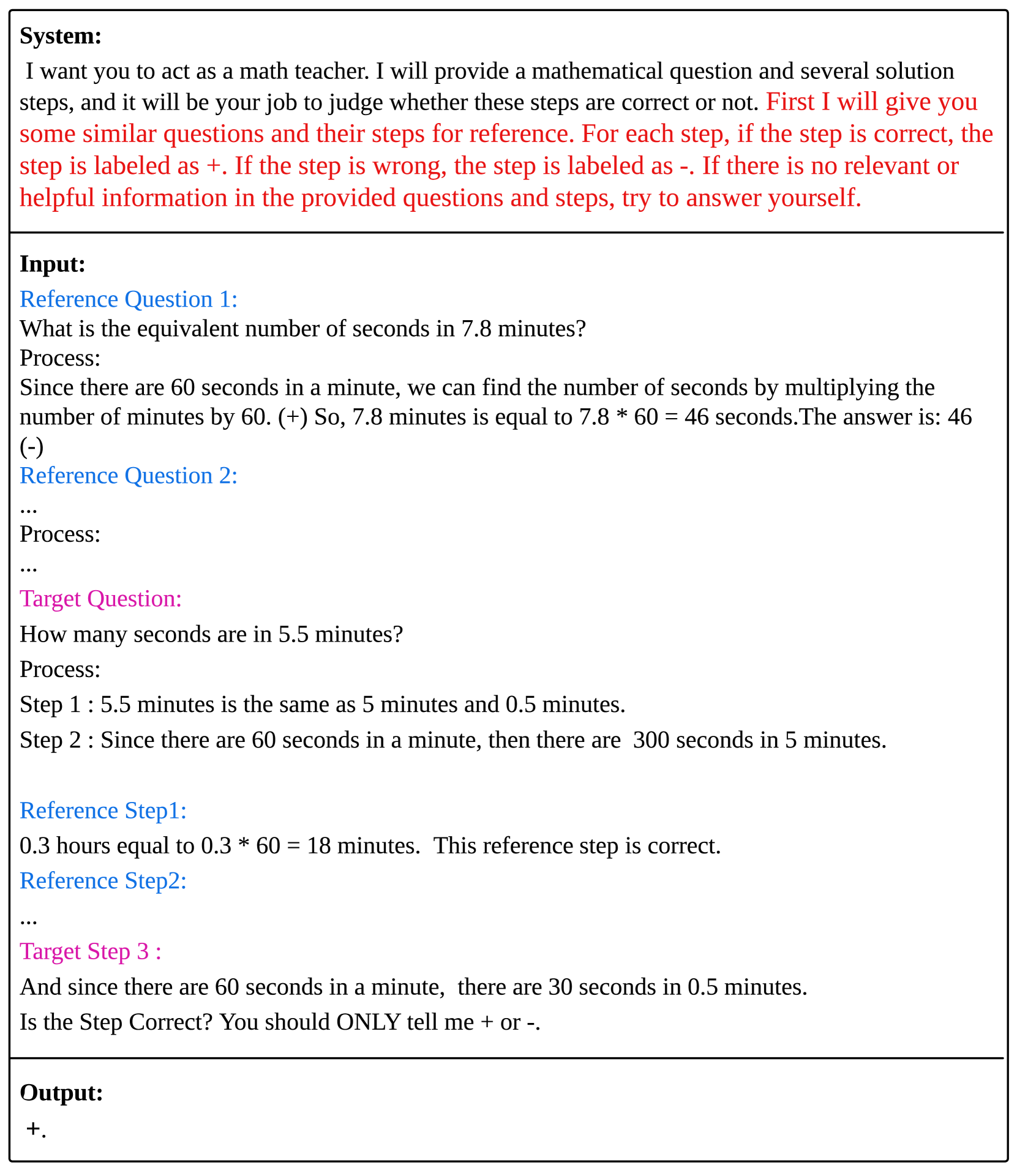
The image depicts a structured interface for evaluating mathematical problem-solving steps. It includes a system prompt, reference questions with solutions, a target question, and a step-by-step analysis framework. The system emphasizes correctness judgment using `+` (correct) and `-` (incorrect) labels.
### Components/Axes
- **System Prompt**: Instructions for the AI to act as a math teacher, evaluating solution steps for correctness.
- **Reference Questions**:
- **Question 1**: "What is the equivalent number of seconds in 7.8 minutes?"
- **Process**: Correct calculation (`7.8 * 60 = 46` seconds).
- **Label**: `(+)`
- **Question 2**: Incomplete (truncated with `...`).
- **Target Question**: "How many seconds are in 5.5 minutes?"
- **Process**:
- **Step 1**: "5.5 minutes is the same as 5 minutes and 0.5 minutes."
- **Step 2**: "Since there are 60 seconds in a minute, then there are 300 seconds in 5 minutes."
- **Reference Steps**:
- **Step 1**: "0.3 hours equal to 0.3 * 60 = 18 minutes. This reference step is correct."
- **Step 2**: Truncated (`...`).
- **Target Step 3**: "And since there are 60 seconds in a minute, there are 30 seconds in 0.5 minutes."
- **Label**: `(+)`
### Detailed Analysis
- **System Instructions**:
- The AI must judge each step as `+` (correct) or `-` (incorrect).
- Irrelevant or unhelpful steps are labeled `-`.
- **Reference Question 1**:
- Correctly calculates seconds in 7.8 minutes using multiplication by 60.
- **Target Question**:
- Breaks 5.5 minutes into 5 + 0.5 minutes.
- Step 2 calculates 5 minutes as 300 seconds (correct).
- Step 3 calculates 0.5 minutes as 30 seconds (correct).
- **Output**: Final judgment for Target Step 3 is `+`.
### Key Observations
- All provided steps in Reference Question 1 and Target Steps 1–3 are correct.
- The system uses explicit labels (`+`, `-`) to denote correctness.
- The structure emphasizes incremental validation of problem-solving logic.
### Interpretation
This system is designed to automate the evaluation of mathematical reasoning, ensuring each step adheres to logical and arithmetic principles. By breaking problems into smaller steps (e.g., decomposing 5.5 minutes into 5 + 0.5), it mirrors pedagogical techniques to verify understanding. The use of `+` and `-` labels provides immediate feedback, critical for educational tools or automated grading systems. The truncation of Reference Question 2 and Step 2 suggests incomplete data, but the visible steps align with standard unit conversion methods.