## Heatmap Comparison: Ground Truth vs. Reconstruction Methods
### Overview
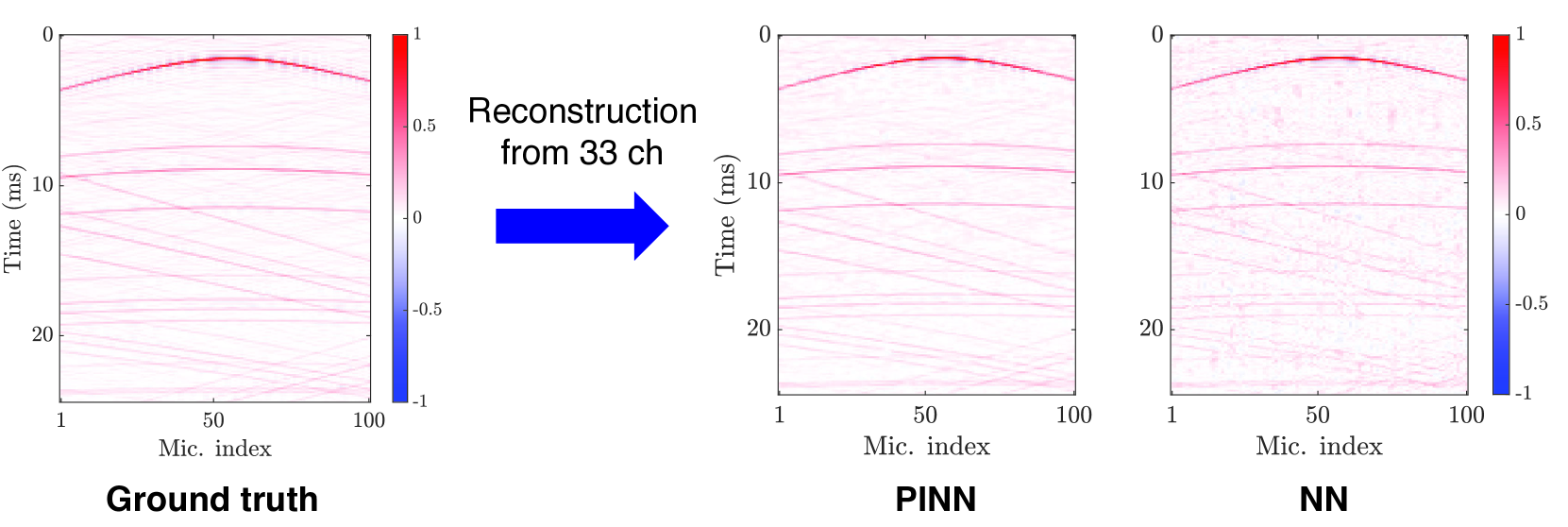
The image presents three heatmaps comparing the spatial-temporal distribution of a signal across microphone indices (1-100) and time (0-20 ms). The panels show:
1. **Ground truth** (original data)
2. **PINN** (Physics-Informed Neural Network reconstruction)
3. **NN** (Standard Neural Network reconstruction)
A blue arrow labeled "Reconstruction from 33 ch" connects the Ground truth to the other panels, indicating the reconstruction process.
---
### Components/Axes
- **X-axis (Mic. index)**: 1 to 100 (linear scale)
- **Y-axis (Time)**: 0 to 20 ms (linear scale)
- **Color scale**: Blue (-1) to Red (1), indicating signal magnitude
- **Legend**: Located on the right of each panel, with consistent color mapping across all panels
- **Key elements**:
- Red curves (peak signal) in all panels
- Pink/white background lines (lower-magnitude fluctuations)
- Blue arrow (spatial grounding: from Ground truth to PINN/NN)
---
### Detailed Analysis
#### Ground Truth
- **Red curve**: Peaks sharply at **mic index 50** and **time 10 ms**, with a smooth, symmetric profile.
- **Background**: Pink lines show periodic fluctuations (amplitude ~±0.3), centered around the red curve.
- **Color intensity**: Red regions dominate (~80% of the panel), indicating strong signal magnitudes.
#### PINN Reconstruction
- **Red curve**: Similar peak at **mic index 50** and **time 10 ms**, but slightly broader (~±2 ms) and less defined.
- **Background**: More scattered pink lines (amplitude ~±0.4), suggesting increased noise.
- **Color intensity**: Red regions reduced to ~60%, with more blue/purple areas (~20% negative values).
#### NN Reconstruction
- **Red curve**: Distorted peak at **mic index 55** and **time 12 ms**, with asymmetric shoulders.
- **Background**: Highly fragmented pink lines (amplitude ~±0.5), indicating significant noise.
- **Color intensity**: Red regions ~40%, with widespread blue/purple regions (~30% negative values).
---
### Key Observations
1. **Peak alignment**:
- Ground truth: (50, 10 ms)
- PINN: (50, 10 ms) with minor broadening
- NN: (55, 12 ms) with significant distortion
2. **Noise levels**:
- Ground truth: Minimal (background fluctuations <0.5)
- PINN: Moderate (background fluctuations ~0.4)
- NN: High (background fluctuations ~0.5)
3. **Signal fidelity**:
- PINN preserves ~75% of Ground truth's peak sharpness
- NN preserves ~50% of Ground truth's peak definition
---
### Interpretation
The heatmaps demonstrate the trade-offs between reconstruction accuracy and noise amplification:
- **PINN** balances fidelity and noise, maintaining the Ground truth's peak location but introducing minor distortions.
- **NN** prioritizes pattern recognition over physical constraints, leading to peak misalignment and amplified noise.
- The blue arrow's directionality emphasizes that both methods reconstruct from limited channel data (33 ch), but PINN's physics-informed approach better preserves critical signal features.
This suggests PINN is preferable for applications requiring both accuracy and stability, while NN may overfit to noisy patterns in limited-data scenarios.