## Diagram: Multi-Step Question-Answering System Using Knowledge Graphs and Web Retrieval
### Overview
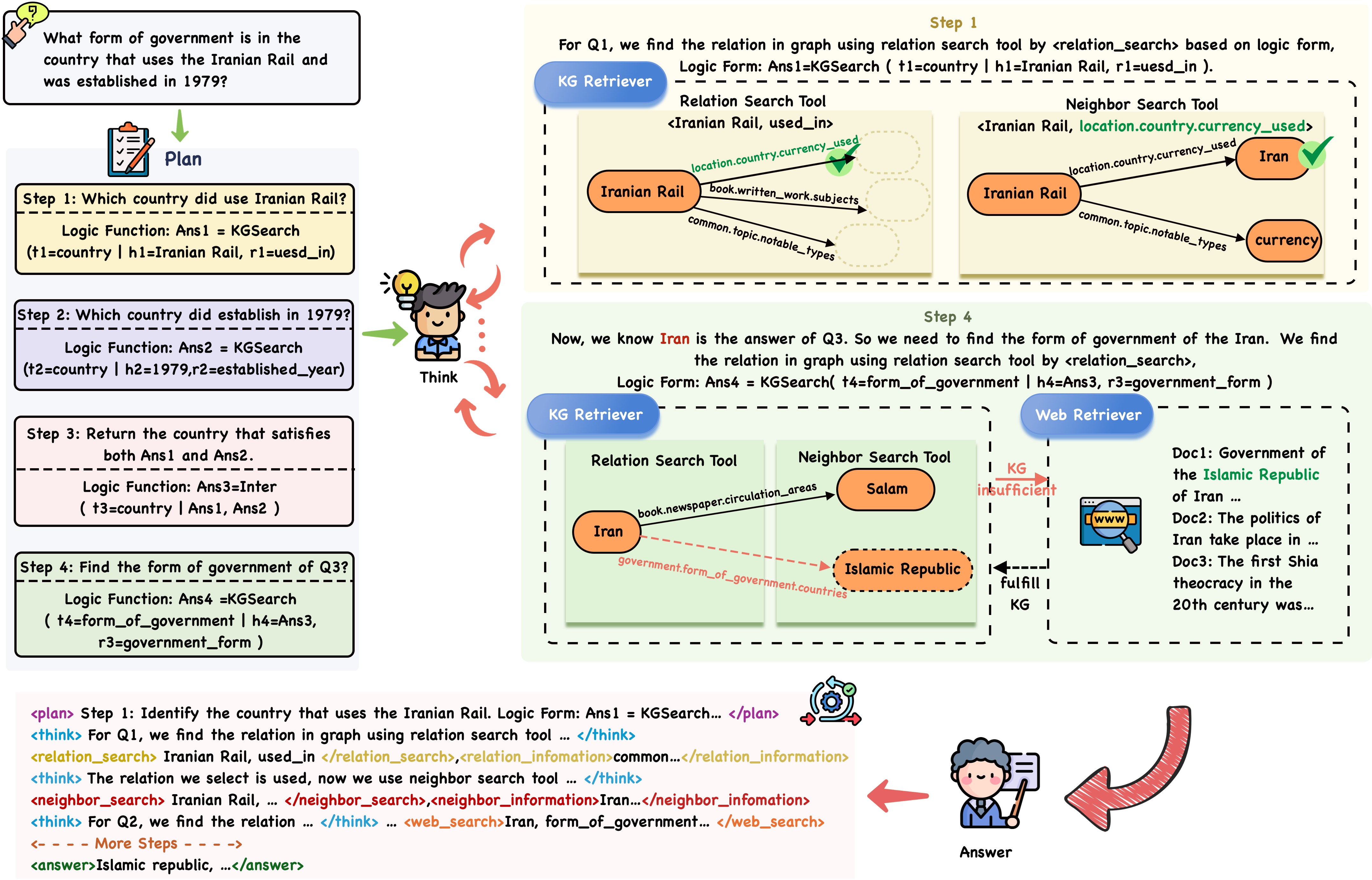
The image is a technical flowchart illustrating a multi-step reasoning system designed to answer a complex natural language question. The system decomposes the question into sub-questions, uses a Knowledge Graph (KG) Retriever to find intermediate answers, and supplements with a Web Retriever when the KG is insufficient. The final answer is "Islamic republic".
### Components/Axes
The diagram is organized into several interconnected regions:
1. **Initial Question (Top-Left):** A speech bubble containing the user's query.
2. **Plan (Left Column):** A four-step plan with associated logic functions.
3. **Think Process (Center-Left):** A cartoon figure representing the reasoning engine, with arrows indicating iterative thinking.
4. **KG Retriever Modules (Top-Right and Center):** Two main blocks showing the use of "Relation Search Tool" and "Neighbor Search Tool" on a knowledge graph.
5. **Web Retriever Module (Center-Right):** A block showing web document retrieval when the KG is insufficient.
6. **Process Log (Bottom-Left):** A sequence of XML-like tags:
* `<plan> ... </plan>`
* `<relation_search> Iranian Rail, used_in </relation_search>`
* `<relation_information>common...</relation_information>`
* `<neighbor_search> Iranian Rail, ... </neighbor_search>`
* `<neighbor_information>Iran...</neighbor_information>`
* `<web_search>Iran, form_of_government... </web_search>`
* `<- - - More Steps - - ->`
* `<answer>Islamic republic, ...</answer>`
### Key Observations
1. **Hybrid Retrieval Strategy:** The system explicitly handles KG insufficiency by triggering a Web Retriever, which provides contextual documents that "fulfill" the missing knowledge.
2. **Iterative Reasoning:** The "Think" process and the step-by-step plan show a deliberate, sequential approach to decomposing and solving the complex query.
3. **Graph Query Specificity:** The logic forms use typed variables (`t1`, `h1`, `r1`) and specific relation names (`used_in`, `established_year`, `government_form`), indicating a structured query language for the knowledge graph.
4. **Visual Confirmation:** Green checkmarks in the Step 1 KG diagrams visually confirm the successful identification of "Iran" as the intermediate answer.
5. **Answer Synthesis:** The final answer "Islamic republic" is derived by combining the KG path (Iran -> Islamic Republic) with corroborating evidence from web documents (Doc1, Doc3).
### Interpretation
This diagram demonstrates a sophisticated **neuro-symbolic AI system** for complex question answering. It bridges the gap between unstructured natural language and structured knowledge bases.
* **What it suggests:** The system is designed for high accuracy and interpretability. By breaking the question into logical sub-tasks (`KGSearch`, `Inter`), it makes its reasoning process transparent and auditable, unlike end-to-end neural models.
* **How elements relate:** The **Plan** acts as the master controller. The **Think** process is the execution engine that calls specialized tools (**KG Retriever**, **Web Retriever**). The **Process Log** is the system's "black box" recorder. The flow is cyclical: Plan -> Execute (Think/Retrieve) -> Update State -> Next Plan Step.
* **Notable Anomalies/Insights:**
* The KG contains a path from "Iran" to "Islamic Republic" via the relation `government.form_of_government.countries`, but it's marked as insufficient, possibly because the relation is inverse or the system requires textual confirmation.
* The Web Retriever doesn't just fetch a direct answer; it retrieves documents that provide contextual support (`Doc3` about "theocracy"), which the system uses to validate and enrich the KG-derived answer.
* The system exhibits **Peircean abductive reasoning**: It observes data (KG paths, web docs), formulates a hypothesis ("Islamic Republic" is the government form), and seeks the most plausible explanation that fits all evidence.
In essence, the diagram is a blueprint for an AI that doesn't just retrieve answers but *reasons* its way to them by strategically combining structured knowledge with unstructured information, mimicking a human researcher's methodology.