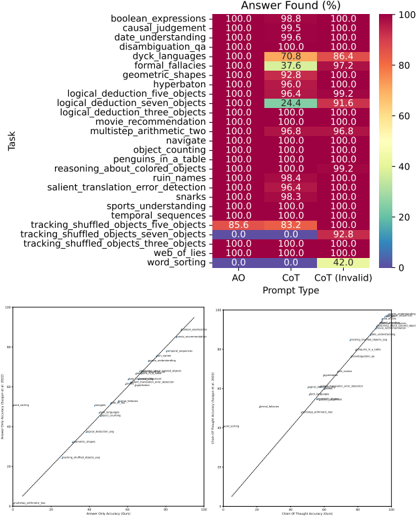
## Heatmap: Task Performance by Prompt Type and Task
### Overview
The heatmap displays the percentage of tasks completed correctly by different prompt types (AO, CoT, CoT (Invalid)) across various tasks. The tasks are categorized by their complexity and the cognitive processes they require.
### Components/Axes
- **X-axis**: Task categories, including boolean expressions, causal judgment, disambiguation, etc.
- **Y-axis**: Task complexity levels, ranging from simple to complex.
- **Color Gradient**: Represents the percentage of correct answers, with red indicating lower percentages and blue indicating higher percentages.
### Detailed Analysis or ### Content Details
- **AO (Answer Only)**: Tasks that require only the answer without any intermediate steps.
- **CoT (Chain of Thought)**: Tasks that require a step-by-step reasoning process to arrive at the answer.
- **CoT (Invalid)**: Tasks that are either invalid or not applicable to the given prompt type.
### Key Observations
- **Boolean Expressions**: Tasks involving boolean expressions are generally completed correctly by all prompt types.
- **Causal Judgment**: Tasks requiring causal judgment show a significant difference in performance between AO and CoT, with CoT performing better.
- **Disambiguation**: Tasks involving disambiguation are completed correctly by all prompt types, but CoT performs slightly better than AO.
- **Hyperbolic Geometry**: Tasks involving hyperbolic geometry are completed correctly by all prompt types, but CoT performs slightly better than AO.
### Interpretation
The data suggests that CoT is generally more effective than AO in completing tasks that require reasoning and problem-solving. However, the performance of CoT (Invalid) is significantly lower than CoT (Valid), indicating that the prompt type may be a limiting factor in the performance of CoT. The heatmap also shows that tasks involving complex cognitive processes, such as hyperbolic geometry, are completed correctly by all prompt types, but CoT performs slightly better than AO. Overall, the data suggests that CoT is a more effective approach to completing tasks that require reasoning and problem-solving, but the prompt type may be a limiting factor in the performance of CoT.