## Diagram: Rollout Worker Iteration
### Overview
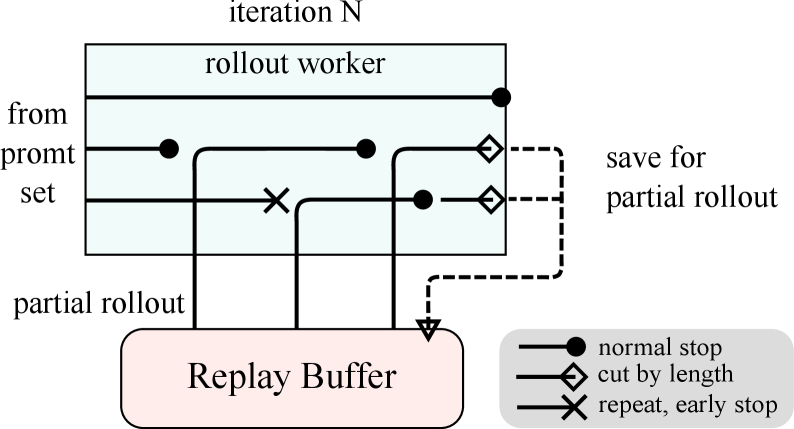
The image is a diagram illustrating the flow of data within a rollout worker during iteration N. It shows how data from a prompt set is processed, potentially cut short or repeated, and then stored in a Replay Buffer. The diagram also indicates a mechanism for saving data for partial rollouts.
### Components/Axes
* **Title:** iteration N
* **Main Component:** rollout worker (a light blue rectangle)
* **Input:** from promt set (left side of the rollout worker)
* **Output:** Replay Buffer (a rounded red rectangle at the bottom)
* **Other Text:** partial rollout (next to the Replay Buffer and above it)
* **Legend:** (bottom-right)
* normal stop (solid line with a filled circle)
* cut by length (solid line with a diamond)
* repeat, early stop (solid line with an X)
* **Annotation:** save for partial rollout (top-right, dashed line)
### Detailed Analysis or Content Details
The diagram shows three distinct data flows within the rollout worker:
1. **Top Flow:** A solid line originates from the "from promt set" label on the left, passes through the rollout worker, and terminates with a filled circle (normal stop) on the right edge of the rollout worker. This line then extends with a dashed line to the "save for partial rollout" annotation.
2. **Middle Flow:** A solid line originates from the "from promt set" label on the left, passes through the rollout worker, and terminates with a diamond (cut by length) on the right edge of the rollout worker. This line then extends with a dashed line to the "save for partial rollout" annotation.
3. **Bottom Flow:** A solid line originates from the "from promt set" label on the left, passes through the rollout worker, and encounters an "X" (repeat, early stop) inside the rollout worker. From the "X", the line curves downward and connects to the Replay Buffer. A second solid line originates from the "from promt set" label on the left, passes through the rollout worker, and terminates with a diamond (cut by length) on the right edge of the rollout worker. This line then extends with a dashed line to the "save for partial rollout" annotation. A dashed line also connects the right edge of the rollout worker to the Replay Buffer.
### Key Observations
* The diagram illustrates three possible outcomes for data flowing through the rollout worker: normal stop, cut by length, or repeat/early stop.
* Data that experiences a normal stop or is cut by length is saved for partial rollout.
* Data that is repeated or stopped early is sent to the Replay Buffer.
* The Replay Buffer also receives data from the rollout worker.
### Interpretation
The diagram depicts a single iteration (N) of a rollout worker process. The worker receives input from a prompt set and processes it. The processing can result in different outcomes, represented by the "normal stop," "cut by length," and "repeat, early stop" markers. The "normal stop" and "cut by length" outcomes are saved for potential partial rollouts, suggesting that these represent successful or partially successful processing steps that can be reused. The "repeat, early stop" outcome, on the other hand, indicates a failure or interruption in the processing, leading to the data being sent to the Replay Buffer, likely for further analysis or reprocessing. The Replay Buffer also receives data from the rollout worker, suggesting that it is used to store data for future use.