\n
## Diagram: Rollout Worker Iteration N
### Overview
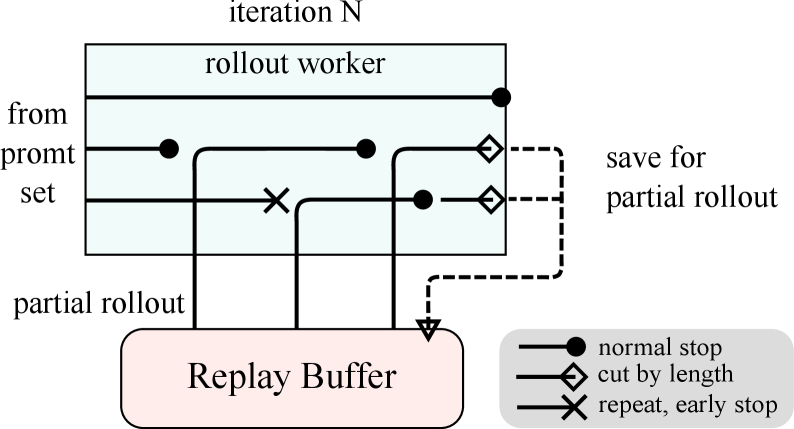
The image is a diagram illustrating the process flow within a "rollout worker" during iteration N. It depicts how data flows from a "prompt set" and "partial rollout" into the worker, and how the worker interacts with a "Replay Buffer". The diagram uses lines and symbols to represent data flow and termination conditions.
### Components/Axes
The diagram consists of the following components:
* **Rollout Worker:** A rectangular box labeled "rollout worker" at the top of the diagram.
* **Prompt Set:** A line labeled "from prompt set" entering the rollout worker.
* **Partial Rollout:** A line labeled "partial rollout" entering the rollout worker.
* **Replay Buffer:** A rectangular box labeled "Replay Buffer" at the bottom of the diagram.
* **Iteration N:** A label at the top-right corner indicating the current iteration.
* **Save for partial rollout:** A dashed line with text indicating data is saved for partial rollout.
* **Legend:** Located in the bottom-right corner, defining the symbols used for different termination conditions:
* **Normal Stop:** Represented by a solid black circle.
* **Cut by Length:** Represented by a diamond shape with a line through it.
* **Repeat, Early Stop:** Represented by an "X" shape.
### Detailed Analysis or Content Details
The diagram shows the following data flow and termination conditions:
1. **From Prompt Set:** A line enters the rollout worker and terminates with a solid black circle (normal stop).
2. **Partial Rollout:** A line enters the rollout worker, connects to another line, and terminates with a diamond shape (cut by length).
3. **Combined Flow:** A line from the "prompt set" connects to a line from the "partial rollout". This combined line terminates with a diamond shape (cut by length).
4. **Early Stop:** A line from the "prompt set" connects to a line that terminates with an "X" shape (repeat, early stop).
5. **Replay Buffer Interaction:** A dashed line connects the rollout worker to the "Replay Buffer", labeled "save for partial rollout". Another dashed line connects the rollout worker to the "Replay Buffer" with a downward pointing arrow.
### Key Observations
* The diagram highlights multiple termination conditions within the rollout worker.
* The "Replay Buffer" appears to be a key component for storing data for subsequent partial rollouts.
* The diagram illustrates a complex interaction between the prompt set, partial rollout, and the rollout worker itself.
* The dashed lines indicate a saving or feedback mechanism to the Replay Buffer.
### Interpretation
This diagram likely represents a step in a reinforcement learning or iterative generation process. The "rollout worker" is performing actions based on a "prompt set" and potentially leveraging previous "partial rollout" data. The different termination conditions (normal stop, cut by length, early stop) suggest that the rollout process can be dynamically adjusted based on various criteria. The "Replay Buffer" is used to store experiences or intermediate results, which can then be used to improve future rollouts. The diagram suggests a system designed for efficient exploration and exploitation of a solution space, with mechanisms for both completing a rollout normally and terminating it early based on specific conditions. The use of "iteration N" implies this is part of a larger iterative process.