\n
## Diagram: Text Generation/Verification Process
### Overview
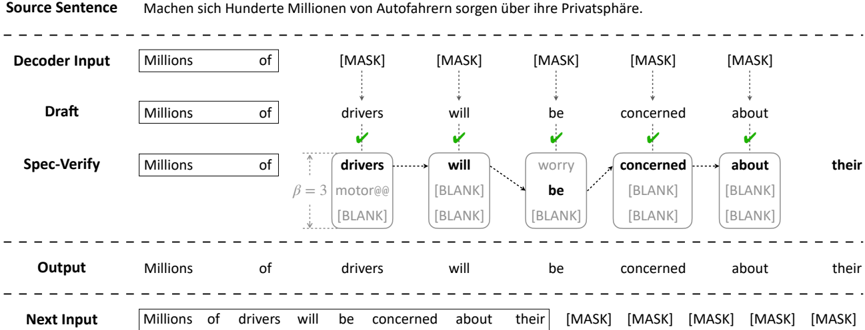
This diagram illustrates a process for generating and verifying text, likely within a machine learning or natural language processing context. It shows a sequence of steps from a source sentence, through a decoder input, a draft, a spec-verify stage, to a final output and subsequent next input. The diagram highlights the role of a "Spec-Verify" component in refining the generated text.
### Components/Axes
The diagram is structured into five horizontal rows, labeled as follows (from top to bottom):
1. **Source Sentence:** Contains the original German sentence.
2. **Decoder Input:** Represents the input to the decoder model.
3. **Draft:** Shows the initial output of the decoder.
4. **Spec-Verify:** Illustrates the verification and refinement stage.
5. **Output:** The final generated text.
6. **Next Input:** The input for the next iteration of the process.
The diagram also includes:
* Arrows indicating the flow of information between stages.
* Boxes highlighting specific words or phrases.
* A parameter labeled "β = 3 motor@" within the "Spec-Verify" stage.
* Green checkmarks indicating successful verification.
* “[MASK]” and “[BLANK]” tokens representing missing or placeholder information.
### Detailed Analysis or Content Details
Let's analyze each row:
1. **Source Sentence:** "Machen sich Hunderte Millionen von Autofahrern sorgen über ihre Privatsphäre." (English translation: "Hundreds of millions of drivers are worried about their privacy.")
2. **Decoder Input:** "Millions of [MASK] [MASK] [MASK] [MASK] [MASK] [MASK]"
3. **Draft:** "Millions of drivers will be concerned about [MASK]"
4. **Spec-Verify:** "Millions of drivers will worry be concerned about their [BLANK] [BLANK] [BLANK] [BLANK]"
* The word "drivers" is highlighted in a box.
* The word "will" is highlighted in a box.
* The word "worry" is highlighted in a box.
* The word "concerned" is highlighted in a box.
* The word "about" is highlighted in a box.
* The word "their" is highlighted in a box.
* The parameter "β = 3 motor@" is present.
5. **Output:** "Millions of drivers will be concerned about their [MASK] [MASK] [MASK] [MASK]"
6. **Next Input:** "Millions of drivers will be concerned about their [MASK] [MASK] [MASK] [MASK]"
The arrows show the following relationships:
* Decoder Input receives information from the Source Sentence.
* Draft receives information from the Decoder Input.
* Spec-Verify receives information from the Draft.
* Output receives information from the Spec-Verify.
* Next Input receives information from the Output.
The green checkmarks are positioned above the words "drivers", "will", "worry", "concerned", and "about" in the Spec-Verify stage, indicating that these words have been successfully verified.
### Key Observations
* The "Spec-Verify" stage appears to refine the initial draft by replacing words and potentially adding information.
* The use of "[MASK]" and "[BLANK]" tokens suggests that the model is dealing with incomplete or uncertain information.
* The parameter "β = 3 motor@" is unclear without further context, but it likely represents a weighting or configuration setting within the Spec-Verify component.
* The diagram demonstrates a process of iterative refinement, where the output of one stage becomes the input for the next.
* The translation from German to English is a key part of the process.
### Interpretation
This diagram illustrates a sophisticated text generation and verification pipeline. The "Spec-Verify" component seems to play a crucial role in ensuring the generated text is both grammatically correct and semantically meaningful. The use of checkmarks suggests a confidence score or a binary verification signal. The "[MASK]" and "[BLANK]" tokens indicate that the model is capable of handling uncertainty and generating text even when some information is missing. The parameter "β = 3 motor@" could be related to the strength of the verification process or the influence of a specific "motor" component within the Spec-Verify stage.
The diagram suggests a system designed to translate and refine text, potentially for applications like machine translation, text summarization, or content creation. The iterative nature of the process implies that the system is capable of learning and improving over time. The diagram highlights the challenges of natural language processing, such as dealing with ambiguity, uncertainty, and the need for semantic verification.