## Diagram: Neural Network Architectures for Image Classification (Dog Task)
### Overview
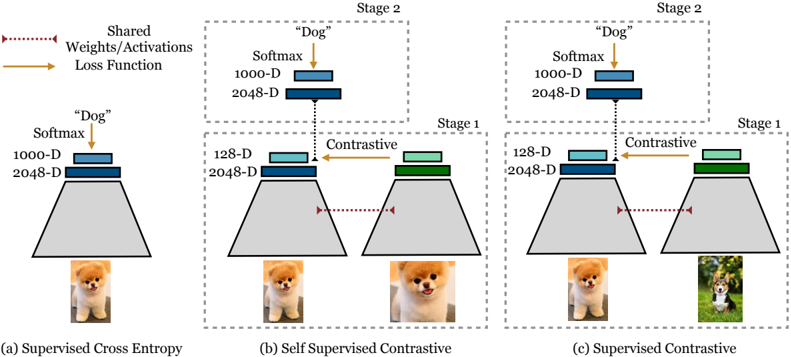
The diagram illustrates three stages of neural network architectures for image classification, focusing on the "Dog" task. Each stage represents a different training methodology, with visualizations of layer dimensions, shared weights/activations, and loss functions. The architectures are depicted as pyramid-like structures with labeled dimensions and directional arrows indicating relationships between components.
### Components/Axes
1. **Stages**:
- **Stage 1**: Supervised Cross Entropy
- **Stage 2**: Self Supervised Contrastive
- **Stage 3**: Supervised Contrastive
2. **Layer Dimensions**:
- 1000-D (1000-dimensional)
- 2048-D (2048-dimensional)
- 128-D (128-dimensional)
- 248-D (248-dimensional)
3. **Key Elements**:
- "Dog" label (classification target)
- Softmax layer (final classification)
- Contrastive loss function (highlighted in Stages 2 and 3)
- Shared weights/activations (indicated by dashed red arrows)
- Loss function connections (solid yellow arrows)
### Detailed Analysis
1. **Stage 1 (Supervised Cross Entropy)**:
- Pyramid structure with **1000-D** and **2048-D** layers.
- "Dog" label at the base, Softmax at the top.
- No contrastive components; purely supervised learning.
2. **Stage 2 (Self Supervised Contrastive)**:
- Pyramid structure with **128-D** and **248-D** layers.
- Contrastive loss function (green block) between layers.
- Shared weights/activations with Stage 1 (dashed red arrow).
- Softmax layer retains 1000-D and 2048-D dimensions.
3. **Stage 3 (Supervised Contrastive)**:
- Dual pyramid structure with **128-D** and **248-D** layers.
- Contrastive loss function (green block) between layers.
- Shared weights/activations with Stage 2 (dashed red arrow).
- Softmax layer retains 1000-D and 2048-D dimensions.
### Key Observations
- **Layer Dimensionality**:
- Stages progress from high-dimensional (2048-D) to lower-dimensional (128-D/248-D) representations.
- Contrastive stages introduce intermediate layers (128-D, 248-D) for feature learning.
- **Shared Weights/Activations**:
- Red dashed arrows indicate parameter reuse between stages, suggesting efficiency gains.
- **Loss Functions**:
- Softmax dominates all stages for final classification.
- Contrastive loss (green) is exclusive to Stages 2 and 3, emphasizing self-supervised learning.
### Interpretation
The diagram demonstrates a progression from traditional supervised learning (Stage 1) to hybrid approaches combining self-supervised contrastive learning (Stage 2) and supervised contrastive learning (Stage 3). Key insights:
1. **Efficiency**: Shared weights/activations reduce computational redundancy across stages.
2. **Contrastive Learning**: Introduced in Stage 2, it enables unsupervised feature learning, later integrated with supervision in Stage 3.
3. **Dimensionality Reduction**: Lower-dimensional layers (128-D, 248-D) in later stages suggest optimized feature extraction for classification.
4. **Task Focus**: The persistent "Dog" label and Softmax layer indicate a fixed classification target, with architectural changes focused on improving learning efficiency and robustness.
This architecture highlights the interplay between supervised and self-supervised learning, leveraging contrastive methods to enhance model performance on the "Dog" classification task while maintaining parameter efficiency.