## Diagram: Multi-Agent Voting and Hegelian Dialectic for Idea Evaluation
### Overview
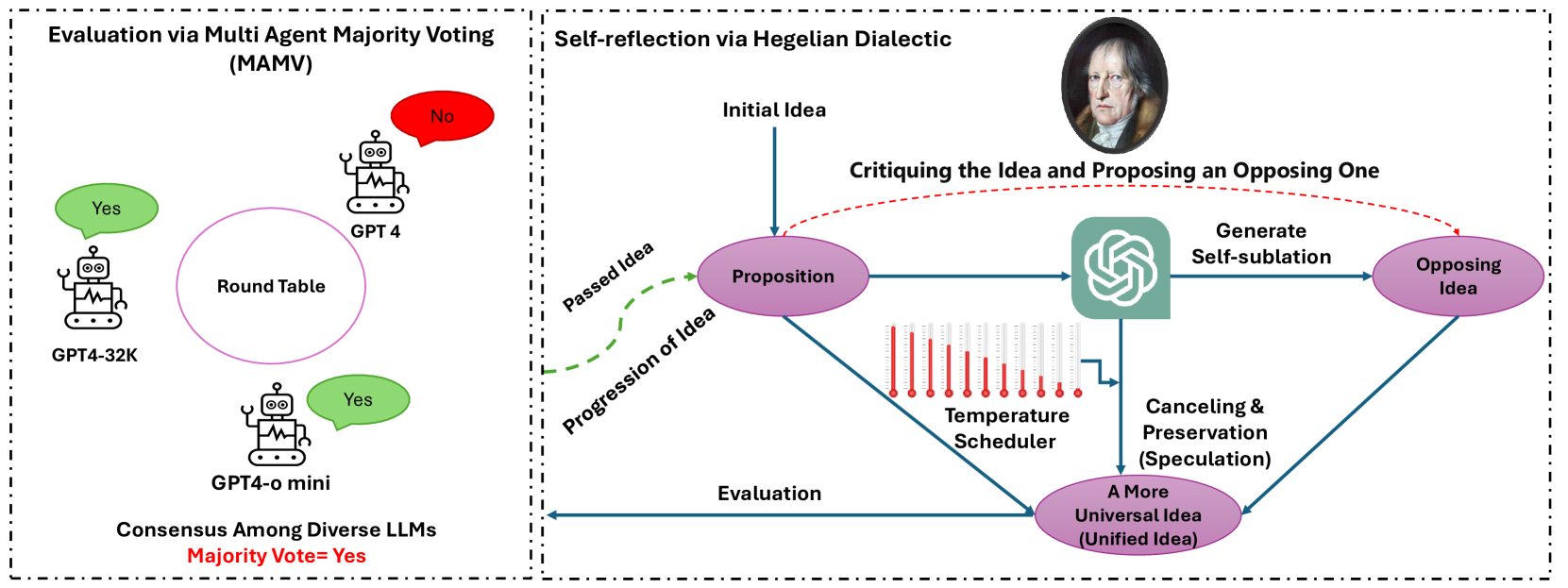
The image presents a conceptual diagram that combines two distinct processes: Multi-Agent Majority Voting (MAMV) for evaluating ideas and a Hegelian Dialectic approach for self-reflection and idea refinement. The MAMV section illustrates a voting process among different LLMs (GPT-4, GPT4-32K, GPT4-o mini), while the Hegelian Dialectic section depicts a cyclical process of idea generation, critique, and synthesis.
### Components/Axes
**Left Side: Evaluation via Multi Agent Majority Voting (MAMV)**
* **Title:** Evaluation via Multi Agent Majority Voting (MAMV)
* **Agents:**
* GPT-4: Robot icon with a red speech bubble labeled "No".
* GPT4-32K: Robot icon with a green speech bubble labeled "Yes".
* GPT4-o mini: Robot icon with a green speech bubble labeled "Yes".
* **Round Table:** A purple circle in the center, labeled "Round Table".
* **Consensus:** Text at the bottom reads "Consensus Among Diverse LLMs" and "Majority Vote = Yes" in red.
**Right Side: Self-reflection via Hegelian Dialectic**
* **Title:** Self-reflection via Hegelian Dialectic
* **Nodes:**
* Initial Idea: Top center, with a blue arrow pointing down to "Proposition".
* Proposition: A purple oval in the center.
* Opposing Idea: A purple oval on the right.
* A More Universal Idea (Unified Idea): A purple oval at the bottom.
* **Processes:**
* Critiquing the Idea and Proposing an Opposing One: Text above a dashed red arrow from "Proposition" to "Opposing Idea".
* Generate Self-sublation: Text next to the OpenAI logo, with a blue arrow from "Proposition" to "Opposing Idea".
* Canceling & Preservation (Speculation): Text next to a blue arrow from "Opposing Idea" to "A More Universal Idea (Unified Idea)".
* Evaluation: Text next to a blue arrow from "A More Universal Idea (Unified Idea)" to "Proposition".
* Passed Idea: Text next to a dashed green arrow from "Proposition" back to itself.
* Progression of Idea: Text next to a dashed green arrow from "Proposition" back to itself.
* **Temperature Scheduler:** A series of thermometers with varying red fill levels, located between the OpenAI logo and "A More Universal Idea (Unified Idea)".
* **Hegel Portrait:** An oval portrait of Georg Wilhelm Friedrich Hegel is located at the top right.
### Detailed Analysis
**Multi-Agent Voting (Left Side):**
* Three LLMs (GPT-4, GPT4-32K, GPT4-o mini) participate in a voting process.
* GPT4-32K and GPT4-o mini vote "Yes" (green speech bubbles).
* GPT-4 votes "No" (red speech bubble).
* The majority vote is "Yes," indicating a consensus among the diverse LLMs.
**Hegelian Dialectic (Right Side):**
* The process starts with an "Initial Idea" that flows into a "Proposition".
* The "Proposition" is then critiqued, leading to the generation of an "Opposing Idea".
* The OpenAI logo is present, suggesting the use of OpenAI models in generating self-sublation.
* The "Temperature Scheduler" likely represents a parameter adjustment mechanism within the OpenAI model.
* The "Opposing Idea" and the original "Proposition" are then synthesized into "A More Universal Idea (Unified Idea)".
* The "Evaluation" process feeds the "Unified Idea" back into the "Proposition" stage, creating a cyclical refinement loop.
* The "Passed Idea" and "Progression of Idea" arrows suggest iterative refinement of the proposition.
### Key Observations
* The diagram combines a simple voting mechanism with a more complex dialectical process.
* The use of color (red for "No," green for "Yes") provides a clear visual representation of the voting outcomes.
* The Hegelian Dialectic section emphasizes iterative refinement and synthesis of ideas.
* The inclusion of the OpenAI logo and "Temperature Scheduler" suggests a practical implementation using OpenAI models.
### Interpretation
The diagram illustrates a method for evaluating and refining ideas using a combination of multi-agent voting and a Hegelian Dialectic approach. The MAMV provides an initial assessment of an idea's validity, while the Hegelian Dialectic facilitates a deeper exploration and refinement of the idea through iterative critique and synthesis. The use of OpenAI models and a "Temperature Scheduler" suggests a practical application of this framework in the context of AI-driven idea generation and evaluation. The diagram suggests that by combining diverse perspectives (MAMV) with a structured process of critique and synthesis (Hegelian Dialectic), it is possible to arrive at more robust and well-developed ideas.