\n
## Diagram: LLM Evaluation and Self-Reflection Processes
### Overview
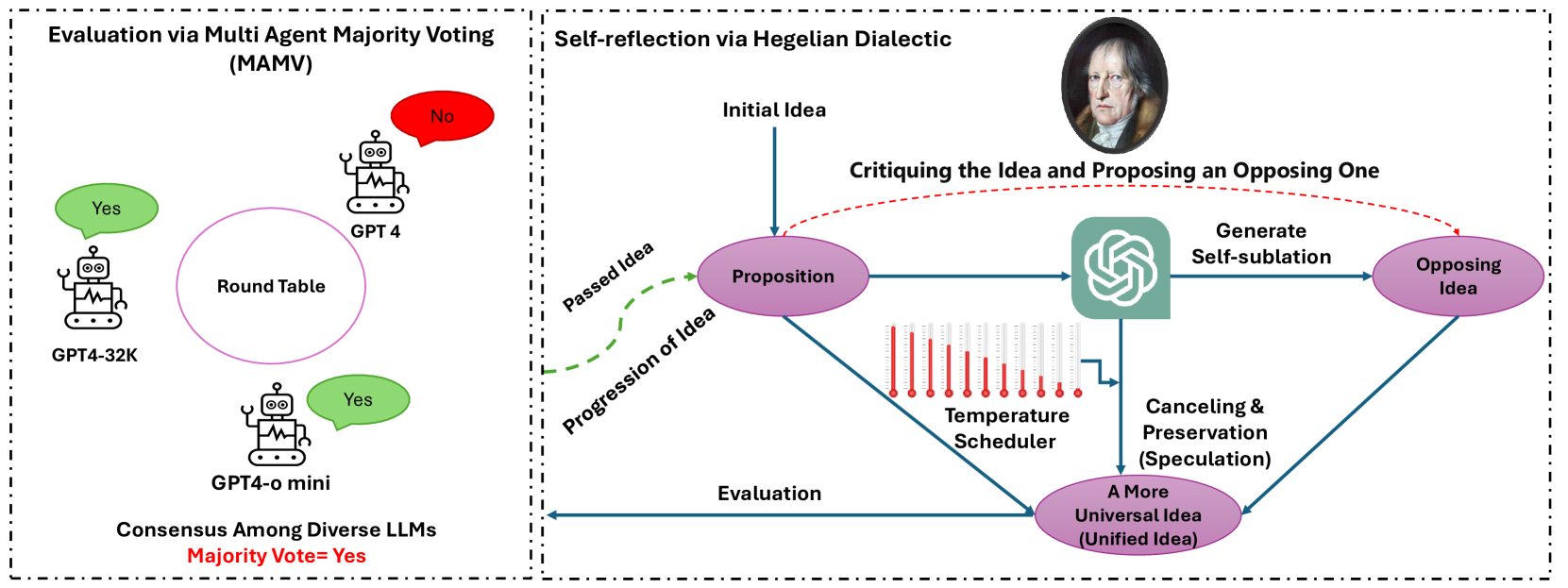
The image presents a comparative diagram illustrating two distinct processes: "Evaluation via Multi Agent Majority Voting (MAMV)" and "Self-reflection via Hegelian Dialectic." The left side depicts a voting system involving multiple Large Language Models (LLMs), while the right side illustrates a cyclical process of idea generation, critique, and refinement inspired by Hegelian philosophy. A dashed vertical line separates the two processes.
### Components/Axes
The diagram consists of interconnected nodes and arrows representing the flow of information and decision-making.
**Left Side (MAMV):**
* **Title:** "Evaluation via Multi Agent Majority Voting (MAMV)"
* **Nodes:** GPT-4, GPT4-32K, GPT4-o mini, "Round Table" (central node).
* **Labels:** "Yes" (associated with GPT4-32K and GPT4-o mini), "No" (associated with GPT-4).
* **Text:** "Consensus Among Diverse LLMs", "Majority Vote: Yes"
**Right Side (Hegelian Dialectic):**
* **Title:** "Self-reflection via Hegelian Dialectic"
* **Nodes:** "Initial Idea", "Critiquing the Idea and Proposing an Opposing One", "Generate Self-sublation", "Opposing Idea", "Temperature Scheduler", "Canceling & Preservation (Speculation)", "A More Universal Idea (Unified Idea)", "Evaluation", "Proposition".
* **Labels:** "Passed Idea", "Progression of Idea".
* **Image:** A portrait of a person (likely a philosopher, potentially Hegel).
* **Visual Element:** A spiral graphic within the "Generate Self-sublation" node.
### Detailed Analysis or Content Details
**Left Side (MAMV):**
The diagram shows three LLMs participating in a voting process. GPT4-32K and GPT4-o mini both vote "Yes," indicated by green circles. GPT-4 votes "No," indicated by a red circle. The "Round Table" node represents the collective deliberation space. The final outcome is a "Majority Vote: Yes," signifying that the idea or proposition has been accepted based on the majority vote of the LLMs.
**Right Side (Hegelian Dialectic):**
The process begins with an "Initial Idea." This idea is then subjected to "Critiquing the Idea and Proposing an Opposing One," leading to the generation of an "Opposing Idea." The "Generate Self-sublation" node, containing a spiral graphic, represents the synthesis of the initial idea and its opposition. This synthesis is then influenced by a "Temperature Scheduler" (represented by red lines, suggesting a fluctuating parameter). The process then branches into two outcomes: "Canceling & Preservation (Speculation)" and "A More Universal Idea (Unified Idea)." The "Unified Idea" is then subject to "Evaluation," which feeds back into the "Proposition" stage, continuing the cycle. The "Passed Idea" is shown as a green dashed arrow.
### Key Observations
* The MAMV process is a straightforward voting mechanism, resulting in a binary outcome (Yes/No).
* The Hegelian Dialectic process is iterative and cyclical, involving continuous refinement and synthesis of ideas.
* The "Temperature Scheduler" in the Hegelian Dialectic process suggests a dynamic parameter influencing the synthesis of ideas.
* The portrait on the right side visually anchors the process to the philosophical concept of Hegelian dialectic.
* The spiral graphic in the "Generate Self-sublation" node visually represents the concept of synthesis and emergence.
### Interpretation
The diagram contrasts two approaches to idea evaluation and refinement. The MAMV process represents a democratic, consensus-based approach, relying on the collective judgment of multiple agents. The Hegelian Dialectic process represents a more nuanced, iterative approach, emphasizing the importance of critique, opposition, and synthesis in achieving a more universal understanding.
The inclusion of the "Temperature Scheduler" in the Hegelian Dialectic process suggests that the degree of randomness or exploration can influence the outcome of the synthesis. The "Canceling & Preservation (Speculation)" branch indicates that not all ideas are successful, and some may be discarded or preserved for future consideration.
The diagram highlights the potential for combining these two approaches. For example, the output of the Hegelian Dialectic process could be subjected to a MAMV vote to determine its acceptance or rejection. The diagram suggests a framework for building more robust and intelligent AI systems capable of both critical thinking and collaborative decision-making. The dashed line separating the two processes suggests they are distinct but potentially complementary methodologies.