## Diagram: Multi-Agent Majority Voting (MAMV) and Hegelian Dialectic Self-Reflection Process
### Overview
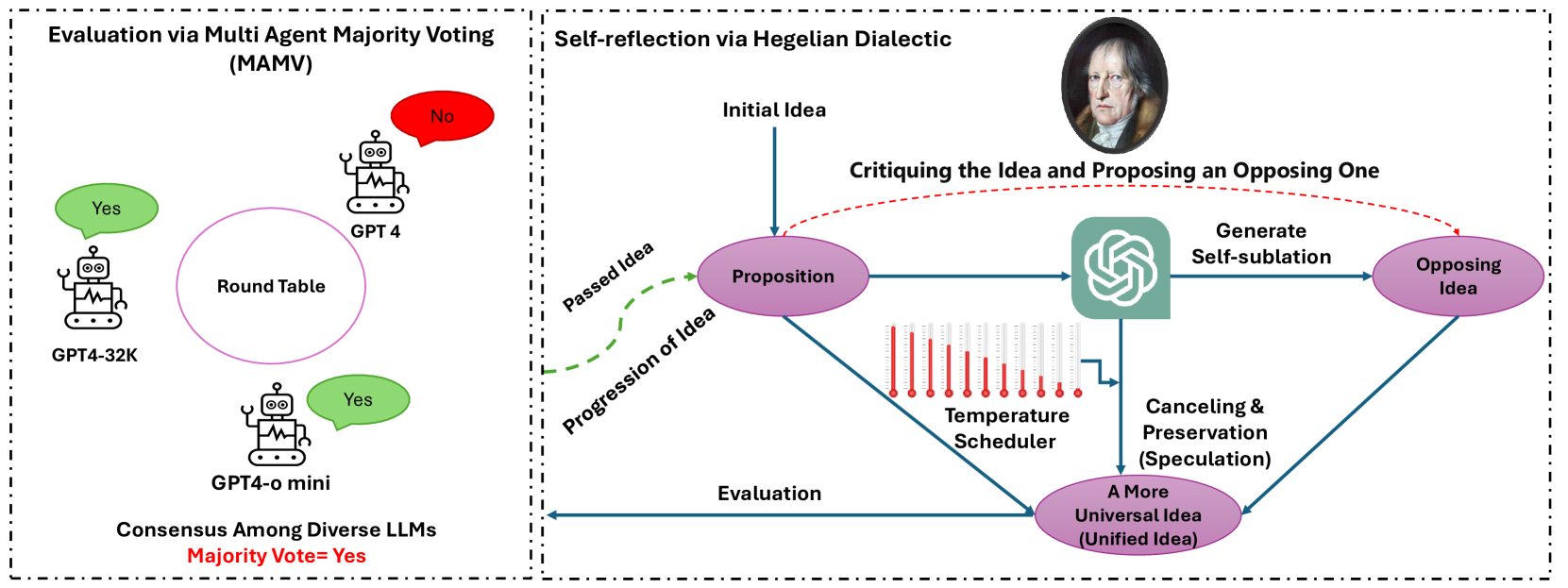
The diagram illustrates two interconnected processes:
1. **Multi-Agent Majority Voting (MAMV)** on the left, involving three AI agents (GPT-4, GPT-4-32K, GPT4-o mini) voting on an idea.
2. **Self-reflection via Hegelian Dialectic** on the right, depicting a cyclical process of proposing, opposing, and synthesizing ideas to reach a "Unified Idea."
---
### Components/Axes
#### Left Section: MAMV Process
- **Agents**:
- GPT-4 (votes "No" in red)
- GPT-4-32K (votes "Yes" in green)
- GPT4-o mini (votes "Yes" in green)
- **Consensus**: Majority vote = "Yes" (highlighted in red text).
- **Visual Elements**:
- Circular "Round Table" symbol connecting agents.
- Speech bubbles with "Yes" (green) and "No" (red).
#### Right Section: Hegelian Dialectic
- **Stages**:
1. **Initial Idea** → **Proposition** (via "Critiquing the Idea and Proposing an Opposing One").
2. **Opposing Idea** generated through "Generate Self-sublation" (note: likely a typo for "Sublation").
3. **Evaluation** → **A More Universal Idea (Unified Idea)**.
- **Key Components**:
- **Temperature Scheduler**: Red bars decreasing in height (left to right), labeled "Progression of Idea."
- **Canceling & Preservation (Speculation)**: Arrows linking opposing ideas to synthesis.
- **Human Figure**: Portrait labeled "Self-reflection via Hegelian Dialectic" (top-right corner).
---
### Detailed Analysis
#### MAMV Process
- **Voting Outcomes**:
- GPT-4-32K and GPT4-o mini agree ("Yes"), while GPT-4 disagrees ("No").
- Consensus achieved via majority vote.
- **Spatial Grounding**:
- Agents are positioned in a triangular formation around the "Round Table" circle.
- "Yes" votes are green; "No" is red, matching the legend.
#### Hegelian Dialectic Process
- **Flow**:
1. **Initial Idea** → **Proposition** (dashed green arrow labeled "Progression of Idea").
2. **Opposing Idea** generated via "Generate Self-sublation" (blue arrow).
3. **Evaluation** (blue arrow) leads to synthesis of a "Unified Idea."
- **Temperature Scheduler**:
- Red bars decrease in height from left to right, suggesting iterative refinement.
- Positioned below the "Proposition" and "Opposing Idea" stages.
---
### Key Observations
1. **Consensus Mechanism**: MAMV prioritizes majority agreement among diverse LLMs.
2. **Dialectic Synthesis**: The process mirrors Hegelian triad (Thesis → Antithesis → Synthesis), with "Unified Idea" as the endpoint.
3. **Typos/Clarifications**:
- "Self-sublation" likely refers to "Sublation" (a Hegelian concept of resolving contradictions).
- "Canceling & Preservation (Speculation)" implies balancing idea rejection and retention.
---
### Interpretation
- **MAMV as a Filter**: The majority vote ensures robustness by aggregating diverse AI perspectives.
- **Dialectic as Evolution**: The Hegelian process transforms raw ideas into refined, universal concepts through conflict and resolution.
- **Human Role**: The portrait suggests human oversight or inspiration in the self-reflection loop.
- **Unified Idea**: The endpoint represents an optimized synthesis of conflicting viewpoints, validated by both AI consensus and dialectic rigor.
This diagram emphasizes collaborative intelligence (MAMV) and philosophical synthesis (Hegelian dialectic) as complementary pathways to innovation.