## Diagram: AI Agent Typology Matrix
### Overview
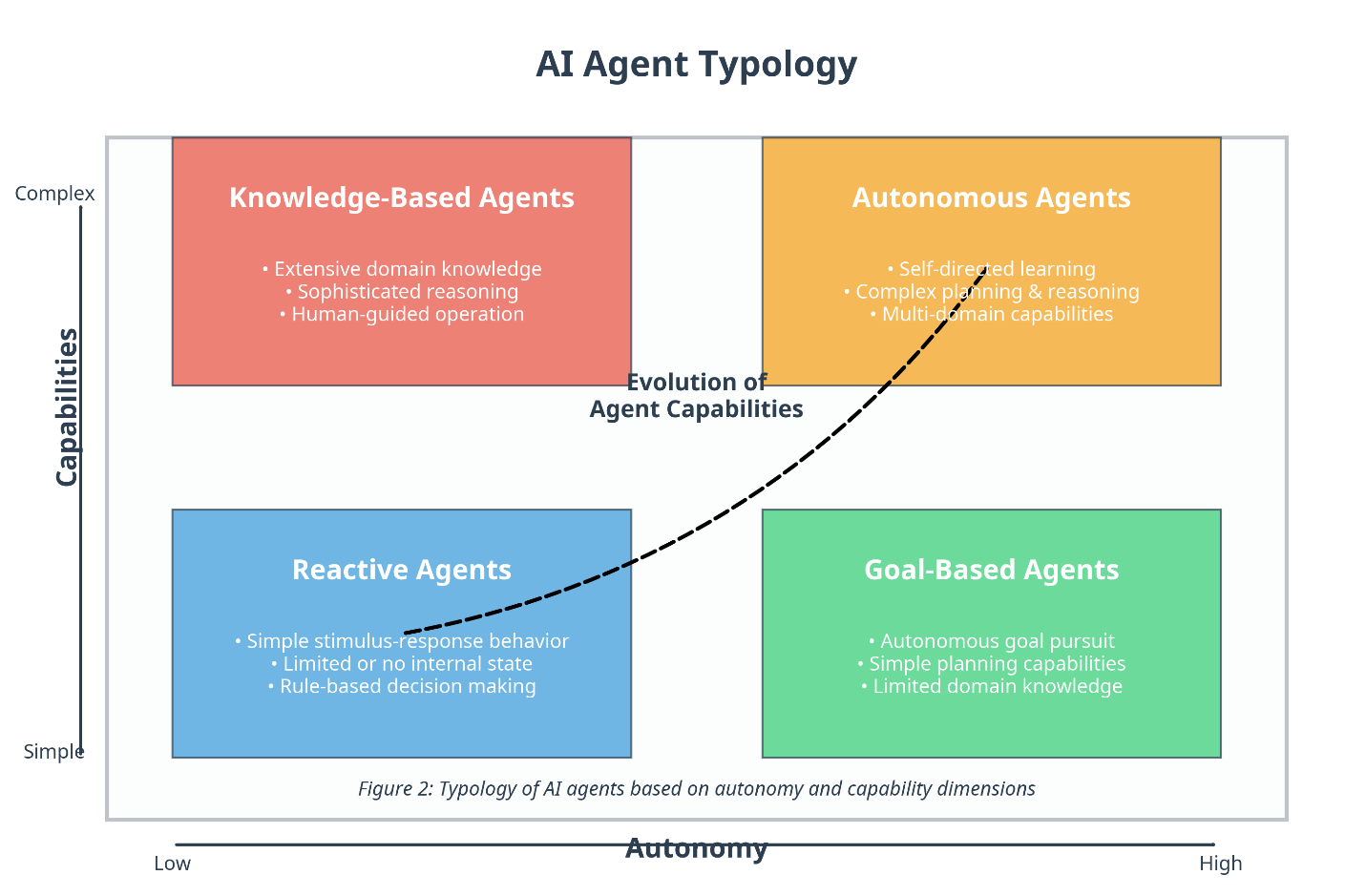
This image presents a conceptual 2x2 matrix diagram titled "AI Agent Typology." It categorizes different types of Artificial Intelligence agents based on two primary dimensions: **Autonomy** (x-axis) and **Capabilities** (y-axis). The diagram identifies four distinct quadrants of agent types and includes a dashed trend line indicating the "Evolution of Agent Capabilities."
### Components/Axes
* **Title:** "AI Agent Typology" (Centered at the top).
* **Y-Axis (Vertical):**
* **Label:** "Capabilities"
* **Scale:** Ranges from "Simple" at the bottom to "Complex" at the top.
* **Visual:** A vertical line on the left side with markers for the extremes.
* **X-Axis (Horizontal):**
* **Label:** "Autonomy"
* **Scale:** Ranges from "Low" on the left to "High" on the right.
* **Visual:** A horizontal line at the bottom with markers for the extremes.
* **Figure Caption:** "Figure 2: Typology of AI agents based on autonomy and capability dimensions" (Centered at the bottom, italicized).
### Content Details (Quadrants)
The matrix is divided into four colored rectangular quadrants, each representing a specific class of AI agent with bulleted characteristics.
**1. Bottom-Left Quadrant (Low Autonomy, Simple Capabilities)**
* **Label:** **Reactive Agents**
* **Color:** Light Blue
* **Characteristics:**
* Simple stimulus-response behavior
* Limited or no internal state
* Rule-based decision making
**2. Top-Left Quadrant (Low Autonomy, Complex Capabilities)**
* **Label:** **Knowledge-Based Agents**
* **Color:** Salmon / Light Red
* **Characteristics:**
* Extensive domain knowledge
* Sophisticated reasoning
* Human-guided operation
**3. Bottom-Right Quadrant (High Autonomy, Simple Capabilities)**
* **Label:** **Goal-Based Agents**
* **Color:** Light Green
* **Characteristics:**
* Autonomous goal pursuit
* Simple planning capabilities
* Limited domain knowledge
**4. Top-Right Quadrant (High Autonomy, Complex Capabilities)**
* **Label:** **Autonomous Agents**
* **Color:** Orange / Gold
* **Characteristics:**
* Self-directed learning
* Complex planning & reasoning
* Multi-domain capabilities
### Trend Analysis (Overlay)
* **Visual Element:** A thick, black, dashed line with an arrowhead pointing upwards and to the right.
* **Label:** "Evolution of Agent Capabilities" (Placed centrally near the line).
* **Trajectory:**
* **Start:** The line originates in the **Reactive Agents** quadrant (bottom-left).
* **Path:** It curves upward through the center of the diagram.
* **End:** It terminates in the **Autonomous Agents** quadrant (top-right).
* **Significance:** The line bypasses the "Knowledge-Based Agents" and "Goal-Based Agents" quadrants to some extent, suggesting a direct evolutionary path or a synthesis of traits leading from simple reactive systems toward complex autonomous systems.
### Key Observations
* **Symmetry:** The diagram is a balanced 2x2 grid.
* **Color Coding:** Distinct colors are used to visually separate the four typologies.
* **Progression:** The layout implies a progression from bottom-left (least advanced) to top-right (most advanced).
* **Trade-offs:**
* **Knowledge-Based Agents** are high in capability but low in autonomy (they need human guidance).
* **Goal-Based Agents** are high in autonomy but lower in capability (limited domain knowledge).
### Interpretation
This diagram serves as a classification framework for understanding the landscape of AI development.
1. **Classification Logic:** It distinguishes agents not just by how smart they are (Capabilities), but by how independently they can operate (Autonomy). This is a crucial distinction in AI safety and engineering.
2. **The Evolutionary Path:** The dashed arrow suggests that the "holy grail" or the direction of progress in AI is moving towards systems that possess *both* high autonomy and high complexity (Autonomous Agents).
3. **Intermediate States:**
* **Knowledge-Based Agents** represent expert systems (like traditional medical diagnosis AI) that know a lot but can't act alone.
* **Goal-Based Agents** represent simpler autonomous systems (like a robotic vacuum) that can act alone but don't "know" much about the world beyond their specific task.
4. **The Starting Point:** **Reactive Agents** represent the most basic AI (like a chess program that only looks at the current board state), serving as the foundational baseline for the typology.