\n
## Diagram: AI Agent Typology
### Overview
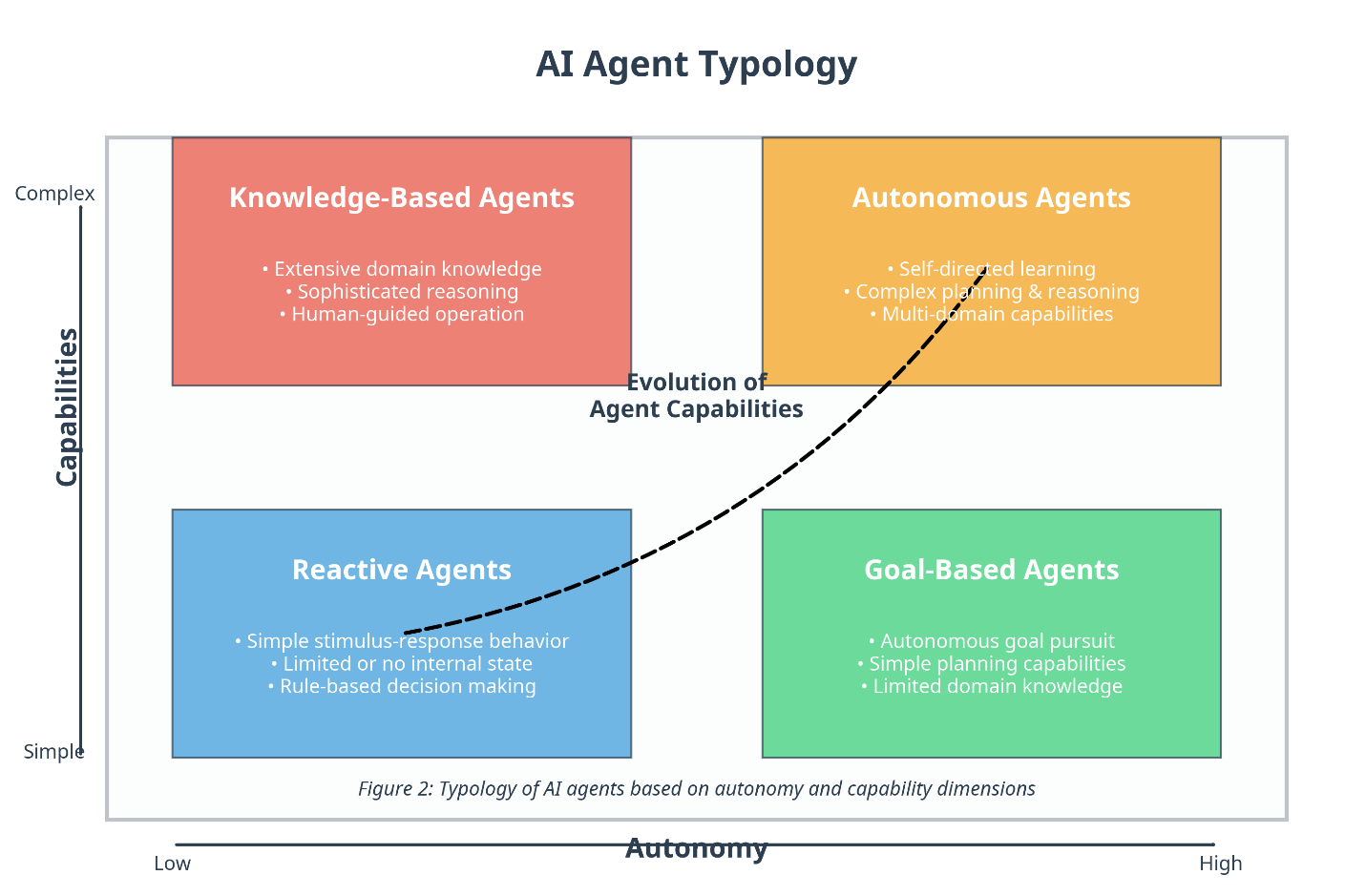
The image is a 2x2 matrix diagram illustrating a typology of AI agents based on two dimensions: Autonomy and Capabilities. The diagram categorizes agents into four types: Reactive, Goal-Based, Knowledge-Based, and Autonomous. An arrow indicates the "Evolution of Agent Capabilities" from Reactive to Autonomous.
### Components/Axes
* **X-axis:** Autonomy, ranging from "Low" (left) to "High" (right).
* **Y-axis:** Capabilities, ranging from "Simple" (bottom) to "Complex" (top).
* **Quadrants:**
* Top-Left: Knowledge-Based Agents (Pink)
* Top-Right: Autonomous Agents (Yellow)
* Bottom-Left: Reactive Agents (Blue)
* Bottom-Right: Goal-Based Agents (Green)
* **Arrow:** "Evolution of Agent Capabilities" (Black) – originates from the bottom-left (Reactive) and curves towards the top-right (Autonomous).
* **Title:** "AI Agent Typology" (Black, top-center)
* **Figure Caption:** "Figure 2: Typology of AI agents based on autonomy and capability dimensions" (Black, bottom-center)
### Detailed Analysis or Content Details
**1. Reactive Agents (Blue Quadrant - Bottom-Left):**
* Characteristics:
* Simple stimulus-response behavior
* Limited or no internal state
* Rule-based decision making
**2. Goal-Based Agents (Green Quadrant - Bottom-Right):**
* Characteristics:
* Autonomous goal pursuit
* Simple planning capabilities
* Limited domain knowledge
**3. Knowledge-Based Agents (Pink Quadrant - Top-Left):**
* Characteristics:
* Extensive domain knowledge
* Sophisticated reasoning
* Human-guided operation
**4. Autonomous Agents (Yellow Quadrant - Top-Right):**
* Characteristics:
* Self-directed learning
* Complex planning & reasoning
* Multi-domain capabilities
**Evolution of Agent Capabilities (Black Arrow):**
* The arrow starts in the Reactive Agents quadrant and curves upwards and to the right, passing through the Goal-Based and Knowledge-Based quadrants, ultimately pointing towards the Autonomous Agents quadrant. This visually represents the increasing autonomy and capabilities as agents evolve.
### Key Observations
* The diagram presents a clear progression of AI agent types, suggesting that agents evolve from simple reactive behaviors to more complex autonomous systems.
* The placement of each agent type highlights the trade-offs between autonomy and capabilities. For example, Reactive Agents have low autonomy but simple capabilities, while Autonomous Agents have high autonomy and complex capabilities.
* The arrow emphasizes that the evolution of agent capabilities is not necessarily linear, but rather a progression through different stages.
### Interpretation
This diagram provides a conceptual framework for understanding the different types of AI agents and their relative strengths and weaknesses. It suggests that the development of AI agents is a process of increasing both autonomy and capabilities. The diagram is useful for categorizing existing AI systems and for guiding the development of new ones. The "Evolution of Agent Capabilities" arrow implies a developmental trajectory, suggesting that more advanced AI agents will build upon the foundations of simpler agents. The diagram doesn't provide specific data points or numerical values, but rather a qualitative representation of the relationships between different agent types. It's a high-level overview intended to provide a conceptual understanding of the field. The diagram is a useful tool for communication and discussion about AI agent design and development.