\n
## AI Agent Typology: 2x2 Matrix Diagram
### Overview
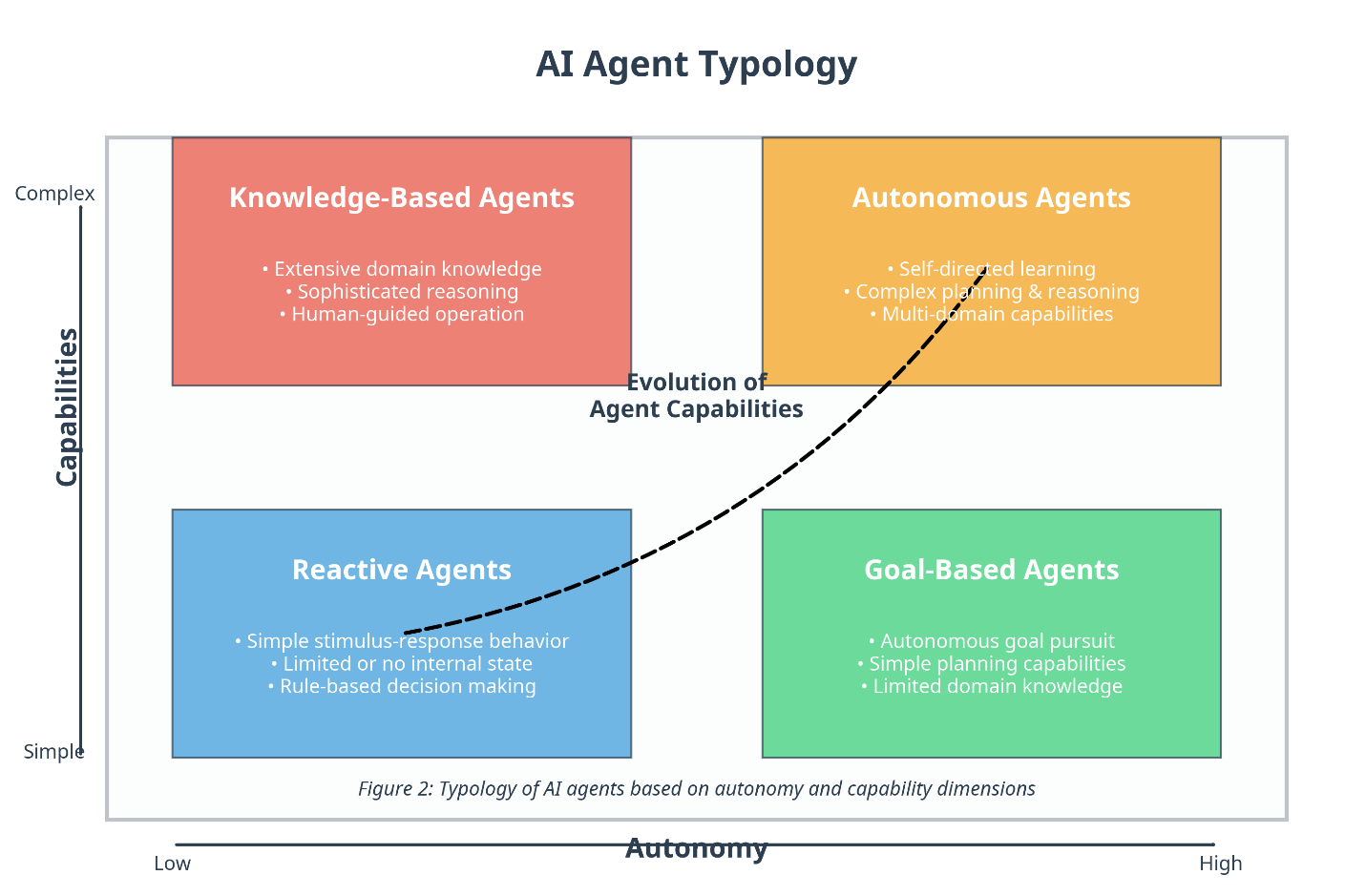
The image is a conceptual 2x2 matrix diagram titled "AI Agent Typology." It classifies AI agents into four distinct types based on two primary dimensions: **Autonomy** (x-axis) and **Capabilities** (y-axis). A dashed line labeled "Evolution of Agent Capabilities" suggests a developmental trajectory across the quadrants. The diagram is labeled as "Figure 2."
### Components/Axes
* **Title:** "AI Agent Typology" (centered at the top).
* **Axes:**
* **X-axis (Horizontal):** Labeled **"Autonomy"**. It runs from **"Low"** on the left to **"High"** on the right.
* **Y-axis (Vertical):** Labeled **"Capabilities"**. It runs from **"Simple"** at the bottom to **"Complex"** at the top.
* **Quadrants (Agent Types):** Four colored boxes, each containing a title and descriptive bullet points.
* **Top-Left (Red/Salmon Box):** **Knowledge-Based Agents**
* Extensive domain knowledge
* Sophisticated reasoning
* Human-guided operation
* **Top-Right (Orange/Yellow Box):** **Autonomous Agents**
* Self-directed learning
* Complex planning & reasoning
* Multi-domain capabilities
* **Bottom-Left (Blue Box):** **Reactive Agents**
* Simple stimulus-response behavior
* Limited or no internal state
* Rule-based decision making
* **Bottom-Right (Green Box):** **Goal-Based Agents**
* Autonomous goal pursuit
* Simple planning capabilities
* Limited domain knowledge
* **Evolutionary Path:** A thick, black, dashed line labeled **"Evolution of Agent Capabilities"**. It originates in the lower-left quadrant (Reactive Agents) and curves upward and rightward, terminating in the upper-right quadrant (Autonomous Agents).
* **Caption:** "Figure 2: Typology of AI agents based on autonomy and capability dimensions" (centered below the matrix).
### Detailed Analysis
The diagram establishes a clear relationship between an agent's level of autonomy and the complexity of its capabilities.
* **Reactive Agents (Low Autonomy, Simple Capabilities):** Positioned at the origin of both axes. They are the most basic, operating on fixed rules without memory or goals.
* **Goal-Based Agents (High Autonomy, Simple Capabilities):** Share the "Simple" capability level with Reactive Agents but are positioned at the "High" end of the Autonomy axis. This indicates they can act independently to achieve goals but lack deep reasoning or broad knowledge.
* **Knowledge-Based Agents (Low Autonomy, Complex Capabilities):** Possess high-level capabilities (sophisticated reasoning, deep knowledge) but are constrained to the "Low" end of the Autonomy axis, implying they require significant human guidance or intervention.
* **Autonomous Agents (High Autonomy, Complex Capabilities):** Represent the pinnacle of the typology, combining high autonomy with complex, multi-domain capabilities. They are the endpoint of the depicted evolutionary path.
### Key Observations
1. **The Evolutionary Trajectory:** The dashed line does not connect all quadrants linearly. It suggests a common or ideal development path from simple, reactive systems, through goal-oriented behavior, towards fully autonomous, knowledge-rich agents. It notably bypasses the "Knowledge-Based Agents" quadrant, implying that high capability without high autonomy may be a parallel or specialized branch rather than a step on the main evolutionary path to autonomy.
2. **Capability vs. Autonomy Trade-off:** The matrix implies that high capability does not automatically confer high autonomy (see Knowledge-Based Agents), and high autonomy does not require the most complex capabilities (see Goal-Based Agents). These are presented as separable dimensions.
3. **Color Coding:** Each agent type is assigned a distinct, solid color for its quadrant, aiding visual separation and recall.
### Interpretation
This typology provides a framework for understanding and categorizing AI systems beyond a simple "smart vs. dumb" spectrum. It argues that two critical, independent axes define an agent's nature: **what it can do** (Capabilities) and **how independently it can do it** (Autonomy).
The diagram suggests that the field's progression, as indicated by the "Evolution" line, is toward systems that maximize both dimensions simultaneously—**Autonomous Agents**. These agents are characterized not just by intelligence but by self-direction and adaptability across multiple domains.
The placement of **Knowledge-Based Agents** is particularly insightful. It highlights a category of powerful, specialized AI (e.g., expert systems, diagnostic tools) that are highly capable within a domain but remain tools under human control, rather than independent actors. This distinguishes them from the vision of general, self-directed AI.
In essence, the chart is a map for navigating the AI landscape, helping to specify whether a given system is a simple automaton, a dedicated tool, an independent goal-seeker, or a fully autonomous entity. It frames the ultimate challenge in AI development as the integration of deep, complex capabilities with robust, self-directed autonomy.