```markdown
## Prompt Template: Graph-RFT Reasoning Framework
### Overview
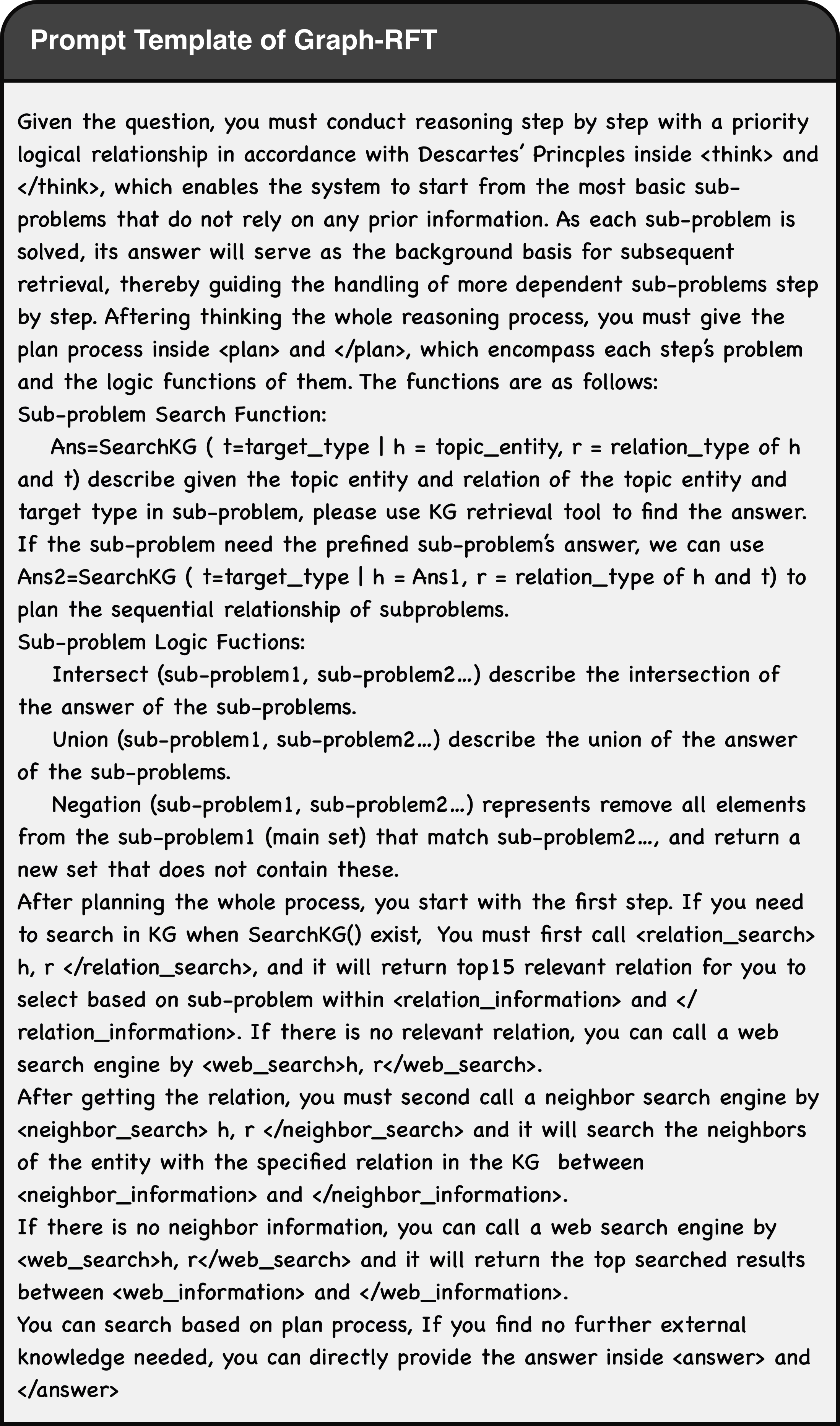
The image presents a structured reasoning framework for solving complex problems using Descartes' principles. It outlines a step-by-step process to decompose problems into sub-problems, apply logical operations, and utilize knowledge retrieval tools. The template emphasizes starting with basic sub-problems and building solutions incrementally.
### Components/Axes
- **Header**: "Prompt Template of Graph-RFT" (dark gray background, white text).
- **Main Content**: Light gray box containing:
- **Reasoning Process**:
- Step-by-step decomposition using `` tags.
- Sub-problem prioritization based on Descartes' principles.
- **Sub-problem Search Function**:
- Defines `Ans=SearchKG(t=target_type | h=topic_entity, r=relation_type)` for retrieving answers via KG (Knowledge Graph).
- Fallback to `web_search` if KG lacks data.
- **Sub-problem Logic Functions**:
- `Intersect(sub-problem1, sub-problem2...)`: Describes overlapping answers.
- `Union(sub-problem1, sub-problem2...)`: Combines answers.
- `Negation(sub-problem1, sub-problem2...)`: Removes elements from the main set.
- **Step-by-Step Execution**:
- Sequential use of `relation_search`, `neighbor_search`, and `web_search` tools.
- Final answer delivery via `<answer>` tags.
### Detailed Analysis
- **Sub-problem Search Function**:
- Primary tool: `SearchKG` with parameters `t` (target type), `h` (topic entity), and `r` (relation type).
- Secondary tool: `web_search` for external data retrieval.
- **Logic Functions**:
- **Intersect**: Identifies common elements between sub-problems.
- **Union**: Merges distinct elements from sub-problems.
- **Negation**: Excludes elements from the main set.
- **Execution Flow**:
1. Start with basic sub-problems.
2. Use `relation_search` to find relevant relations in KG.
3. If no relations exist, use `web_search` for external data.
4. Apply `neighbor_search` to explore entity relationships.
5. Combine results using logic functions.
6. Provide final answer in `<answer>` tags.
### Key Observations
- The framework prioritizes foundational sub-problems to build complex solutions.
- Logic functions (`Intersect`, `Union`, `Negation`) enable dynamic problem-solving.
- Tools (`SearchKG`, `web_search`, `neighbor_search`) are hierarchically applied based on data availability.
- Emphasis on transparency via `