## Image Comparison: Octree-3DGS vs. FLOD-3DGS
### Overview
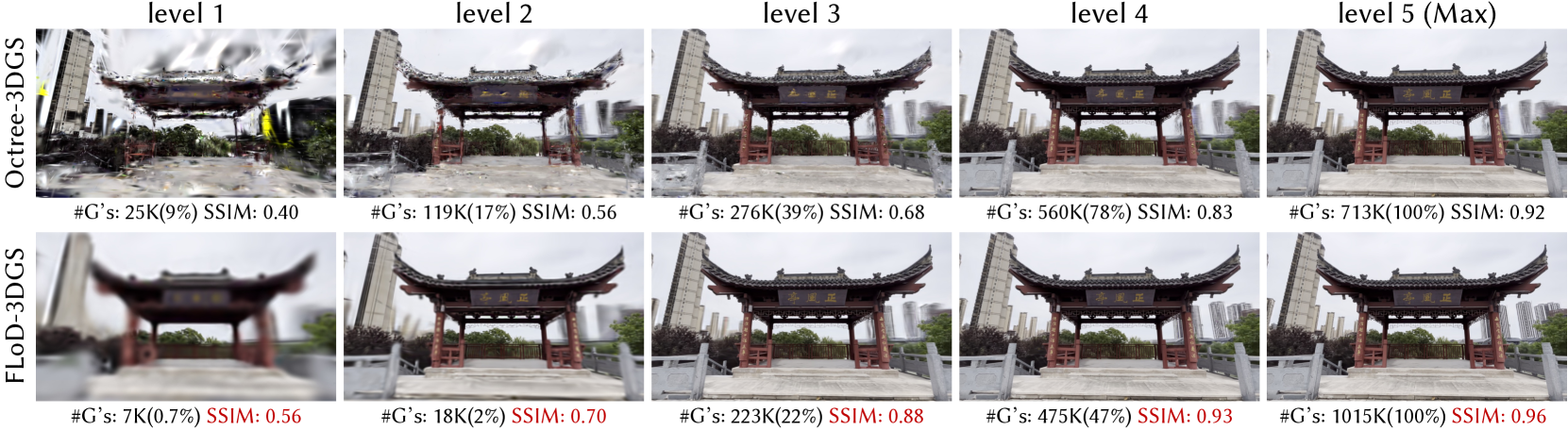
The image presents a visual comparison of two 3D Gaussian Splatting (3DGS) methods, Octree-3DGS and FLOD-3DGS, across five levels of detail. Each level displays a rendered image of a Chinese-style pavilion, along with metrics indicating the number of Gaussians (#G's) and the Structural Similarity Index Measure (SSIM). The goal is to illustrate how the visual quality and complexity of the rendered scene change with increasing levels of detail for each method.
### Components/Axes
* **Rows:** Two rows, representing the two methods being compared: Octree-3DGS (top row) and FLOD-3DGS (bottom row).
* **Columns:** Five columns, representing five levels of detail, labeled "level 1" to "level 5 (Max)".
* **Images:** Each cell contains a rendered image of the same scene (a Chinese-style pavilion).
* **Metrics:** Below each image, there are two metrics:
* `#G's`: Number of Gaussians used in the rendering, followed by the percentage of total Gaussians in parentheses.
* `SSIM`: Structural Similarity Index Measure, indicating the similarity between the rendered image and a ground truth image (not shown).
* **Labels:**
* Left side: "Octree-3DGS" and "FLOD-3DGS" labels indicate the method used for each row.
* Top: "level 1", "level 2", "level 3", "level 4", "level 5 (Max)" labels indicate the level of detail for each column.
### Detailed Analysis or ### Content Details
**Octree-3DGS (Top Row):**
* **Level 1:**
* Image: Highly distorted and blurry, with significant artifacts.
* `#G's`: 25K (9%)
* SSIM: 0.40
* **Level 2:**
* Image: Improved clarity compared to level 1, but still contains distortions.
* `#G's`: 119K (17%)
* SSIM: 0.56
* **Level 3:**
* Image: Further improvement in clarity, with fewer noticeable artifacts.
* `#G's`: 276K (39%)
* SSIM: 0.68
* **Level 4:**
* Image: Good visual quality, with most details of the pavilion visible.
* `#G's`: 560K (78%)
* SSIM: 0.83
* **Level 5 (Max):**
* Image: Highest visual quality, with sharp details and minimal artifacts.
* `#G's`: 713K (100%)
* SSIM: 0.92
**FLOD-3DGS (Bottom Row):**
* **Level 1:**
* Image: Very blurry and lacks detail.
* `#G's`: 7K (0.7%)
* SSIM: 0.56 (displayed in red)
* **Level 2:**
* Image: Slightly improved clarity compared to level 1, but still blurry.
* `#G's`: 18K (2%)
* SSIM: 0.70 (displayed in red)
* **Level 3:**
* Image: Noticeable improvement in clarity, with more details visible.
* `#G's`: 223K (22%)
* SSIM: 0.88 (displayed in red)
* **Level 4:**
* Image: Good visual quality, with most details of the pavilion visible.
* `#G's`: 475K (47%)
* SSIM: 0.93 (displayed in red)
* **Level 5 (Max):**
* Image: Highest visual quality, with sharp details and minimal artifacts.
* `#G's`: 1015K (100%)
* SSIM: 0.96 (displayed in red)
### Key Observations
* **Visual Quality:** Both methods show a clear improvement in visual quality as the level of detail increases.
* **Number of Gaussians:** The number of Gaussians used increases significantly with each level of detail for both methods.
* **SSIM:** The SSIM value also increases with each level of detail, indicating a higher similarity to the ground truth image.
* **FLOD-3DGS vs. Octree-3DGS:** At lower levels (1 and 2), FLOD-3DGS uses significantly fewer Gaussians than Octree-3DGS, but achieves a comparable or even slightly better SSIM. At higher levels, FLOD-3DGS uses more Gaussians than Octree-3DGS.
* **SSIM Color:** The SSIM values for FLOD-3DGS are displayed in red, possibly indicating a specific characteristic or comparison point.
### Interpretation
The image demonstrates the trade-off between visual quality and computational complexity in 3D Gaussian Splatting. Both Octree-3DGS and FLOD-3DGS achieve higher visual fidelity (as measured by SSIM) by increasing the number of Gaussians used in the rendering.
The comparison between the two methods suggests that FLOD-3DGS may be more efficient at lower levels of detail, achieving comparable visual quality with fewer Gaussians. However, at the highest level of detail, FLOD-3DGS uses more Gaussians to achieve a slightly higher SSIM. The red color of the SSIM values for FLOD-3DGS might indicate a specific optimization or characteristic of this method related to structural similarity.
The data suggests that the choice between Octree-3DGS and FLOD-3DGS may depend on the desired level of detail and the available computational resources. For applications where lower levels of detail are sufficient, FLOD-3DGS might offer a more efficient solution. For applications requiring the highest possible visual quality, FLOD-3DGS might be preferred, even if it requires more Gaussians.