## Neural Network Architecture Diagram: Input-Output Transformation
### Overview
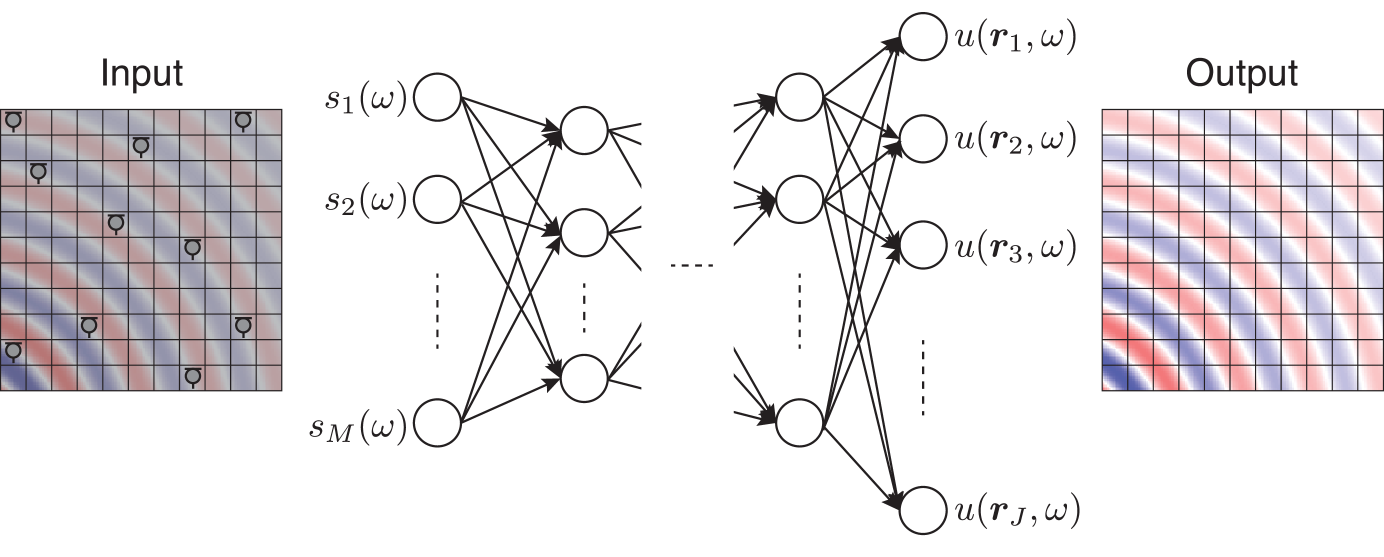
The image depicts a feedforward neural network processing input data through multiple hidden layers to produce output. The architecture includes:
- Input grid with spatial data points
- Hidden layer nodes with parameterized states
- Output grid with gradient-based activation patterns
- Full connectivity between layers
### Components/Axes
**Input Section (Left):**
- Grid: 5x5 matrix with gray circular markers
- Color gradient: Red-to-blue transition from bottom-left to top-right
- No explicit axis labels, but spatial coordinates implied
**Hidden Layer (Center):**
- Nodes labeled: s₁(ω), s₂(ω), ..., sₘ(ω)
- Black circular nodes with bidirectional arrows
- Parameter ω appears in all hidden layer states
**Output Section (Right):**
- Grid: 5x5 matrix with red/blue gradient
- Color gradient: Red-to-blue transition from top-left to bottom-right
- Output nodes labeled: u(r₁,ω), u(r₂,ω), ..., u(rⱼ,ω)
**Legend/Annotations:**
- No explicit legend present
- ω symbol consistently used across all node labels
- Dashed lines indicate hidden layer connections
### Detailed Analysis
**Input Grid:**
- 25 data points arranged in 5x5 matrix
- Gray circular markers suggest discrete input features
- Color gradient implies spatial correlation between adjacent cells
**Hidden Layer:**
- M nodes (exact count unspecified) between input/output
- Parameter ω suggests shared weight/bias across nodes
- Bidirectional arrows indicate recurrent connections within layer
**Output Grid:**
- 25 activation units with continuous color gradient
- Red areas (top-left) transition to blue (bottom-right)
- Output nodes maintain ω parameterization
**Architectural Features:**
- Fully connected architecture (all-to-all connections)
- No skip connections or residual pathways shown
- Parameter ω appears to be global across network
### Key Observations
1. Input-output grids share identical spatial dimensions (5x5)
2. Color gradients in input/output suggest inverse spatial relationships
3. Hidden layer uses parameter ω consistently across all nodes
4. Output activation pattern mirrors but inverts input gradient direction
5. No explicit activation function labels present
### Interpretation
This diagram illustrates a basic feedforward neural network with:
- Spatial input processing (5x5 grid)
- Parameterized hidden layer (M nodes with ω)
- Gradient-based output transformation
The consistent use of ω across all nodes suggests shared parameterization, potentially representing:
- Global weight matrix
- Batch normalization parameter
- Regularization factor
The inverted color gradient between input and output implies the network learns to:
1. Detect spatial patterns in input data
2. Transform these patterns through hidden representations
3. Produce output with opposite spatial correlation
The bidirectional arrows in the hidden layer indicate potential for:
- Recurrent processing within the layer
- Temporal dynamics (if ω represents time steps)
- Feature re-evaluation during forward pass
The absence of explicit activation functions suggests this is either:
- A conceptual diagram focusing on architecture
- A simplified representation omitting implementation details
- A visualization emphasizing parameter flow rather than computation
The matching grid dimensions between input and output imply:
- No dimensionality reduction/expansion
- Direct 1:1 correspondence between input features and output units
- Potential for identity mapping or spatial transformation
This architecture could be applied to tasks requiring:
- Spatial pattern recognition
- Feature transformation with parameter sharing
- Gradient-based output generation