## Line/Bar Chart: STFT and SNR vs Percentage of Binaural Audios
### Overview
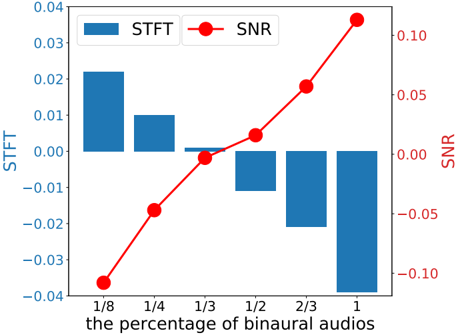
The chart compares two metrics—Short-Time Fourier Transform (STFT) and Signal-to-Noise Ratio (SNR)—across varying percentages of binaural audio input. STFT is represented by blue bars, while SNR is shown as a red line with circular markers. The x-axis ranges from 1/8 (12.5%) to 1 (100%) binaural audio, and the y-axes are normalized to [-0.10, 0.10] for SNR and [-0.04, 0.04] for STFT.
### Components/Axes
- **X-axis**: "the percentage of binaural audios" (labeled as fractions: 1/8, 1/4, 1/3, 1/2, 2/3, 1).
- **Left Y-axis (STFT)**: Ranges from -0.04 to 0.04, labeled "STFT".
- **Right Y-axis (SNR)**: Ranges from -0.10 to 0.10, labeled "SNR".
- **Legend**: Located in the top-right corner, with blue squares for STFT and red circles for SNR.
- **Bars**: Blue vertical bars for STFT values at each x-axis interval.
- **Line**: Red line with circular markers for SNR values, connecting data points across the x-axis.
### Detailed Analysis
- **STFT (Blue Bars)**:
- At **1/8**: ~0.02
- At **1/4**: ~0.01
- At **1/3**: ~0.00
- At **1/2**: ~-0.01
- At **2/3**: ~-0.02
- At **1**: ~-0.03
- **SNR (Red Line)**:
- At **1/8**: ~-0.04
- At **1/4**: ~-0.02
- At **1/3**: ~0.00
- At **1/2**: ~0.01
- At **2/3**: ~0.05
- At **1**: ~0.10
### Key Observations
1. **STFT Decreases Linearly**: STFT values start positive (~0.02 at 1/8) and decrease steadily to negative values (-0.03 at 100% binaural audio).
2. **SNR Increases Linearly**: SNR values start negative (-0.04 at 1/8) and rise sharply to positive values (0.10 at 100% binaural audio).
3. **Inverse Relationship**: As the percentage of binaural audio increases, STFT decreases while SNR increases, suggesting a trade-off between these metrics.
4. **Outlier at 100%**: The SNR value at 100% binaural audio (0.10) is the highest observed, while STFT reaches its lowest (-0.03).
### Interpretation
The data suggests that increasing the proportion of binaural audio improves SNR (better signal quality) but degrades STFT (potentially reducing temporal resolution or other STFT-related properties). The sharp rise in SNR at 100% binaural audio indicates a critical threshold where binaural processing significantly enhances signal clarity. Conversely, the linear decline in STFT implies a cost to this improvement, possibly related to computational complexity or loss of specific audio features. This trade-off highlights the need to balance binaural audio usage based on application priorities (e.g., SNR optimization vs. STFT fidelity).