## Flow Diagram: Automated Problem Generation and RL Training
### Overview
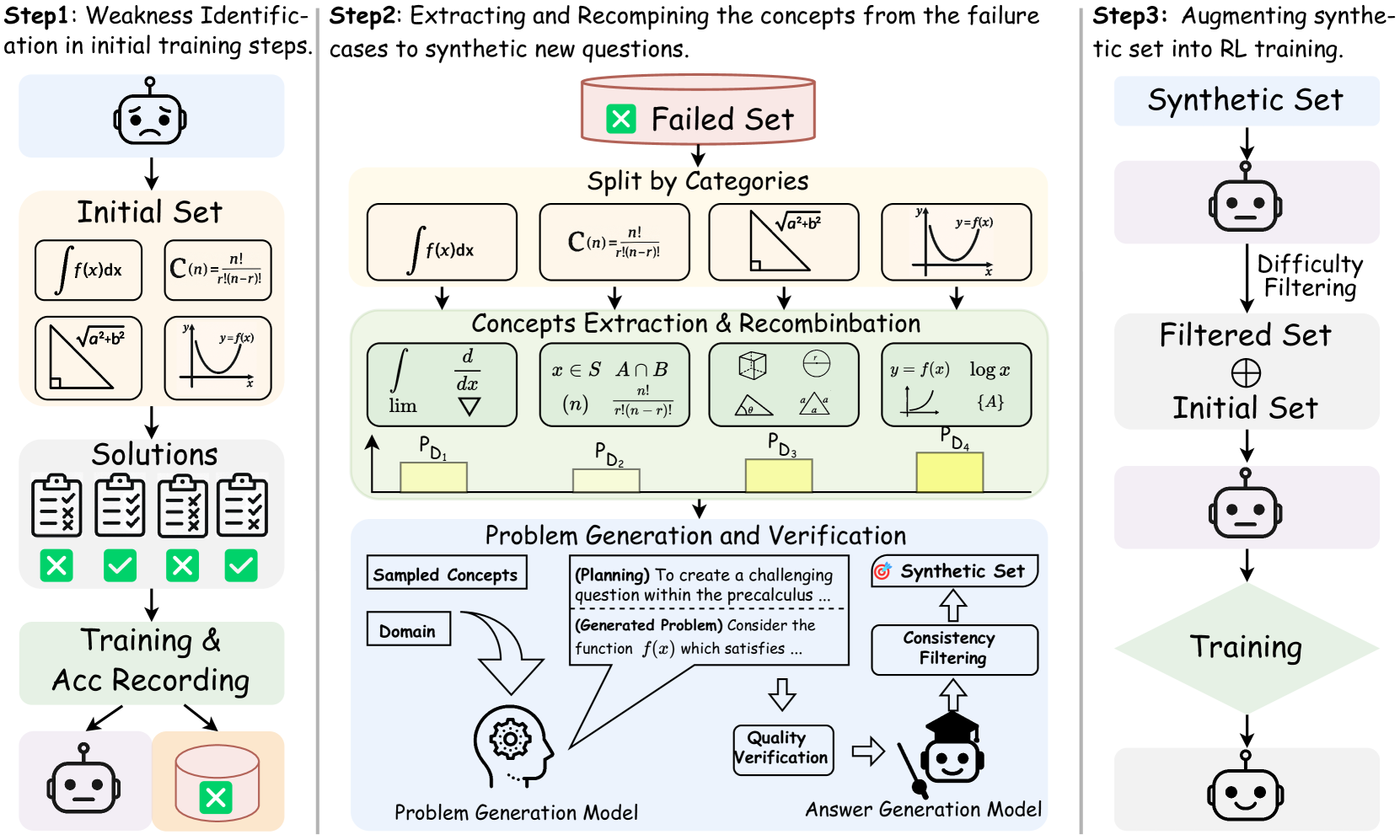
The image is a flow diagram illustrating a three-step process for automated problem generation and reinforcement learning (RL) training. The steps are: 1) Weakness identification in initial training steps, 2) Extracting and recombining concepts from failure cases to generate synthetic new questions, and 3) Augmenting the synthetic set into RL training. The diagram uses visual elements like robots, mathematical formulas, and flow arrows to represent the different stages and processes.
### Components/Axes
* **Step 1: Weakness Identification in Initial Training Steps**
* **Initial Set:** Contains mathematical expressions:
* `∫f(x)dx`
* `C(n) = n! / (r!(n-r)!)`
* `√(a²+b²) `
* `y = f(x)`
* **Solutions:** Four solution sets are shown, with the 2nd and 4th marked as correct (green checkmark) and the 1st and 3rd marked as incorrect (red X).
* **Training & Acc Recording:** Leads to a robot icon and a cylinder icon with a red X.
* **Step 2: Extracting and Recombining the Concepts from the Failure Cases to Synthetic New Questions**
* **Failed Set:** A container marked with a red X.
* **Split by Categories:** The same mathematical expressions as in the Initial Set are shown.
* `∫f(x)dx`
* `C(n) = n! / (r!(n-r)!)`
* `√(a²+b²) `
* `y = f(x)`
* **Concepts Extraction & Recombination:** Contains mathematical expressions:
* `∫lim d/dx`
* `x ∈ S ∩ A ∩ B`
* 3D Cube with angles
* `y = f(x) log x {A}`
* **P_D1, P_D2, P_D3, P_D4:** Yellow bars below the concepts.
* **Problem Generation and Verification:**
* **Sampled Concepts:** Box labeled "Sampled Concepts"
* **Domain:** Box labeled "Domain" with an arrow pointing to the Problem Generation Model.
* **Problem Generation Model:** A brain icon with gears.
* **(Planning) To create a challenging question within the precalculus ...**
* **(Generated Problem) Consider the function f(x) which satisfies ...**
* **Quality Verification:** Arrow pointing from the Problem Generation Model to the Answer Generation Model.
* **Answer Generation Model:** A graduation cap icon.
* **Consistency Filtering:** Arrow pointing from the Answer Generation Model back to the "Synthetic Set".
* **Synthetic Set:** A target icon.
* **Step 3: Augmenting Synthetic Set into RL Training**
* **Synthetic Set:** A container.
* **Difficulty Filtering:** An arrow pointing down from the Synthetic Set to the Filtered Set.
* **Filtered Set:** A container with a plus symbol inside a circle, combined with the Initial Set.
* **Training:** A diamond shape.
### Detailed Analysis or Content Details
* **Step 1:** The initial set of problems is evaluated, and the accuracy of the solutions is recorded. Incorrect solutions are flagged with a red X.
* **Step 2:** Failed problems are analyzed to extract underlying concepts. These concepts are then recombined to generate new, synthetic problems. The generated problems undergo quality verification and consistency filtering.
* **Step 3:** The synthetic problems are augmented into the RL training process. Difficulty filtering is applied, and the filtered set is combined with the initial set for training.
### Key Observations
* The diagram emphasizes the iterative nature of the problem generation and training process.
* The use of mathematical formulas and symbols indicates a focus on mathematical problem-solving.
* The robot icons suggest automation and machine learning.
### Interpretation
The diagram illustrates a system for automatically generating and refining mathematical problems for use in reinforcement learning. By analyzing failed attempts, the system extracts key concepts and recombines them to create new, challenging problems. This process aims to improve the training of RL agents by providing a diverse and adaptive set of learning materials. The system leverages both problem generation and answer generation models, ensuring the quality and consistency of the generated problems. The iterative nature of the process, with consistency filtering and difficulty filtering, suggests a continuous refinement of the problem set to optimize the learning experience.