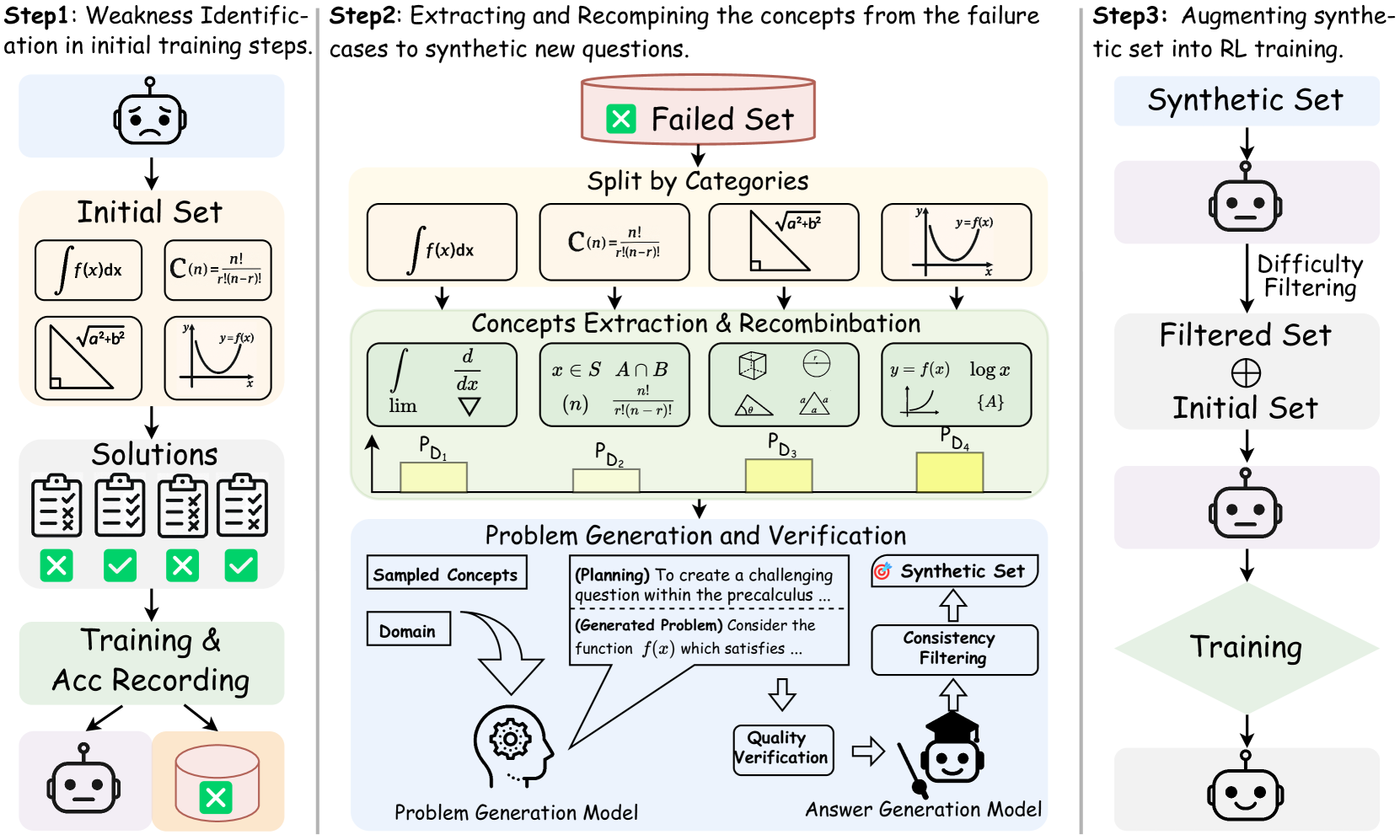
## Flowchart: Iterative Machine Learning Training Process with Synthetic Data Augmentation
### Overview
The diagram illustrates a three-step iterative process for improving machine learning model training through synthetic data generation and failure analysis. It combines mathematical concept extraction, problem generation, and reinforcement learning (RL) augmentation.
### Components/Axes
**Step 1: Weakness Identification**
- **Initial Set**: Contains mathematical concepts (integrals, combinations, geometric shapes)
- **Solutions**: Checkmarked (✓) and failed (✗) problem attempts
- **Training & Acc Recording**: Robot icon and database symbol
**Step 2: Concept Extraction & Recombination**
- **Split by Categories**: Integrals, combinations, geometric shapes
- **Concepts Extraction**: Mathematical operations (limits, intersections, geometric transformations)
- **Problem Generation**: Planning module with precalculus constraints
- **Verification**: Quality check with robot icon
**Step 3: Synthetic Set Augmentation**
- **Synthetic Set**: Robot icon with difficulty filtering
- **Filtered Set**: Cross (+) symbol
- **Training**: Robot icon with graduation cap
**Flow Arrows**: Connect components between steps (e.g., Initial Set → Solutions → Training → Step 2 → Step 3)
### Detailed Analysis
**Step 1 Elements**:
- Initial Set contains:
- Integral notation: ∫f(x)dx
- Combination formula: C(n) = n! / [r!(n-r)!]
- Geometric shapes (triangle, parabola)
- Solutions show 4 attempts with mixed ✓/✗ results
- Training & Acc Recording connects to database
**Step 2 Elements**:
- Split by Categories includes:
- Integral: ∫f(x)dx
- Combination formula
- Geometric shapes (triangle, parabola)
- Concepts Extraction shows:
- Limit notation: lim d/dx
- Set intersection: x∈S ∧ A∩B
- Geometric figures (cube, circle)
- Problem Generation includes:
- Planning module with precalculus constraints
- Generated problem example: "Consider function f(x) satisfying..."
- Quality Verification connects to Answer Generation Model
**Step 3 Elements**:
- Synthetic Set includes:
- Robot icon with difficulty filtering
- Filtered Set symbol (+)
- Training connects back to Initial Set
### Key Observations
1. **Iterative Feedback Loop**: Training results feed back into Initial Set through synthetic data
2. **Failure Analysis**: Failed solutions (✗) trigger concept extraction
3. **Mathematical Rigor**: Explicit mathematical notation used throughout
4. **Automation**: Robot icons represent automated processes
5. **Quality Control**: Multiple verification stages (quality check, consistency filtering)
### Interpretation
This flowchart demonstrates a sophisticated approach to machine learning model improvement through:
1. **Weakness Identification**: Initial training reveals problem areas through solution attempts
2. **Conceptual Recombination**: Failed cases are analyzed to extract mathematical concepts
3. **Synthetic Problem Generation**: New challenging problems are created within mathematical constraints
4. **Quality Filtering**: Generated problems undergo rigorous verification
5. **Reinforcement Learning**: Synthetic data is filtered and integrated back into training
The process creates a closed-loop system where model weaknesses directly inform synthetic data generation, which in turn strengthens the model through targeted training. The use of mathematical notation suggests this could be applied to STEM-focused machine learning applications, particularly in domains requiring precise problem-solving capabilities.