## Diagram: AI Agent Architecture and Planning Cycle
### Overview
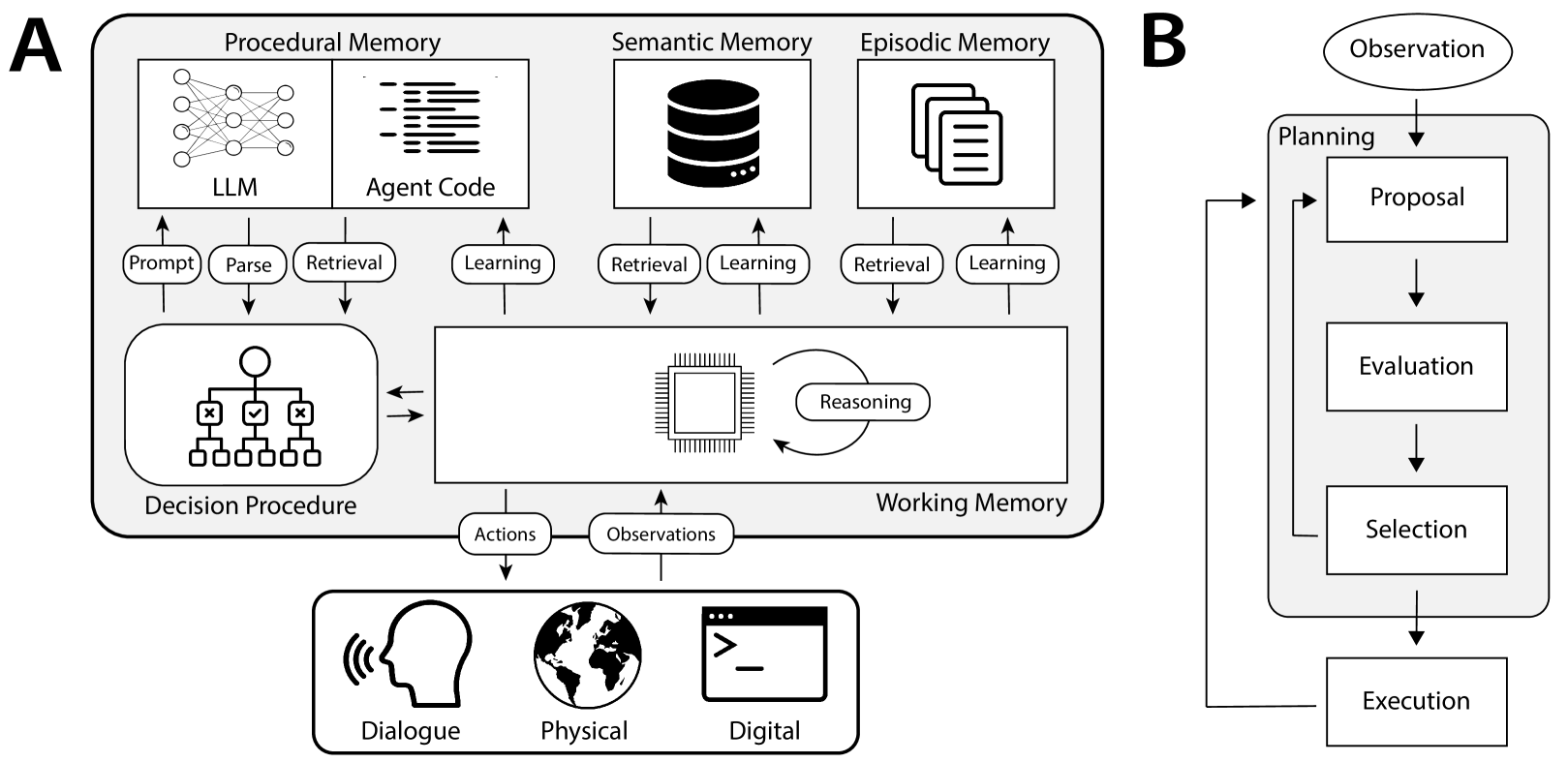
The image presents two diagrams, labeled A and B, illustrating the architecture of an AI agent and its planning cycle, respectively. Diagram A depicts the agent's memory components and decision-making process, while diagram B outlines the steps involved in the agent's planning process.
### Components/Axes
**Diagram A: AI Agent Architecture**
* **Top Level:**
* **Procedural Memory:** Contains "LLM" (Large Language Model) and "Agent Code".
* "LLM" is represented by a neural network diagram.
* "Agent Code" is represented by a series of horizontal lines.
* **Semantic Memory:** Represented by a database icon.
* **Episodic Memory:** Represented by a stack of documents icon.
* **Middle Level:**
* "Prompt", "Parse", and "Retrieval" are associated with "LLM".
* "Learning" is associated with "Agent Code".
* "Retrieval" and "Learning" are associated with "Semantic Memory".
* "Retrieval" and "Learning" are associated with "Episodic Memory".
* **Central Level:**
* **Working Memory:** Contains a CPU icon with a "Reasoning" loop.
* **Decision Procedure:** Contains a circle connected to three boxes, each containing an "X" mark. Below the boxes are smaller boxes.
* **Bottom Level:**
* "Actions" and "Observations" connect the "Working Memory" to the environment.
* **Environment:** Consists of "Dialogue" (speech bubble icon), "Physical" (globe icon), and "Digital" (command prompt icon).
**Diagram B: Planning Cycle**
* **Top:** "Observation" (oval shape).
* **Process Flow (within a rounded rectangle labeled "Planning"):**
* "Proposal" (rectangle).
* "Evaluation" (rectangle).
* "Selection" (rectangle).
* "Execution" (rectangle).
* A feedback loop connects "Execution" back to "Proposal".
### Detailed Analysis or ### Content Details
**Diagram A:**
* The agent's memory is divided into procedural, semantic, and episodic components.
* The LLM and Agent Code within procedural memory are used to process prompts, parse information, retrieve data, and learn.
* Semantic and episodic memories are used for retrieval and learning.
* The working memory facilitates reasoning based on actions and observations.
* The decision procedure takes input from the working memory and influences actions in the environment.
* The environment consists of dialogue, physical, and digital aspects.
**Diagram B:**
* The planning cycle starts with an observation.
* A proposal is generated based on the observation.
* The proposal is evaluated.
* A selection is made based on the evaluation.
* The selected action is executed.
* The execution results are fed back into the proposal stage, creating a continuous loop.
### Key Observations
* Diagram A illustrates the internal architecture of an AI agent, emphasizing its memory components and decision-making process.
* Diagram B outlines the agent's planning cycle, highlighting the iterative nature of proposal, evaluation, selection, and execution.
* The agent interacts with the environment through actions and observations, influencing and being influenced by dialogue, physical, and digital aspects.
### Interpretation
The diagrams provide a high-level overview of an AI agent's architecture and planning process. Diagram A emphasizes the importance of different memory types (procedural, semantic, episodic) and their roles in processing information and making decisions. The inclusion of an LLM suggests a modern approach to AI, leveraging large language models for various tasks. Diagram B highlights the iterative nature of planning, where observations lead to proposals, which are then evaluated, selected, and executed, with feedback loops enabling continuous improvement. The agent's interaction with the environment through dialogue, physical actions, and digital interfaces demonstrates its ability to operate in diverse contexts. The diagrams suggest a sophisticated AI system capable of learning, reasoning, and adapting to its environment.