\n
## Diagram: Agent Architecture & Planning Loop
### Overview
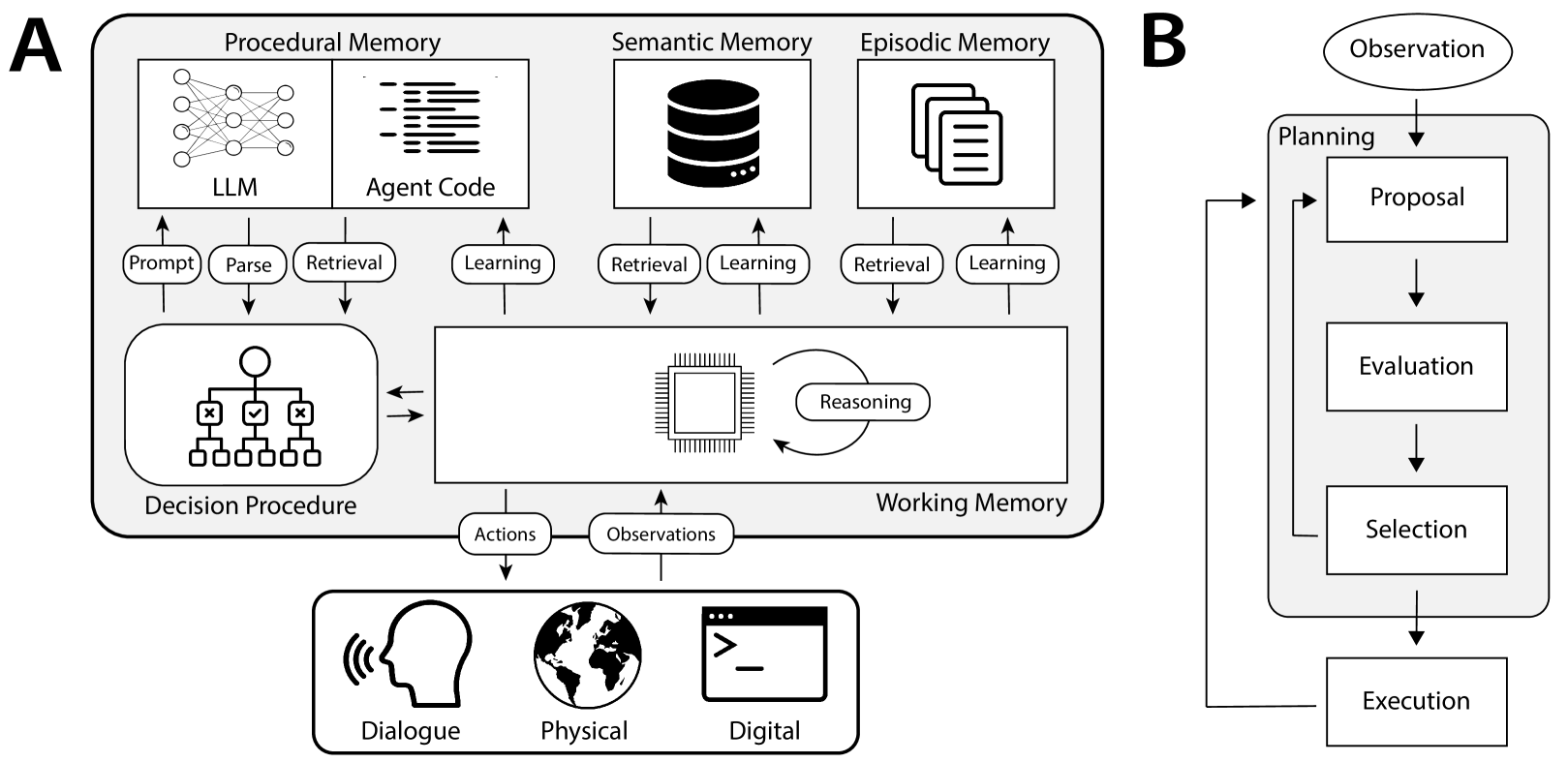
The image presents two interconnected diagrams, labeled 'A' and 'B'. Diagram 'A' illustrates the architecture of an agent, detailing its memory components, processing units, and interaction modalities. Diagram 'B' depicts a planning loop, outlining the sequential steps involved in decision-making and action execution. The diagrams are visually connected by a bidirectional arrow, suggesting a feedback loop between the agent's architecture and its planning process.
### Components/Axes
**Diagram A - Agent Architecture:**
* **Memory Components:** Procedural Memory, Semantic Memory, Episodic Memory, Working Memory.
* **Processing Units:** LLM (Large Language Model), Agent Code, Reasoning, Decision Procedure.
* **Interaction Modalities:** Dialogue, Physical, Digital.
* **Processes:** Prompt, Parse, Retrieval, Learning, Actions, Observations.
**Diagram B - Planning Loop:**
* **Stages:** Observation, Planning, Proposal, Evaluation, Selection, Execution.
### Detailed Analysis or Content Details
**Diagram A - Agent Architecture:**
* **LLM:** Receives a "Prompt", which is then processed through "Parse" and "Retrieval" stages.
* **Agent Code:** Connected to LLM via "Learning".
* **Semantic Memory:** Connected to Agent Code and Reasoning via "Retrieval" and "Learning". Represented as a cylinder.
* **Episodic Memory:** Connected to Agent Code and Reasoning via "Retrieval" and "Learning". Represented as a stack of papers.
* **Procedural Memory:** Connected to LLM. Represented as vertical lines.
* **Reasoning:** Receives input from Semantic Memory, Episodic Memory, and Working Memory. Represented as a chip.
* **Working Memory:** Receives input from Reasoning and "Observations". Represented as a chip.
* **Decision Procedure:** Receives input from LLM and outputs "Actions". Represented as a sphere with checkmarks and crosses.
* **Actions:** Lead to "Dialogue", "Physical" (globe), and "Digital" (computer screen) outputs.
* **Observations:** Feed back into Working Memory.
**Diagram B - Planning Loop:**
* The loop begins with "Observation".
* "Observation" leads to "Planning".
* "Planning" generates a "Proposal".
* "Proposal" is subjected to "Evaluation".
* "Evaluation" results in "Selection".
* "Selection" culminates in "Execution".
* "Execution" feeds back into "Observation", completing the loop.
### Key Observations
* The agent architecture (Diagram A) is highly interconnected, with multiple feedback loops between memory components, processing units, and interaction modalities.
* The planning loop (Diagram B) is a sequential process, with each stage building upon the previous one.
* The bidirectional arrow connecting Diagrams A and B suggests that the agent's architecture influences its planning process, and vice versa.
* The use of visual metaphors (e.g., cylinder for Semantic Memory, stack of papers for Episodic Memory) helps to convey the nature of each component.
### Interpretation
The diagrams illustrate a cognitive architecture for an intelligent agent. Diagram A outlines the agent's internal structure, emphasizing the importance of different types of memory (procedural, semantic, episodic, working) and processing units (LLM, reasoning, decision procedure). The agent interacts with the world through dialogue, physical actions, and digital interfaces. Diagram B depicts the agent's decision-making process, which involves observing the environment, planning a course of action, evaluating potential proposals, selecting the best option, and executing it. The feedback loop between the two diagrams suggests that the agent learns from its experiences and adapts its behavior accordingly.
The architecture appears to be designed for complex problem-solving, leveraging the strengths of LLMs, reasoning engines, and various memory systems. The planning loop provides a structured approach to decision-making, ensuring that actions are carefully considered and evaluated before being executed. The agent's ability to interact with the world through multiple modalities suggests that it is capable of operating in a variety of environments. The overall design emphasizes adaptability, learning, and intelligent action.