## Diagram: AI Agent Architecture and Planning Process
### Overview
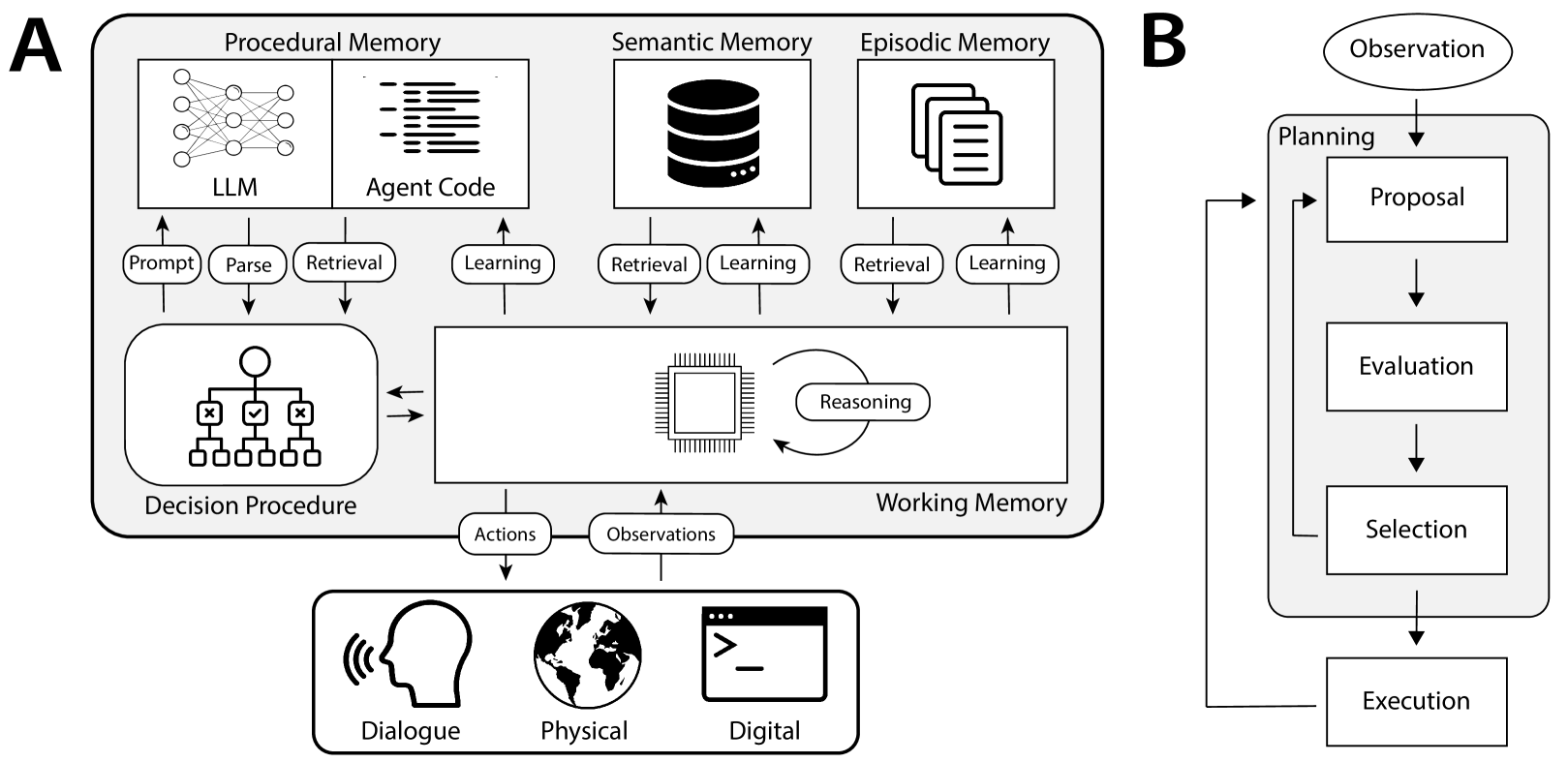
The image is a technical diagram illustrating the architecture of an AI agent's cognitive system (Section A) and its associated planning and execution loop (Section B). It is a black-and-white schematic composed of labeled boxes, icons, and directional arrows indicating data flow and processes.
### Components/Axes
The diagram is divided into two primary sections, labeled **A** (left) and **B** (right).
**Section A: Agent Architecture**
This section is enclosed in a large rounded rectangle and contains several interconnected subsystems:
1. **Memory Systems (Top Row):**
* **Procedural Memory:** Contains two sub-components: "LLM" (represented by a neural network icon) and "Agent Code" (represented by lines of code).
* **Semantic Memory:** Represented by a database cylinder icon.
* **Episodic Memory:** Represented by an icon of stacked documents or files.
2. **Core Processing (Middle):**
* **Working Memory:** A central rectangular block containing a microchip icon and a circular "Reasoning" process loop.
* **Decision Procedure:** A block to the left of Working Memory, containing a flowchart or decision tree icon.
3. **Processes & Interfaces (Connecting Elements):**
* Arrows labeled with processes connect the memory systems to the core: "Prompt," "Parse," "Retrieval," "Learning."
* Arrows labeled "Actions" and "Observations" connect the core to an external interaction layer.
4. **External Interaction Layer (Bottom):**
* A rounded rectangle containing three domains: "Dialogue" (head with sound waves icon), "Physical" (globe icon), and "Digital" (terminal window icon).
**Section B: Planning Loop**
This section, to the right, depicts a cyclical process flow:
1. **Input:** An oval labeled "Observation" at the top.
2. **Planning Block:** A large rectangle containing a sequential sub-process:
* "Proposal" -> "Evaluation" -> "Selection".
3. **Output:** A box labeled "Execution" at the bottom.
4. **Flow:** Arrows show the flow from Observation into Planning, through the sub-stages, to Execution, and a feedback loop from Execution back to the start of the Planning block.
### Detailed Analysis
**Section A - Component Isolation & Flow:**
* **Procedural Memory** interacts with the **Decision Procedure** via "Prompt," "Parse," and "Retrieval" processes. It also receives "Learning" input.
* **Semantic Memory** and **Episodic Memory** both have bidirectional "Retrieval" and "Learning" connections to the **Working Memory**.
* The **Decision Procedure** and **Working Memory** have a bidirectional connection.
* The **Working Memory** is the central hub, receiving "Observations" from the external layer and sending "Actions" to it. It also engages in "Reasoning."
* The **External Interaction Layer** defines the agent's modalities for interacting with the world: through conversation (Dialogue), the physical world (Physical), and digital interfaces (Digital).
**Section B - Process Flow:**
* The process is initiated by an **Observation**.
* This feeds into the **Planning** module, which internally cycles through generating a **Proposal**, **Evaluation** of that proposal, and **Selection** of a course of action.
* The selected plan proceeds to **Execution**.
* A feedback arrow loops from **Execution** back to the input of the **Planning** block, indicating an iterative or continuous planning cycle.
### Key Observations
1. **Hierarchical Memory:** The architecture explicitly separates different types of memory (Procedural, Semantic, Episodic), suggesting a design inspired by cognitive science.
2. **Central Reasoning Hub:** The **Working Memory** acts as the integration point for all memory retrieval, learning, reasoning, and external interaction.
3. **Closed-Loop System:** Both sections depict closed loops. Section A shows continuous interaction between the agent and its environment (Actions/Observations). Section B shows a planning-execution-feedback loop.
4. **Abstraction of Components:** Icons are used to abstract complex components (e.g., a neural network for "LLM," a database for "Semantic Memory").
### Interpretation
This diagram presents a comprehensive blueprint for an autonomous AI agent. **Section A** details the agent's "mind" – its static knowledge structures (memories) and dynamic processes (reasoning, decision-making). It emphasizes that learning and retrieval are fundamental processes connecting long-term memories to the active working memory. The inclusion of "Agent Code" within Procedural Memory suggests the agent can modify or utilize its own programming as a skill.
**Section B** operationalizes the agent's behavior through a classic sense-plan-act cycle, but with a sophisticated, multi-stage planning module. The feedback loop from Execution back to Planning is critical; it implies the agent can learn from the outcomes of its actions and adjust future plans, enabling adaptive behavior.
Together, the two sections illustrate a system designed for complex, real-world tasks. The agent perceives its environment (via Dialogue, Physical, or Digital channels), integrates those observations with its vast stored knowledge and memories, reasons about the situation, makes decisions, and executes actions in a continuous, goal-directed loop. The separation of planning into proposal, evaluation, and selection suggests a deliberative process that weighs options before acting, rather than a purely reactive system.