## Screenshot: Code Editor with Mathematical Theorems
### Overview
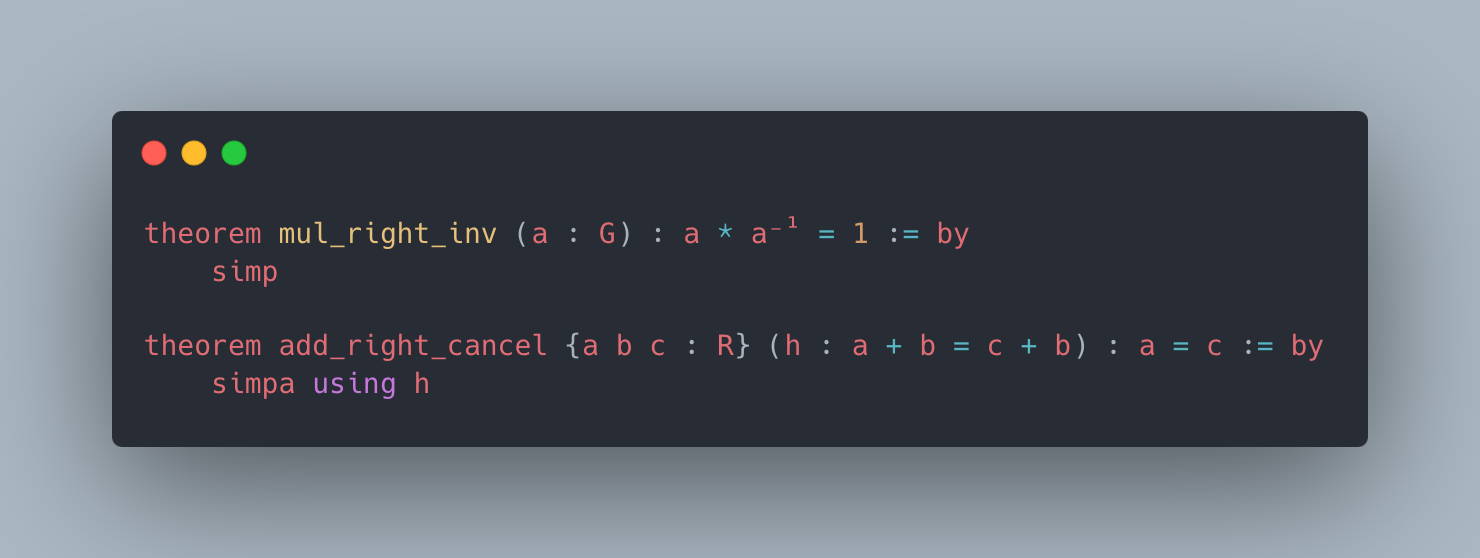
The image shows a code editor interface with two mathematical theorems written in a programming or formal verification language (likely Lean or a similar proof assistant). The code uses syntax highlighting with color-coded elements (e.g., keywords, variables, operators).
### Components/Axes
- **Top-left corner**: Three colored dots (red, yellow, green) typical of macOS window controls.
- **Code blocks**: Two theorem definitions with syntax highlighting.
- **First theorem**:
- **Text**: `theorem mul_right_inv (a : G) : a * a⁻¹ = 1 := by`
- **Subtext**: `simp`
- **Second theorem**:
- **Text**: `theorem add_right_cancel {a b c : R} (h : a + b = c + b) : a = c := by`
- **Subtext**: `simpa using h`
### Detailed Analysis
- **Theorem 1 (`mul_right_inv`)**:
- **Purpose**: Defines the multiplicative inverse property in a group `G`.
- **Equation**: `a * a⁻¹ = 1` (multiplication of an element and its inverse equals the identity).
- **Proof method**: `by simp` (uses the `simp` tactic to simplify the proof).
- **Theorem 2 (`add_right_cancel`)**:
- **Purpose**: Defines the cancellation law for addition in a ring `R`.
- **Equation**: If `a + b = c + b`, then `a = c`.
- **Proof method**: `by simpa using h` (uses the `simpa` tactic with the hypothesis `h`).
### Key Observations
- **Syntax Highlighting**:
- Keywords (`theorem`, `by`, `simp`, `simpa`) are in red.
- Variables (`a`, `b`, `c`, `G`, `R`) are in yellow.
- Operators (`*`, `⁻¹`, `=`, `+`) are in blue.
- Hypotheses (`h`) are in purple.
- **Structure**: Theorems are written in a formal, declarative style typical of proof assistants.
### Interpretation
This code demonstrates formal verification of algebraic properties in a mathematical structure (group and ring). The theorems assert fundamental properties:
1. **Multiplicative Inverse**: Every element in a group has an inverse that, when multiplied, yields the identity.
2. **Additive Cancellation**: If two elements added to the same third element are equal, the original elements must be equal.
The use of `simp` and `simpa` suggests the code is part of a proof assistant workflow, where these tactics automate proof steps by applying known axioms or lemmas. The presence of `h` (a hypothesis) indicates the second theorem relies on a previously established equality.
No numerical data or trends are present, as the image focuses on formal mathematical definitions and proofs.