\n
## Screenshot: Mathematical Theorem Code
### Overview
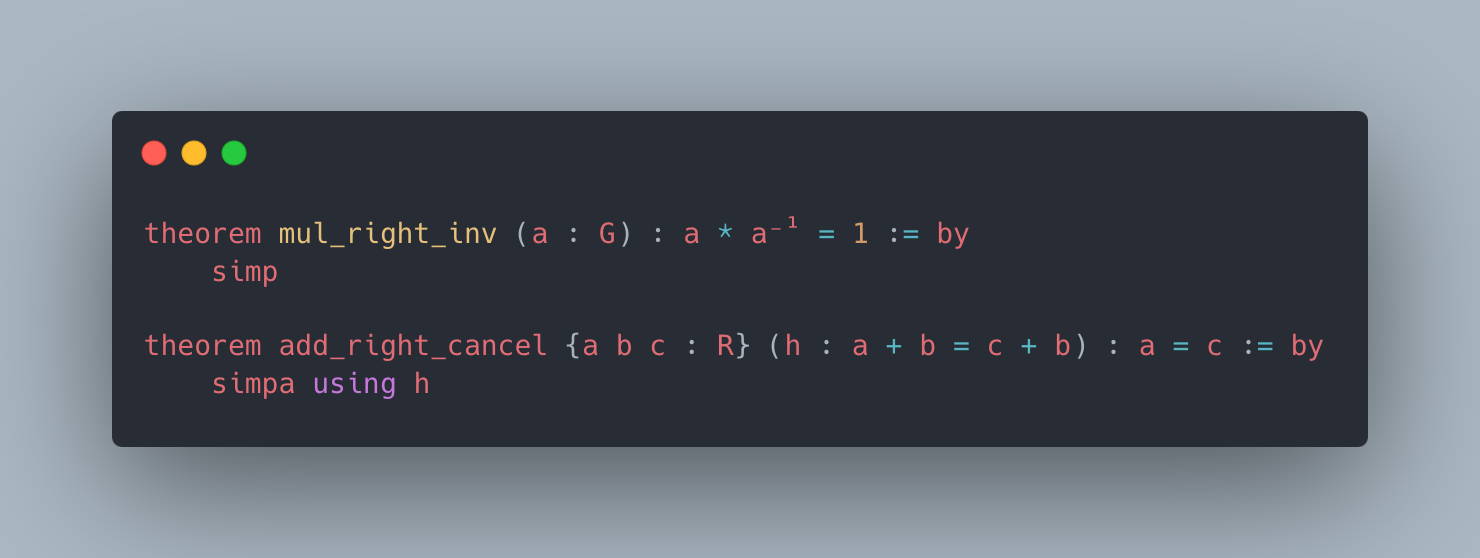
The image is a screenshot displaying code snippets of mathematical theorems, likely from a formal proof assistant or a mathematical software environment. The code appears to be written in a functional programming style, possibly Lean or Coq, given the syntax. There are three colored circles at the top-left corner.
### Components/Axes
There are no axes or traditional chart components. The image consists of text and three colored circles positioned at the top-left. The circles are colored red, orange, and green, from left to right.
### Detailed Analysis or Content Details
The screenshot contains two theorem definitions:
1. **theorem mul_right_inv (a : G) : a * a⁻¹ = 1 := by simp**
* `theorem mul_right_inv`: This is the name of the theorem.
* `(a : G)`: This defines a variable `a` of type `G`.
* `: a * a⁻¹ = 1`: This is the statement of the theorem, asserting that for any element `a` in `G`, `a` multiplied by its inverse `a⁻¹` equals the identity element `1`.
* `:= by simp`: This indicates that the theorem is proved by simplification (`simp`).
2. **theorem add_right_cancel {a b c : R} (h : a + b = c + b) : a = c := by simpa using h**
* `theorem add_right_cancel`: This is the name of the theorem.
* `{a b c : R}`: This defines variables `a`, `b`, and `c` of type `R`.
* `(h : a + b = c + b)`: This defines a hypothesis `h` stating that `a + b` is equal to `c + b`.
* `: a = c`: This is the statement of the theorem, asserting that `a` is equal to `c`.
* `:= by simpa using h`: This indicates that the theorem is proved by simplification (`simpa`) using the hypothesis `h`.
### Key Observations
The code snippets demonstrate basic mathematical properties: the existence of multiplicative inverses and the cancellation property of addition. The use of `simp` and `simpa` suggests a tactic-based proof system where the proof assistant automatically attempts to simplify the expression to verify the theorem.
### Interpretation
The image showcases a snippet of formal mathematical reasoning. The theorems are expressed in a precise, unambiguous language suitable for automated verification. The use of a proof assistant allows for rigorous validation of mathematical statements, reducing the risk of errors. The theorems themselves are fundamental in abstract algebra and real analysis. The `G` and `R` likely represent a group and the real numbers respectively. The presence of these theorems suggests the code is part of a larger library or project aimed at formalizing mathematical knowledge.