## Diagram: Airflow Scenarios
### Overview
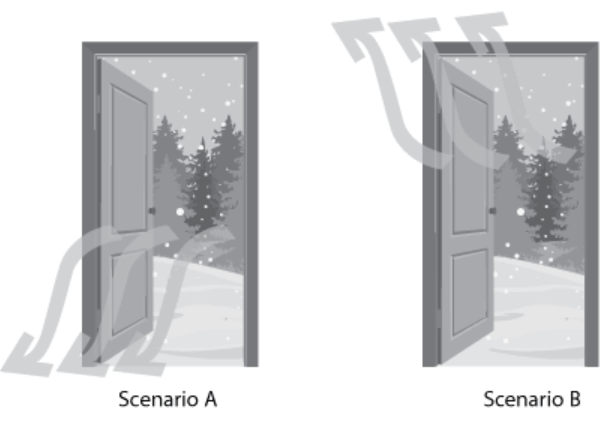
The image presents two scenarios (A and B) depicting airflow through doorways during winter conditions. Both scenarios show a door slightly ajar, revealing a snowy outdoor scene. Arrows indicate the direction of airflow.
### Components/Axes
* **Scenario A:** Depicts a door slightly ajar with airflow entering from the top and bottom of the door opening, indicated by gray arrows pointing inward.
* **Scenario B:** Depicts a door slightly ajar with airflow exiting from the top of the door opening, indicated by gray arrows pointing outward.
* **Background:** Both scenarios feature a snowy landscape with pine trees visible through the doorway.
### Detailed Analysis
* **Scenario A:** Three arrows are shown entering the room. Two arrows originate from the bottom of the door opening, and one arrow originates from the top of the door opening.
* **Scenario B:** Three arrows are shown exiting the room from the top of the door opening.
### Key Observations
* Scenario A shows cold air entering the room from both the top and bottom of the door opening.
* Scenario B shows warm air exiting the room from the top of the door opening.
### Interpretation
The diagram illustrates the concept of air convection and temperature gradients. In Scenario A, the cold air outside is denser and enters the room from the bottom, while also entering from the top. In Scenario B, the warm air inside rises and exits through the top of the door opening. This demonstrates how temperature differences can drive airflow in buildings, potentially leading to heat loss and drafts.