\n
## Diagram: Air Leakage Scenarios
### Overview
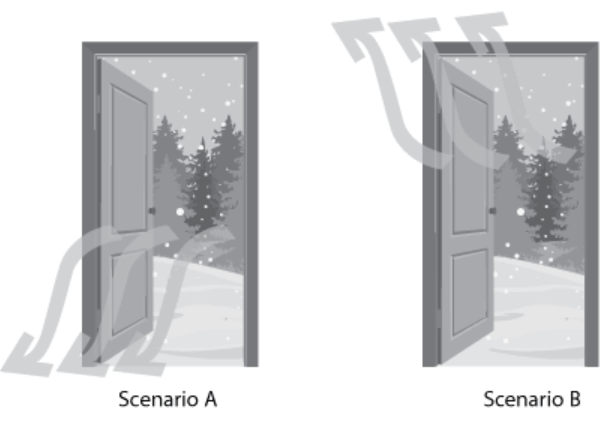
The image presents a comparative diagram illustrating air leakage through a door in two different scenarios, labeled "Scenario A" and "Scenario B". Both scenarios depict a door open to a snowy outdoor landscape with trees visible in the background. The primary difference lies in the depiction of airflow around the doorframe.
### Components/Axes
The diagram consists of two main panels, each representing a scenario. Each panel features:
* A doorframe with a door slightly ajar.
* A snowy outdoor scene visible through the doorway.
* Arrows indicating airflow.
* Labels: "Scenario A" (bottom-left) and "Scenario B" (bottom-right).
### Detailed Analysis or Content Details
**Scenario A:**
* The airflow is depicted as faint, curved lines originating from the top and sides of the doorframe, moving inwards. The lines are relatively sparse and diffuse.
* The door is slightly open.
* The outdoor scene shows snow falling and a landscape covered in snow.
**Scenario B:**
* The airflow is depicted as more prominent, darker, and numerous arrows originating from the top, sides, and bottom of the doorframe, moving inwards. The arrows are more concentrated and clearly indicate a stronger airflow.
* The door is slightly open.
* The outdoor scene is similar to Scenario A, showing snow falling and a snow-covered landscape.
### Key Observations
The key difference between the two scenarios is the intensity and volume of airflow. Scenario B demonstrates a significantly greater amount of air leakage compared to Scenario A. The arrows in Scenario B are more numerous, darker, and more concentrated, indicating a stronger draft.
### Interpretation
The diagram illustrates the concept of air leakage and its potential impact on energy efficiency and comfort. Scenario A likely represents a relatively well-sealed door, where air leakage is minimal. Scenario B represents a door with significant air leakage, potentially due to gaps around the frame or a poor seal. The diagram suggests that even a slightly open door can allow a substantial amount of air to enter or exit a building, leading to energy loss and discomfort. The visual contrast between the two scenarios effectively communicates the importance of proper door sealing and insulation. The diagram does not provide quantitative data, but rather a qualitative comparison of air leakage levels. It is a conceptual illustration rather than a precise measurement.