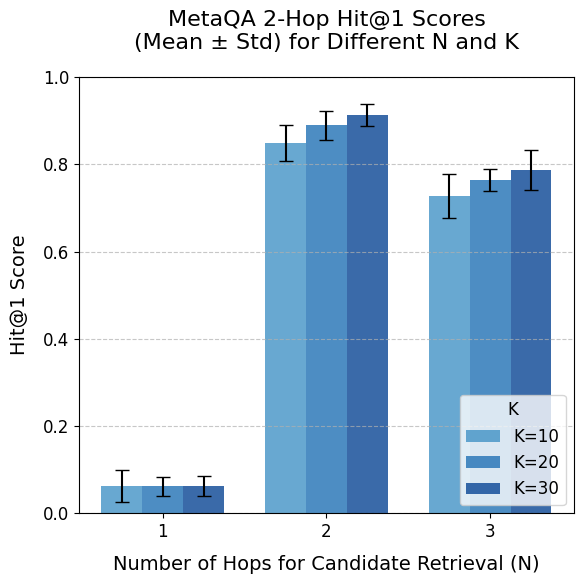
## Bar Chart: MetaQA 2-Hop Hit@1 Scores (Mean ± Std) for Different N and K
### Overview
The chart compares the performance of a retrieval system (MetaQA) across three configurations of candidate retrieval hops (N=1, 2, 3) and three values of K (10, 20, 30). Performance is measured as Hit@1 scores (mean ± standard deviation), with higher scores indicating better performance.
### Components/Axes
- **X-axis**: "Number of Hops for Candidate Retrieval (N)" with categories: 1, 2, 3.
- **Y-axis**: "Hit@1 Score" scaled from 0.0 to 1.0.
- **Legend**: Located in the bottom-right corner, mapping colors to K values:
- Light blue: K=10
- Medium blue: K=20
- Dark blue: K=30
- **Error bars**: Vertical lines on top of each bar representing standard deviation.
### Detailed Analysis
1. **N=1 (Single Hop)**:
- All K values (10, 20, 30) show nearly identical performance (~0.05–0.07).
- Error bars are small (~±0.01), indicating low variability.
2. **N=2 (Two Hops)**:
- Scores increase with K:
- K=10: ~0.85 (±0.02)
- K=20: ~0.88 (±0.01)
- K=30: ~0.90 (±0.01)
- Highest performance across all configurations.
3. **N=3 (Three Hops)**:
- Scores decrease slightly compared to N=2 but remain higher than N=1:
- K=10: ~0.75 (±0.02)
- K=20: ~0.78 (±0.01)
- K=30: ~0.80 (±0.01)
- Error bars remain consistent with N=2.
### Key Observations
- **K dependency**: Higher K values consistently improve performance across all N.
- **Non-linear N effect**: N=2 outperforms both N=1 and N=3, suggesting diminishing returns or overfitting at N=3.
- **Error consistency**: Standard deviations are smallest for N=2 and K=30, indicating stable results.
### Interpretation
The data demonstrates that increasing K (number of candidates considered) improves retrieval accuracy, but the number of hops (N) has a non-linear relationship with performance. N=2 achieves the optimal balance, likely because it expands candidate diversity without introducing excessive noise. N=1’s low scores suggest insufficient candidate exploration, while N=3’s decline may reflect redundant or conflicting information from additional hops. The minimal error bars across all configurations indicate reliable measurements. This implies that tuning K and N is critical for optimizing 2-hop retrieval systems, with N=2 and K≥20 being the most effective configuration.