## Audio Processing Diagram: Loudness Normalization and Time Alignment
### Overview
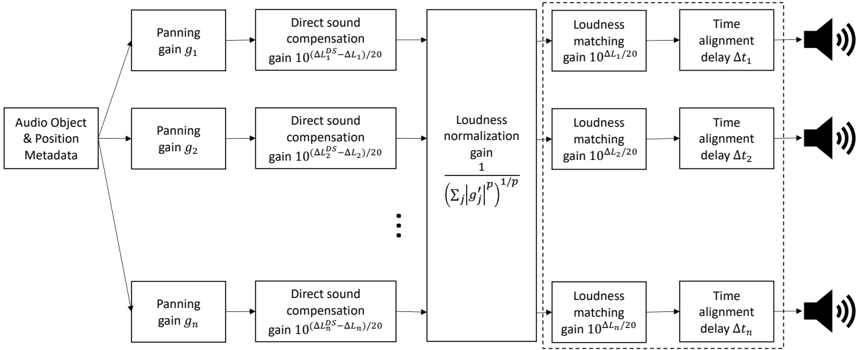
The image is a block diagram illustrating an audio processing pipeline. It shows how an audio object's metadata is used to generate multiple audio channels, each with panning, direct sound compensation, loudness matching, and time alignment. The diagram includes a loudness normalization step that affects all channels.
### Components/Axes
The diagram consists of the following components:
1. **Audio Object & Position Metadata:** This is the input to the system.
2. **Panning gain g1, g2, ..., gn:** These blocks represent the panning gain applied to each channel.
3. **Direct sound compensation gain 10^(ΔL_i^DS - ΔL_i)/20:** These blocks represent the direct sound compensation applied to each channel.
4. **Loudness normalization gain 1 / (Σ_j |g'_j|^p)^(1/p):** This block represents the loudness normalization applied to all channels.
5. **Loudness matching gain 10^(ΔL_i/20):** These blocks represent the loudness matching applied to each channel.
6. **Time alignment delay Δt1, Δt2, ..., Δtn:** These blocks represent the time alignment delay applied to each channel.
7. **Speakers:** Represented by speaker icons at the end of each channel.
### Detailed Analysis or ### Content Details
The diagram shows 'n' parallel processing paths, each representing an audio channel.
* **Input:** The process begins with "Audio Object & Position Metadata".
* **Panning:** This metadata is split into 'n' paths. Each path starts with a "Panning gain" block, labeled as g1, g2, ..., gn.
* **Direct Sound Compensation:** Following the panning gain, each path has a "Direct sound compensation" block, with gains represented as 10^(ΔL_i^DS - ΔL_i)/20, where 'i' ranges from 1 to 'n'.
* **Loudness Normalization:** All 'n' paths converge into a single "Loudness normalization" block. The gain for this block is given by the formula: 1 / (Σ_j |g'_j|^p)^(1/p).
* **Loudness Matching:** After loudness normalization, the signal is split again into 'n' paths. Each path has a "Loudness matching" block with gains represented as 10^(ΔL_i/20), where 'i' ranges from 1 to 'n'.
* **Time Alignment:** Each path ends with a "Time alignment delay" block, labeled as Δt1, Δt2, ..., Δtn.
* **Output:** The output of each path is represented by a speaker icon.
### Key Observations
* The diagram illustrates a multi-channel audio processing system.
* The loudness normalization step is applied to all channels collectively.
* Each channel has individual panning, direct sound compensation, loudness matching, and time alignment.
### Interpretation
The diagram represents a system for spatial audio rendering. The "Audio Object & Position Metadata" likely contains information about the audio source and its desired location in a 3D space. The processing pipeline then generates individual audio channels for each speaker, taking into account panning, distance, and loudness. The loudness normalization step ensures that the overall loudness of the audio scene is consistent, while the time alignment step compensates for differences in arrival times due to speaker placement. The system aims to create a realistic and immersive audio experience for the listener.