## Scatter Plot: Security Studies - Confidence vs. Target Length
### Overview
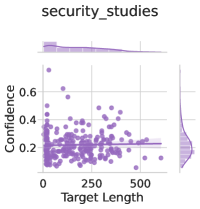
The image presents a scatter plot titled "security_studies" showing the relationship between "Confidence" and "Target Length." The plot includes marginal distributions (histograms) for both variables along the top and right sides. The scatter plot shows individual data points, and a regression line is fitted to the data.
### Components/Axes
* **Title:** security_studies
* **X-axis:** Target Length
* Scale: 0 to 500, with markers at approximately 0, 250, and 500.
* **Y-axis:** Confidence
* Scale: 0 to 0.6, with markers at 0, 0.2, 0.4, and 0.6.
* **Data Points:** Each point represents a data entry, colored in a light purple.
* **Marginal Distributions:**
* Top: Histogram of Target Length.
* Right: Histogram of Confidence.
* **Regression Line:** A light purple line showing the linear trend of the data.
### Detailed Analysis
* **Target Length:**
* The majority of data points are concentrated between 0 and 250.
* The histogram on top shows a right-skewed distribution, indicating that most target lengths are relatively small.
* **Confidence:**
* Most confidence values are between 0 and 0.4.
* The histogram on the right shows a distribution concentrated towards lower confidence values.
* **Scatter Plot:**
* The scatter plot shows a weak positive correlation between Target Length and Confidence.
* The regression line is nearly horizontal, suggesting that Target Length has little impact on Confidence.
* There are some outliers with high confidence values at low target lengths.
### Key Observations
* The data is concentrated in the lower-left quadrant, indicating that most data points have low target lengths and low confidence.
* The regression line suggests a very weak positive correlation between Target Length and Confidence.
* The marginal distributions show that both Target Length and Confidence are skewed towards lower values.
### Interpretation
The scatter plot suggests that there is little to no relationship between Target Length and Confidence in the "security_studies" dataset. The concentration of data points at low target lengths and low confidence values indicates that most entries in the dataset have these characteristics. The weak positive correlation suggested by the regression line is likely not statistically significant. The marginal distributions confirm that both Target Length and Confidence are skewed towards lower values, which may be important for further analysis or modeling.