\n
## Diagram: Spatial Audio Setup
### Overview
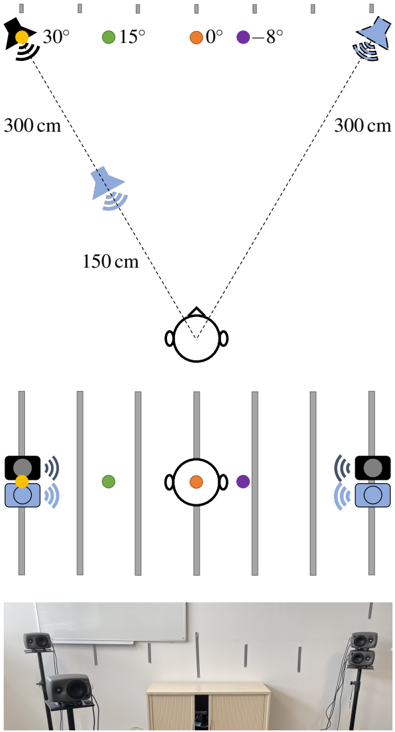
This diagram illustrates a spatial audio setup with four speakers positioned around a central listening position. It depicts the speaker angles, distances, and a photograph of the physical setup. The diagram is divided into three main sections: a top-down view with angles and distances, a simplified representation of speaker positions, and a photograph of the actual setup.
### Components/Axes
* **Speakers:** Represented by black squares with a speaker icon.
* **Listening Position:** Represented by a head silhouette with concentric circles indicating sound reception.
* **Angles:** 30°, 15°, 0°, -8° (associated with each speaker).
* **Distances:** 300 cm (distance from two speakers to the listening position), 150 cm (distance from the central speaker to the listening position).
* **Color Coding:**
* Black: 30° speaker
* Green: 15° speaker
* Orange: 0° speaker
* Purple: -8° speaker
* **Vertical Lines:** Representing the physical placement of the speakers.
### Detailed Analysis / Content Details
The diagram shows a top-down view of the speaker arrangement.
* **Speaker 1 (Black, 30°):** Located on the top-left, emitting sound waves at a 30-degree angle. Distance to listening position is 300 cm.
* **Speaker 2 (Green, 15°):** Located on the top-center, emitting sound waves at a 15-degree angle. Distance to listening position is 300 cm.
* **Speaker 3 (Orange, 0°):** Located in the center, emitting sound waves at a 0-degree angle. Distance to listening position is 150 cm.
* **Speaker 4 (Purple, -8°):** Located on the top-right, emitting sound waves at a -8-degree angle. Distance to listening position is 300 cm.
The simplified representation below the top-down view shows the speakers as colored circles corresponding to their angles, positioned along vertical lines. The listening position is represented by a head silhouette with concentric circles.
The bottom section is a photograph of the physical setup. It shows four speakers on stands, positioned in a room. A cabinet is visible in the center of the room.
### Key Observations
* The speakers are not equidistant from the listening position. The central speaker is closer (150 cm) than the other three (300 cm).
* The angles suggest a wide soundstage, covering from -8° to 30°.
* The color coding is consistent throughout the diagram, linking speaker position, angle, and representation.
### Interpretation
This diagram details the setup for a spatial audio experiment or demonstration. The varying distances and angles of the speakers are likely intended to create a specific auditory experience for the listener. The central speaker at a closer distance may serve as a primary sound source, while the surrounding speakers provide spatial cues. The photograph confirms the physical arrangement matches the schematic representation. The setup appears to be designed to create a surround sound experience, with the angles and distances carefully chosen to optimize sound localization and immersion. The use of angles suggests an attempt to create a realistic sound field, potentially for virtual reality or audio testing purposes.