# Technical Document Extraction: LLM Response Generation Flow
## 1. Document Overview
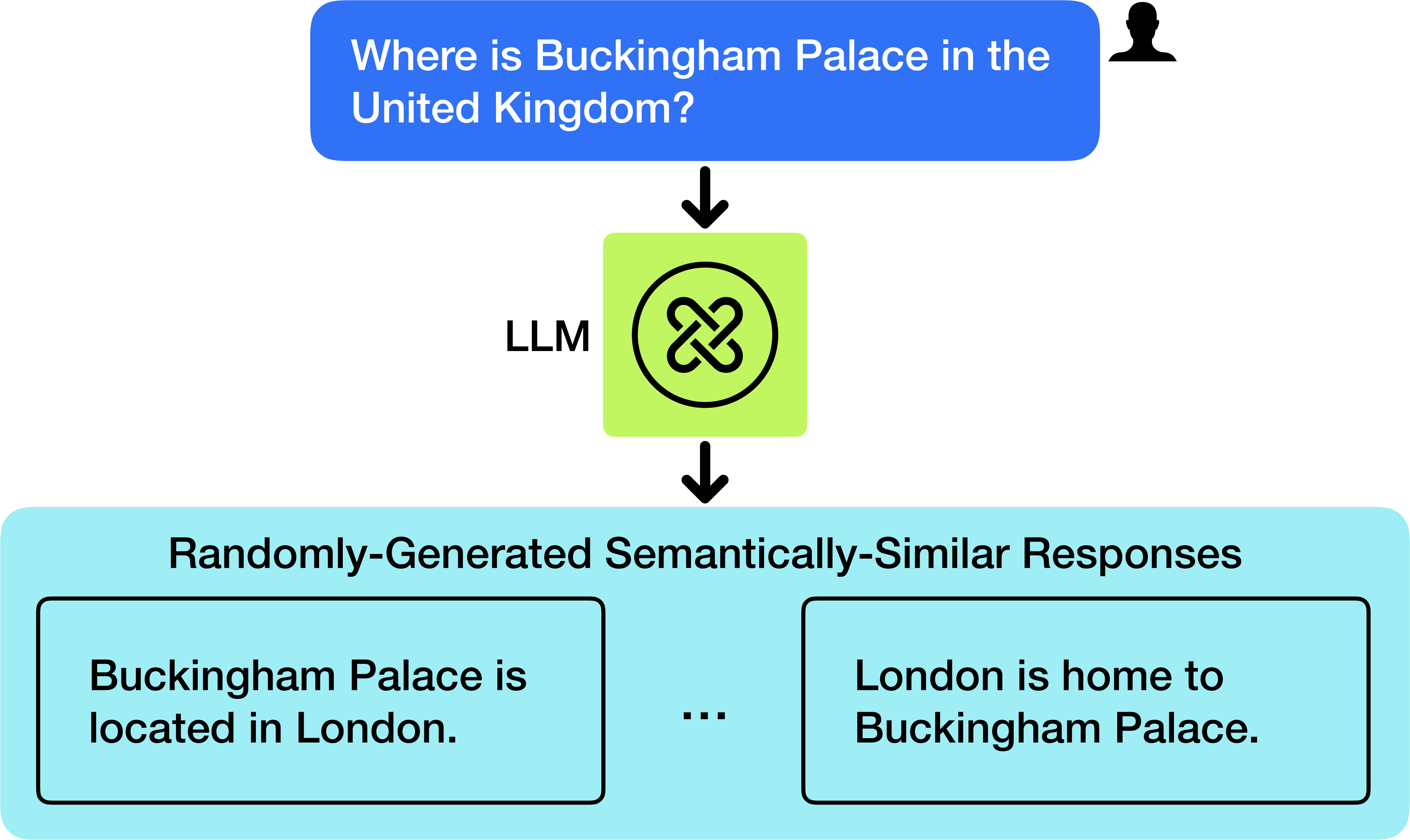
This image is a technical flow diagram illustrating the process of a Large Language Model (LLM) generating multiple semantically similar responses to a specific user query. The diagram uses a top-down vertical flow with color-coded components to distinguish between input, processing, and output stages.
---
## 2. Component Isolation and Transcription
### Region 1: Input Header (Top)
* **Visual Element:** A blue rounded rectangular speech bubble. To the right of the bubble is a black silhouette icon of a person's head and shoulders, signifying a user.
* **Text Content:** "Where is Buckingham Palace in the United Kingdom?"
* **Function:** Represents the initial user prompt/query.
### Region 2: Processing Layer (Middle)
* **Visual Element:** A lime-green square containing a black circular icon with a stylized "X" or knot-like symbol.
* **Label (Left of icon):** "LLM"
* **Function:** Represents the Large Language Model processing the input.
* **Connectors:** A black downward-pointing arrow connects the Input Header to the LLM; another black downward-pointing arrow connects the LLM to the Output Footer.
### Region 3: Output Footer (Bottom)
* **Visual Element:** A large light-cyan rounded rectangle containing a header and two sub-boxes.
* **Section Header:** "Randomly-Generated Semantically-Similar Responses"
* **Sub-Box A (Left):** A light-cyan box with a black border containing the text: "Buckingham Palace is located in London."
* **Separator (Center):** An ellipsis "..." indicating that there are other potential variations not explicitly shown.
* **Sub-Box B (Right):** A light-cyan box with a black border containing the text: "London is home to Buckingham Palace."
* **Function:** Demonstrates the variability of LLM outputs where different phrasing conveys the same factual information.
---
## 3. Logic and Flow Analysis
1. **Input Phase:** The process begins with a natural language question regarding the location of a landmark.
2. **Transformation Phase:** The query is passed into the **LLM**. The central placement of the LLM indicates it is the engine responsible for interpreting the query and generating data.
3. **Output Phase:** The LLM produces a set of results categorized as "Randomly-Generated Semantically-Similar Responses."
* **Trend/Pattern:** The diagram highlights that for one single input, the model can produce multiple outputs that are factually identical but syntactically different.
* **Response 1:** Focuses on the Palace as the subject ("Buckingham Palace is...").
* **Response 2:** Focuses on the city as the subject ("London is...").
---
## 4. Summary of Textual Data
| Component | Text Content |
| :--- | :--- |
| **User Query** | Where is Buckingham Palace in the United Kingdom? |
| **Processor** | LLM |
| **Output Category** | Randomly-Generated Semantically-Similar Responses |
| **Response Variation 1** | Buckingham Palace is located in London. |
| **Response Variation 2** | London is home to Buckingham Palace. |
| **Continuity Marker** | ... (Ellipsis) |