## System Diagram: EvolverR Workflow
### Overview
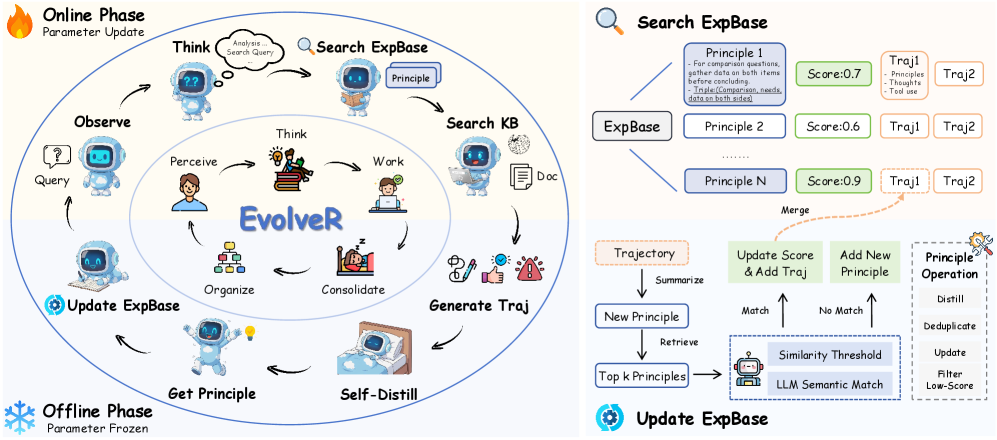
The image presents a system diagram illustrating the workflow of "EvolverR," a process divided into "Online Phase" and "Offline Phase." The diagram details the steps involved in both phases, including data processing, principle generation, and knowledge base updates. The right side of the diagram focuses on the "Search ExpBase" process, detailing how principles are scored, merged, and used to update the knowledge base.
### Components/Axes
**Left Side (EvolverR Workflow):**
* **Online Phase:** Located at the top-left, indicated by a flame icon and labeled "Parameter Update."
* **Offline Phase:** Located at the bottom-left, indicated by a snowflake icon and labeled "Parameter Frozen."
* **EvolverR:** Central element of the diagram, representing the core process.
* **Workflow Steps:**
* Observe (Query)
* Think (Analysis... Search Query)
* Search ExpBase (Principle)
* Search KB (Doc)
* Work
* Generate Traj
* Self-Distill
* Get Principle
* Update ExpBase
* Organize
* Consolidate
* Perceive
**Right Side (Search ExpBase):**
* **Search ExpBase:** Title at the top-right, indicated by a magnifying glass icon.
* **Principles:** Principle 1, Principle 2, Principle N.
* Principle 1: "- For comparison questions, gather data on both items before concluding. - Triple: (Comparison, needs, data on both sides)"
* **Scores:** Score:0.7 (for Principle 1), Score:0.6 (for Principle 2), Score:0.9 (for Principle N).
* **Trajectories:** Traj1, Traj2 associated with each principle.
* **Merge:** Indicates the merging of principles.
* **Trajectory:** A box labeled "Trajectory" with a downward arrow to "Summarize".
* **New Principle:** A box labeled "New Principle" with a downward arrow to "Retrieve".
* **Top k Principles:** A box labeled "Top k Principles" with an arrow leading to a dashed box labeled "Similarity Threshold" and "LLM Semantic Match" containing a robot icon.
* **Update Score & Add Traj:** A green box labeled "Update Score & Add Traj" with an upward arrow from the "Similarity Threshold" box labeled "Match".
* **Add New Principle:** A green box labeled "Add New Principle" with an upward arrow from the "Similarity Threshold" box labeled "No Match".
* **Update ExpBase:** A blue gear icon with the label "Update ExpBase".
* **Principle Operation:** A dashed box labeled "Principle Operation" containing the following operations: Distill, Deduplicate, Update, Filter Low-Score.
### Detailed Analysis or ### Content Details
**Left Side (EvolverR Workflow):**
* The workflow starts with "Observe" and "Query," indicating data input.
* "Think" involves analysis and search queries.
* "Search ExpBase" and "Search KB" represent knowledge retrieval.
* "Work," "Generate Traj," "Self-Distill," "Get Principle," "Organize," "Consolidate," and "Perceive" represent the core processing steps.
* "Update ExpBase" closes the loop, updating the knowledge base.
**Right Side (Search ExpBase):**
* Principles are scored (0.7, 0.6, 0.9) and associated with trajectories (Traj1, Traj2).
* Principles are merged, and new principles are added based on similarity thresholds.
* The "LLM Semantic Match" component suggests the use of a Large Language Model for semantic matching.
* Principle operations include distillation, deduplication, updating, and filtering low-score principles.
### Key Observations
* The diagram illustrates a cyclical process with distinct online and offline phases.
* The "Search ExpBase" process involves scoring, merging, and updating principles.
* The use of "LLM Semantic Match" indicates the application of advanced language models.
* The diagram highlights the importance of knowledge base updates and principle refinement.
### Interpretation
The diagram depicts a sophisticated system for knowledge evolution and refinement. "EvolverR" continuously updates its knowledge base through online and offline phases, incorporating new information and refining existing principles. The "Search ExpBase" process is crucial for identifying and integrating relevant principles, leveraging semantic matching to ensure accuracy and relevance. The system's ability to distill, deduplicate, and filter principles suggests a focus on maintaining a high-quality knowledge base. The cyclical nature of the workflow indicates a continuous learning and improvement process.