## Diagram: Evolver System Architecture
### Overview
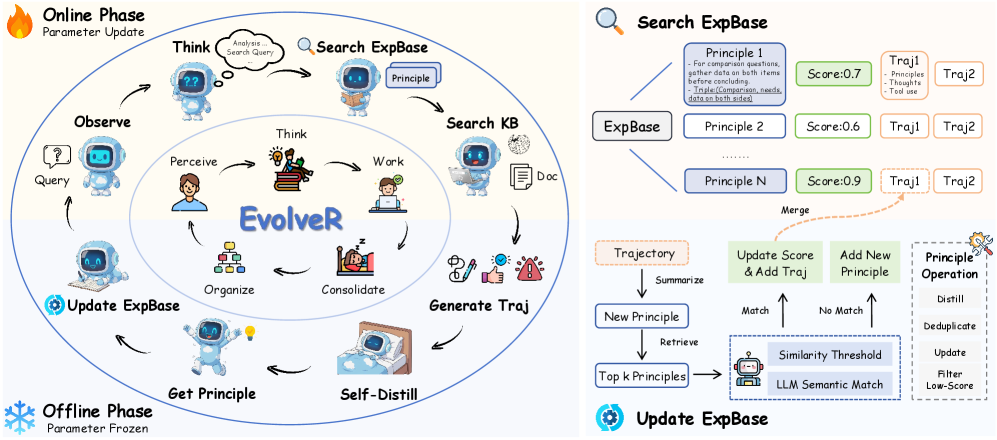
The image depicts a diagram illustrating the architecture and workflow of a system called "Evolver". It showcases a cyclical process involving online and offline phases, with components for observation, thinking, searching knowledge bases, generating trajectories, and updating an experience base (ExpBase). The diagram uses icons representing human interaction, computer processing, and data flow.
### Components/Axes
The diagram is divided into two main phases: "Online Phase" (top, enclosed in a yellow rounded rectangle) and "Offline Phase" (bottom, enclosed in a blue rounded rectangle). Key components include:
* **Evolver:** Central element, a stylized robot icon.
* **ExpBase:** A database represented as a stack of documents.
* **Search ExpBase:** A magnifying glass over the ExpBase.
* **Search KB:** A magnifying glass over a document icon labeled "Doc".
* **Trajectory:** Represented by a curved line with labels "Traj1" and "Traj2".
* **Principle Operation:** A set of operations including Distill, Deduplicate, Update, and Filter Low-Score.
* **Update ExpBase:** A circular arrow with a gear icon.
* **Online Phase:** Includes "Observe", "Think", "Search ExpBase", "Generate Traj", and "Self-Distill" steps.
* **Offline Phase:** Includes "Get Principle" and "Update ExpBase" steps.
* **LLM Semantic Match:** A box indicating a similarity threshold.
### Detailed Analysis or Content Details
The diagram illustrates a cyclical process.
**Online Phase:**
1. **Observe:** A user interacts with a system via a query (represented by a question mark in a speech bubble).
2. **Think:** The system "thinks" (represented by a head with question marks).
3. **Search ExpBase:** The system searches the ExpBase for relevant principles. The ExpBase contains "Principle 1", "Principle 2", and "Principle N".
* Principle 1 has a score of 0.7 and associated trajectories Traj1 and Traj2. The text associated with Principle 1 states: "For comparison questions, gather data on both items before concluding. Tasks: Comparison, needs data on both sides."
* Principle 2 has a score of 0.6 and associated trajectories Traj1 and Traj2.
* Principle N has a score of 0.9 and associated trajectories Traj1 and Traj2.
4. **Generate Traj:** Trajectories are generated based on the principles.
5. **Self-Distill:** The system self-distills.
**Offline Phase:**
1. **Get Principle:** The system retrieves principles.
2. **Update ExpBase:** The ExpBase is updated.
**Trajectory Processing:**
* Trajectories are summarized.
* New principles are retrieved.
* Top K principles are selected.
* An LLM Semantic Match is performed against a similarity threshold.
* If there is a match, the score is updated and the trajectory is added. If there is no match, a new principle is added.
**Principle Operation:**
* Distill
* Deduplicate
* Update
* Filter Low-Score
### Key Observations
* The system operates in a continuous loop between online and offline phases.
* The ExpBase is central to the system's knowledge and learning.
* Trajectories play a key role in connecting principles to actions.
* The LLM Semantic Match is used to determine the relevance of new information.
* The system incorporates a mechanism for filtering low-score principles.
* The diagram emphasizes the iterative nature of the process, with continuous observation, thinking, and updating of the ExpBase.
### Interpretation
The diagram illustrates a reinforcement learning or continual learning system, where an agent ("Evolver") learns from experience by observing, thinking, searching a knowledge base, generating trajectories, and updating its experience base. The "Online Phase" represents the agent's interaction with the environment, while the "Offline Phase" represents the agent's internal processing and learning. The use of an LLM for semantic matching suggests that the system leverages natural language processing to understand and reason about information. The cyclical nature of the process indicates that the system is designed to continuously improve its performance over time. The scoring system associated with the principles suggests a mechanism for prioritizing and weighting different pieces of knowledge. The "Principle Operation" steps indicate a process for maintaining the quality and consistency of the ExpBase. The diagram suggests a sophisticated system capable of adapting to new information and improving its decision-making abilities.