## Diagram: EvolveR System Architecture
### Overview
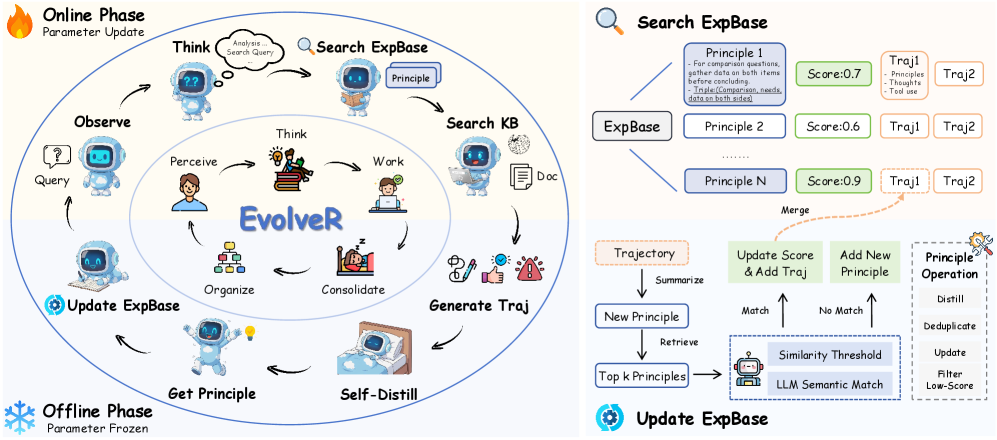
The diagram illustrates a two-phase system (Online and Offline) for knowledge evolution and principle management. It features robotic agents, human interactions, and knowledge base (KB) operations, with cyclical processes for updating principles and trajectories.
### Components/Axes
#### Online Phase (Parameter Update)
- **Core Loop**:
- **Observe**: Robot with question mark → "Query"
- **Think**: Person with lightbulb → "Analyze... Search Query"
- **Search ExpBase**: Robot with magnifying glass → "Principle"
- **Search KB**: Robot with document → "Doc"
- **Work**: Person with laptop → "Work"
- **Organize**: Color-coded blocks → "Organize"
- **Consolidate**: Person sleeping → "Consolidate"
- **Generate Traj**: Pencil, checkmark, warning sign → "Generate Traj"
- **Self-Distill**: Robot in bed → "Self-Distill"
- **Get Principle**: Robot with lightbulb → "Get Principle"
- **Update ExpBase**: Gear icon → "Update ExpBase"
- **Key Elements**:
- **ExpBase**: Knowledge base with principles (Principle 1, 2, ..., N) and trajectories (Traj1, Traj2).
- **Principle Operations**: Distill, Deduplicate, Update, Filter (low-score).
- **LLM Semantic Match**: Threshold-based similarity checks.
#### Offline Phase (Parameter Frozen)
- **Update ExpBase**:
- **Trajectory**: Summarize → New Principle → Retrieve Top k Principles
- **Similarity Threshold**: Filters via LLM Semantic Match.
- **Principle Operation**:
- **Distill**: Extract core ideas.
- **Deduplicate**: Remove redundancies.
- **Update**: Revise principles.
- **Filter**: Remove low-score principles.
### Detailed Analysis
1. **Online Phase Flow**:
- Starts with observation (robot querying) → thinking (human analysis) → searching external/existing knowledge bases → work → organization → consolidation → trajectory generation → self-distillation → principle retrieval → knowledge base update.
- Arrows form a closed loop, emphasizing continuous iteration.
2. **Offline Phase Flow**:
- Focuses on refining trajectories and principles without parameter updates.
- Trajectories are summarized, matched against existing principles, and updated if no match.
- Principle operations ensure quality (distill, deduplicate) and relevance (filter low-scores).
3. **ExpBase Structure**:
- Contains principles (e.g., Principle 1: "For comparison questions...") with scores (0.7, 0.6, 0.9).
- Trajectories (Traj1, Traj2) link principles to actions (e.g., "Principles → Thoughts → Tool use").
### Key Observations
- **Cyclical Nature**: The Online Phase emphasizes real-time adaptation, while the Offline Phase focuses on static refinement.
- **Knowledge Integration**: ExpBase acts as a central hub, merging new principles and trajectories from both phases.
- **Human-Robot Collaboration**: Humans drive analysis and work, while robots handle querying, searching, and updates.
### Interpretation
The EvolveR system combines human intuition (e.g., "Think" phase) with automated knowledge management. The Online Phase enables dynamic learning (parameter updates), while the Offline Phase ensures stability (parameter frozen) through rigorous principle curation. The ExpBase’s role as a mediator between phases highlights its importance in maintaining coherence. Trajectories serve as actionable pathways, validated by LLM semantic matching to avoid redundancy. This architecture suggests a hybrid AI-human system for adaptive knowledge evolution, balancing exploration (Online) and exploitation (Offline).