## Diagram: User Request to LLM Assistant Dispatch
### Overview
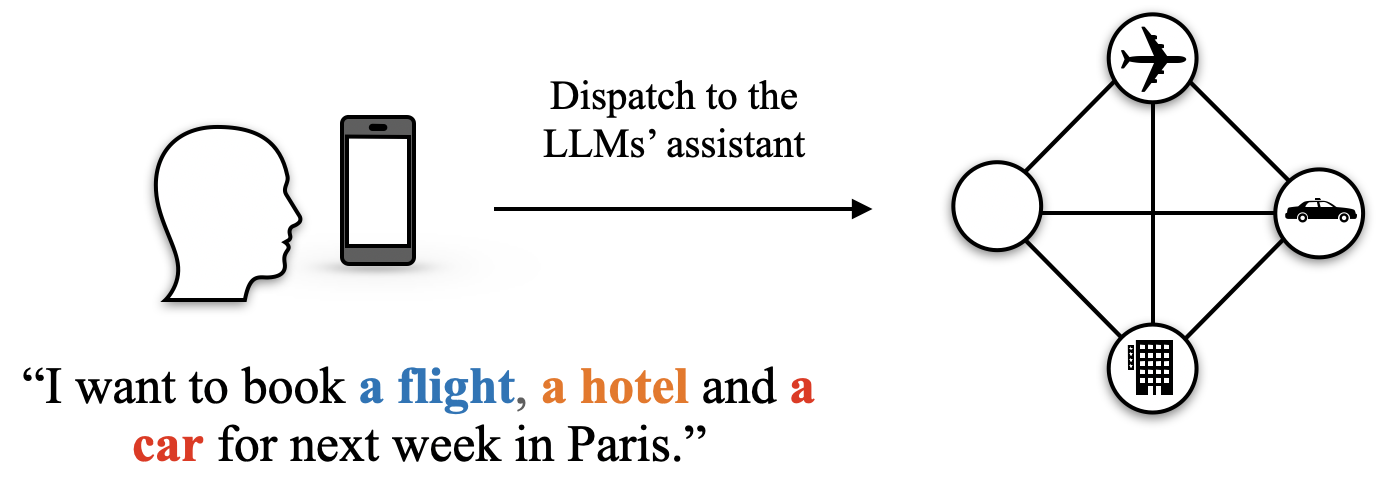
This diagram illustrates a process flow, starting with a user's natural language request for travel-related services, which is then processed and dispatched to an LLM's assistant. The assistant appears to represent a system that can handle multiple, interconnected tasks.
### Components/Axes
The diagram consists of three main sections:
1. **User Input:**
* A silhouette of a human head, indicating a user.
* A smartphone icon, representing the device used for input.
* A text box containing the user's request: "I want to book a **flight**, a **hotel** and a **car** for next week in Paris."
* The words "flight" and "hotel" are highlighted in blue and orange, respectively.
* The word "car" is highlighted in red.
2. **Process/Dispatch:**
* A horizontal arrow pointing from the user input section to the right, signifying the direction of the process.
* Text above the arrow reads: "Dispatch to the LLMs’ assistant".
3. **LLM Assistant Representation:**
* A graph-like structure composed of four interconnected nodes (circles).
* Each node contains an icon representing a service:
* **Top Node:** An airplane icon, representing flights.
* **Right Node:** A car icon, representing car rentals.
* **Bottom Node:** A building icon, representing hotels.
* **Left Node:** An empty circle, which may represent a general task or an unassigned service.
* Lines connect the nodes, indicating potential relationships or dependencies between the services. Specifically:
* The airplane node is connected to the empty node and the car node.
* The car node is connected to the airplane node, the empty node, and the building node.
* The building node is connected to the car node and the empty node.
* The empty node is connected to the airplane node, the car node, and the building node.
* There is also a central horizontal line connecting the left and right nodes, and a central vertical line connecting the top and bottom nodes, forming a grid-like structure within the diamond shape of the connections.
### Detailed Analysis or Content Details
The diagram visually represents the transformation of a user's spoken or typed request into a structured format that can be handled by an AI assistant.
* The user's request is a multi-intent query, asking for three distinct services: flights, hotels, and cars, with specific temporal (next week) and locational (Paris) constraints.
* The "Dispatch to the LLMs’ assistant" text indicates that the raw request is processed and then routed to a more sophisticated system.
* The graph structure on the right suggests that the LLM's assistant can manage these services as distinct but potentially related entities. The presence of an empty node might signify a placeholder for a general task, a coordination node, or a service that was not explicitly requested but is implicitly required (e.g., booking confirmation). The interconnections suggest that the assistant can manage dependencies or parallel processing of these requests.
### Key Observations
* The diagram highlights the ability of an LLM assistant to parse complex, multi-part natural language requests.
* The visual representation of the LLM assistant as a connected graph implies a modular or service-oriented architecture for handling different travel components.
* The distinct icons within the nodes clearly categorize the types of services being managed.
### Interpretation
This diagram demonstrates a conceptual workflow for how a large language model (LLM) assistant might process a user's travel booking request. The initial natural language input is parsed, identifying key entities and intents (flight, hotel, car, location, time). This parsed information is then "dispatched" to the LLM's assistant, which is depicted as a network of interconnected services.
The interconnected nodes suggest that the assistant can manage these services in a coordinated manner. For instance, booking a flight might influence the availability or pricing of hotels, or vice-versa. The empty node could represent a central orchestrator or a generic task that needs to be fulfilled, such as confirming all bookings or handling payment. The visual representation implies that the LLM assistant is not just a simple command interpreter but a system capable of understanding and managing complex, multi-faceted requests by breaking them down into constituent services and their relationships. This is a fundamental step in building sophisticated AI agents that can perform real-world tasks.