## Diagram: User Request to Multi-Service LLM Assistant Flow
### Overview
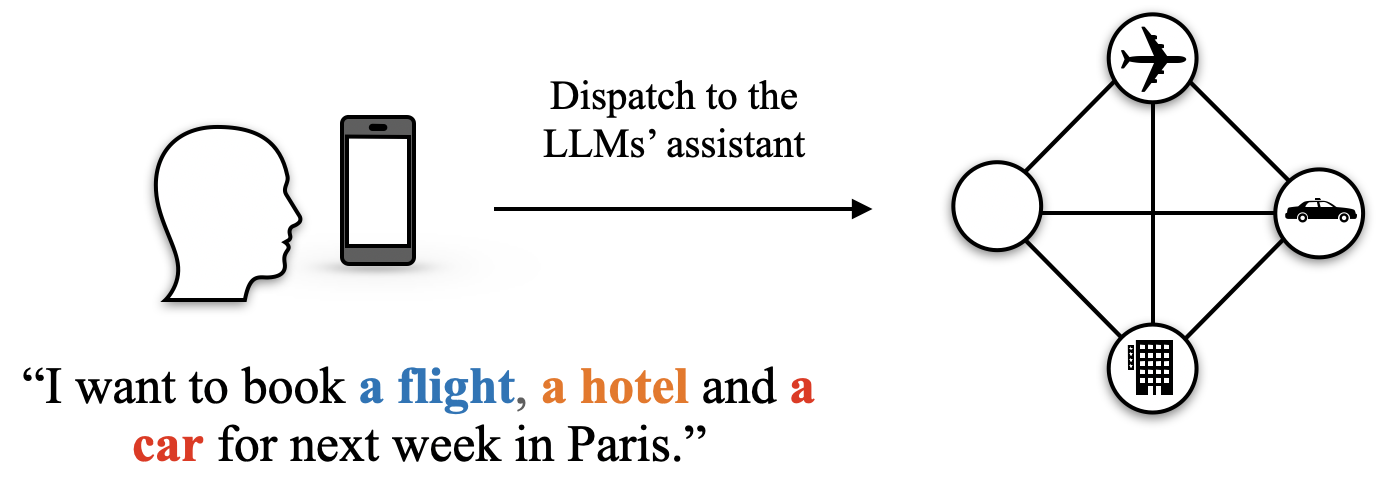
The image is a conceptual diagram illustrating the process of a user making a complex, multi-service travel booking request through a smartphone, which is then dispatched to a Large Language Model (LLM) based assistant. The assistant is depicted as a central node connected to various service providers (flight, hotel, car rental). The diagram emphasizes the assistant's role in interpreting and coordinating a natural language request into actionable tasks across different domains.
### Components/Axes
The diagram is composed of three main sections arranged horizontally from left to right:
1. **User & Interface (Left Section):**
* **Icon:** A simple line-drawing profile of a human head facing right.
* **Icon:** A smartphone icon positioned to the right of the head.
* **Text (Below Icons):** A user's spoken or typed request: `"I want to book a flight, a hotel and a car for next week in Paris."`
* **Text Formatting:** The words "a flight" are in **blue**, "a hotel" is in **orange**, and "a car" is in **red**. The rest of the text is in black.
2. **Dispatch Process (Center Section):**
* **Arrow:** A solid black arrow points from the smartphone/user area to the right.
* **Text (Above Arrow):** The label for the arrow: `Dispatch to the LLMs' assistant`.
3. **Service Network (Right Section):**
* **Structure:** A diamond-shaped network graph with four circular nodes connected by lines.
* **Node 1 (Top):** Contains an **airplane icon** (representing flight booking services).
* **Node 2 (Right):** Contains a **car icon** (representing car rental services).
* **Node 3 (Bottom):** Contains a **building/hotel icon** (representing hotel booking services).
* **Node 4 (Left):** A **blank, empty circle**. This likely represents the central LLM assistant or orchestrator node.
* **Connections:** All four nodes are interconnected with straight lines, forming a complete graph where each node is directly connected to every other node.
### Detailed Analysis
* **Flow Direction:** The process flows unidirectionally from left to right: User -> Smartphone Interface -> Dispatch Arrow -> LLM Assistant Network.
* **User Request Specifics:** The request is for three distinct services (flight, hotel, car) for a specific timeframe ("next week") and location ("Paris"). The color-coding visually isolates and highlights these three key service components within the natural language sentence.
* **Network Topology:** The service network is a fully connected mesh (a complete graph K₄). This implies that the central assistant (blank node) has direct communication pathways to each service provider (flight, hotel, car), and the service providers may also have pathways to communicate with each other, suggesting potential for integrated booking or data sharing.
* **Spatial Grounding:** The legend (the color-coded text) is embedded directly within the user's quote at the bottom-left of the image. The service icons in the network (top, right, bottom) correspond directly to the color-coded terms in the quote (blue=flight/plane, orange=hotel/building, red=car).
### Key Observations
1. **Abstraction of the Assistant:** The LLM assistant is represented as a blank circle, emphasizing its role as a generic, intelligent processing node rather than a specific branded product.
2. **Implicit Complexity:** The diagram simplifies a complex process. The single "dispatch" arrow encapsulates what would involve speech-to-text, intent recognition, entity extraction (services, date, location), and task planning.
3. **Interconnected Services:** The fully connected network suggests a system architecture where the assistant can not only call upon individual services but may also facilitate coordination between them (e.g., ensuring a hotel check-in date aligns with a flight arrival time).
4. **Focus on Intent:** The design highlights the transformation of an unstructured, human-language command into a structured set of tasks distributed across a service-oriented architecture.
### Interpretation
This diagram serves as a high-level technical illustration of a **multi-domain task-oriented dialogue system**. It demonstrates the core value proposition of an LLM-powered assistant: to act as a unified, natural language interface to a fragmented ecosystem of digital services.
* **What it suggests:** The system is designed to handle compound requests. Instead of the user interacting with three separate apps (airline, hotel, car rental), they make one request to the assistant. The assistant's intelligence lies in parsing the request, identifying the sub-tasks, and orchestrating the necessary API calls or interactions with the respective service backends (represented by the icon nodes).
* **Relationships:** The user is the source of intent. The smartphone is the input channel. The "dispatch" represents the handoff from the client application to the backend AI service. The network graph represents the backend ecosystem where the actual service fulfillment is coordinated.
* **Notable Implication:** The blank node (assistant) is the central hub. Its position in the network (connected to all services) is critical. It implies that the assistant maintains the context of the overall user goal ("a trip to Paris") and manages the state across multiple, potentially independent, service transactions. This is more advanced than a simple command router; it suggests an agent capable of multi-step planning and execution.