## Flowchart: User Request Dispatch to LLM Assistant Services
### Overview
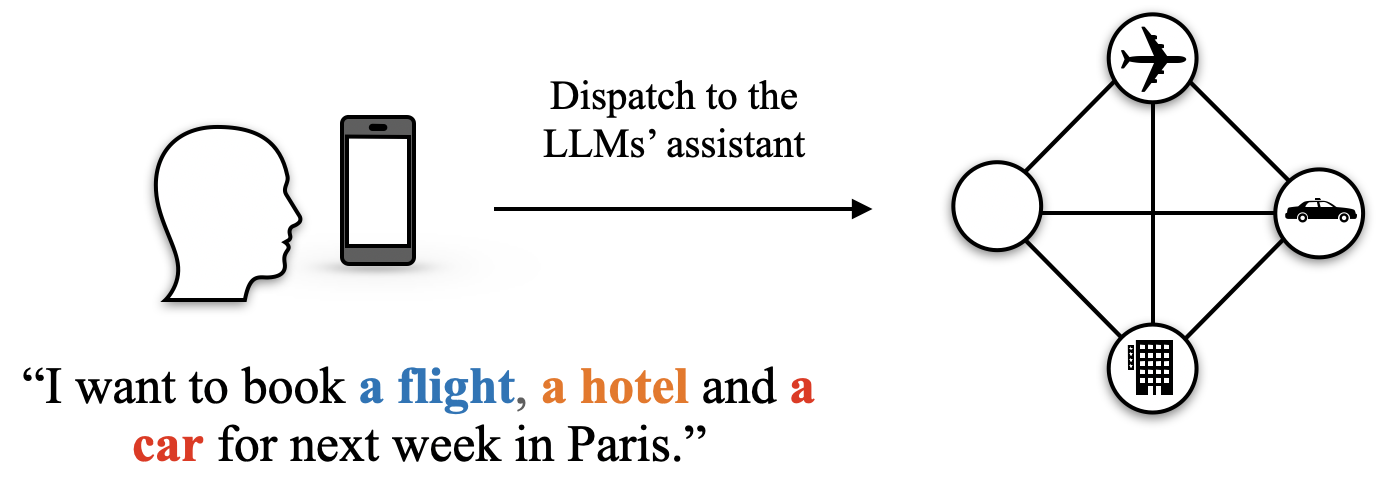
The image depicts a user interface interaction flow where a user's request to book travel services (flight, hotel, car) is processed and dispatched to corresponding service providers via an LLM assistant. The diagram uses color-coded text, icons, and a flowchart structure to represent the workflow.
### Components/Axes
1. **Left Panel**:
- **User Interface**: Silhouette of a human head facing a smartphone.
- **Text Input**: Message on the smartphone screen:
`"I want to book a flight, a hotel and a car for next week in Paris."`
- Color-coded keywords:
- `flight` (blue)
- `hotel` (orange)
- `car` (red)
- **Dispatch Instruction**: Arrow labeled `"Dispatch to the LLMs’ assistant"` pointing right.
2. **Right Panel (Flowchart)**:
- **Structure**: Diamond-shaped flowchart with four interconnected nodes.
- **Nodes**:
- **Top Node**: Airplane icon (flight service).
- **Right Node**: Car icon (car rental service).
- **Bottom Node**: Building icon (hotel service).
- **Left Node**: Blank (unlabeled, possibly a placeholder or error).
- **Connections**: Lines link all nodes, suggesting parallel processing or interdependencies.
### Detailed Analysis
- **Textual Content**:
The user’s request explicitly mentions three services (`flight`, `hotel`, `car`), each highlighted in distinct colors (blue, orange, red). The LLM assistant is tasked with dispatching these requests to the corresponding services. The blank node introduces ambiguity, as it lacks an icon or label, potentially indicating an unassigned or unspecified service.
- **Flowchart Dynamics**:
The diamond structure implies a centralized dispatch mechanism (LLM assistant) routing requests to multiple services simultaneously. The absence of a clear start/end point suggests a continuous or iterative process.
### Key Observations
1. **Color-Coded Prioritization**:
The use of distinct colors for service types (`flight`, `hotel`, `car`) may indicate categorization or prioritization logic within the LLM’s processing pipeline.
2. **Blank Node Anomaly**:
The unlabeled node disrupts the symmetry of the flowchart and raises questions about incomplete service mapping or a design oversight.
3. **Parallel Processing**:
The interconnected nodes suggest the LLM assistant handles multiple service requests concurrently rather than sequentially.
### Interpretation
The diagram illustrates a modular service dispatch system where user intents are parsed and routed to specialized providers. The color-coding of keywords likely aids the LLM in identifying service categories, while the flowchart visualizes the system’s architecture. The blank node highlights a potential gap in service coverage or a need for error handling. This workflow emphasizes automation and scalability, critical for real-time travel booking systems. The absence of explicit time or cost data suggests the focus is on routing efficiency rather than financial or temporal optimization.