TECHNICAL ASSET FINGERPRINT
18af947e9c13bb538e815af3
Click to view fullscreen
Press ESC or click to close
FOUND IN PAPERS
EXPERT: healer-alpha-free VERSION 1
RUNTIME: free/openrouter/healer-alpha
INTEL_VERIFIED
## Directed Graph Diagram: Event and Relationship Network
### Overview
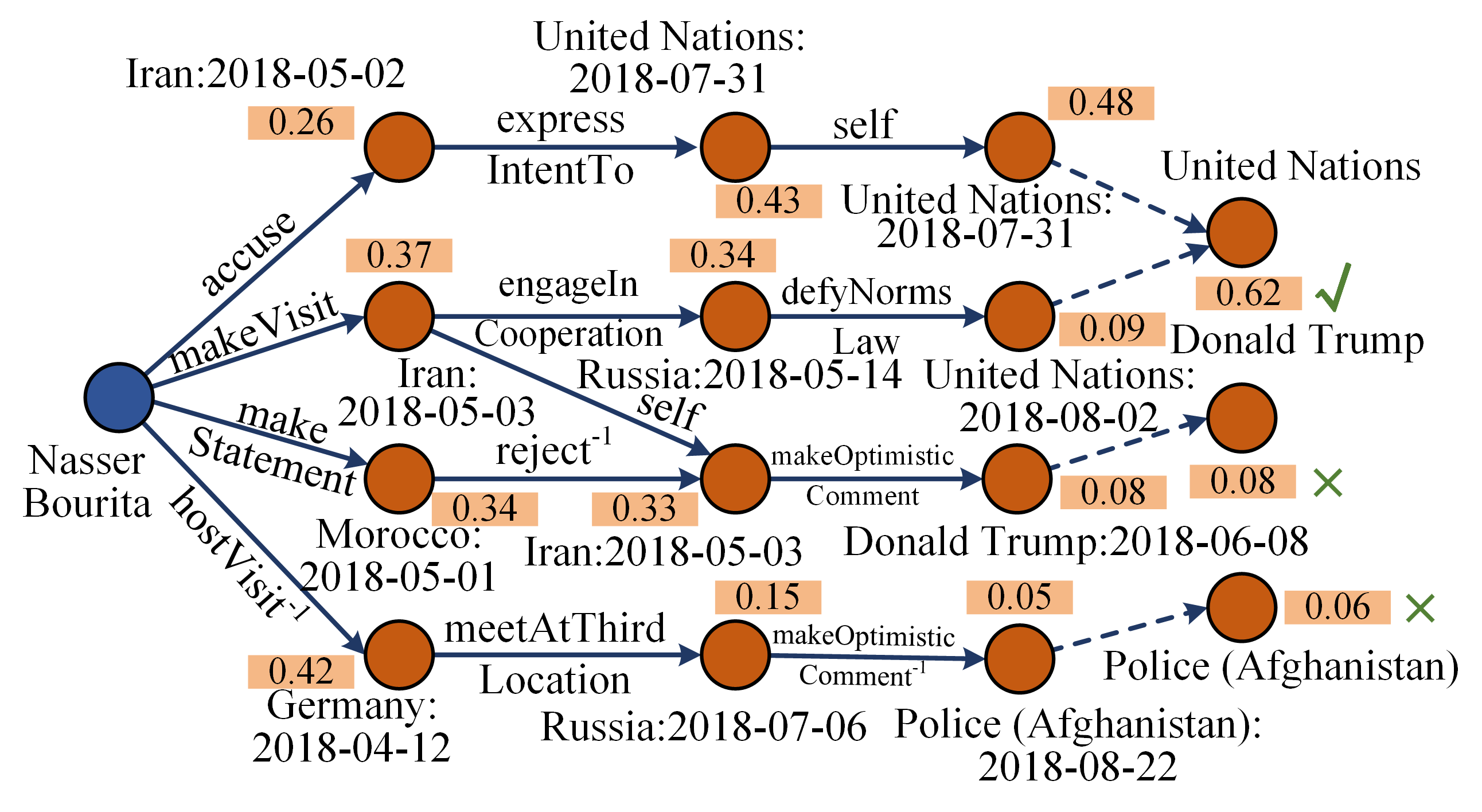
The image displays a directed graph (network diagram) illustrating a series of events, relationships, and actions involving several geopolitical entities and individuals. The graph originates from a central entity and branches into multiple pathways, each annotated with relationship labels, dates, and numerical scores (likely confidence or probability values). The diagram appears to model a sequence of diplomatic or political events, with some paths culminating in validated (✓) or invalidated (×) outcomes.
### Components/Elements
* **Node Types:**
* **Central Node (Blue Circle):** "Nasser Bourita" (Position: Left-center). This is the origin point for all primary relationships.
* **Subsequent Nodes (Orange Circles):** Represent other entities, locations, or events. Each is labeled with an entity name and a date in `YYYY-MM-DD` format.
* **Edge Types:**
* **Solid Blue Arrows:** Indicate direct relationships or actions flowing from one node to another. Each has a text label describing the relationship (e.g., "accuse", "makeVisit").
* **Dashed Blue Arrows:** Appear in the final segments of some paths, leading to terminal nodes.
* **Annotations:**
* **Numerical Scores:** Displayed in small orange boxes on or near edges. These are decimal values between 0.05 and 0.62.
* **Outcome Symbols:** A green checkmark (✓) and red crosses (×) are placed next to some terminal nodes, indicating a binary outcome (e.g., correct/incorrect, validated/invalidated).
* **Superscript Notation:** The labels "reject⁻¹" and "hostVisit⁻¹" include a superscript "-1", which may denote an inverse or reciprocal action.
### Detailed Analysis: Path-by-Path Breakdown
The graph contains four primary pathways originating from "Nasser Bourita".
**Path 1: Topmost Branch**
1. **Start:** Nasser Bourita → `accuse` → **Node:** "Iran:2018-05-02" (Score on edge: 0.26).
2. From "Iran:2018-05-02" → `express IntentTo` → **Node:** "United Nations:2018-07-31" (Score on edge: 0.43).
3. From "United Nations:2018-07-31" → `self` → **Node:** "United Nations:2018-07-31" (Score on edge: 0.48). *Note: This appears to be a self-referential loop or a node representing a subsequent action by the same entity on the same date.*
4. From the second "United Nations:2018-07-31" node → (dashed arrow) → **Terminal Node:** "United Nations" (Score: 0.62). **Outcome:** ✓ (Green Checkmark).
**Path 2: Second Branch**
1. **Start:** Nasser Bourita → `makeVisit` → **Node:** "Iran:2018-05-03" (Score on edge: 0.37).
2. From "Iran:2018-05-03" → `engageIn Cooperation` → **Node:** "Russia:2018-05-14" (Score on edge: 0.34).
3. From "Russia:2018-05-14" → `defyNorms Law` → **Node:** "United Nations:2018-08-02" (Score on edge: 0.09).
4. From "United Nations:2018-08-02" → (dashed arrow) → **Terminal Node:** "Donald Trump" (Score: 0.08). **Outcome:** × (Red Cross).
**Path 3: Third Branch**
1. **Start:** Nasser Bourita → `makeStatement` → **Node:** "Morocco:2018-05-01" (Score on edge: Not explicitly labeled on this initial edge).
2. From "Morocco:2018-05-01" → `reject⁻¹` → **Node:** "Iran:2018-05-03" (Score on edge: 0.34). *Note: This node is also reached from Path 2.*
3. From "Iran:2018-05-03" (this instance) → `self` → **Node:** "Donald Trump:2018-06-08" (Score on edge: 0.33).
4. From "Donald Trump:2018-06-08" → `makeOptimistic Comment` → **Node:** "Police (Afghanistan):2018-08-22" (Score on edge: 0.05).
5. From "Police (Afghanistan):2018-08-22" → (dashed arrow) → **Terminal Node:** "Police (Afghanistan)" (Score: 0.06). **Outcome:** × (Red Cross).
**Path 4: Bottommost Branch**
1. **Start:** Nasser Bourita → `hostVisit⁻¹` → **Node:** "Germany:2018-04-12" (Score on edge: 0.42).
2. From "Germany:2018-04-12" → `meetAtThird Location` → **Node:** "Russia:2018-07-06" (Score on edge: 0.15).
3. From "Russia:2018-07-06" → `makeOptimistic Comment⁻¹` → **Node:** "Police (Afghanistan):2018-08-22" (Score on edge: 0.05). *Note: This node is also reached from Path 3.*
4. This path merges with Path 3 at the "Police (Afghanistan):2018-08-22" node and shares the same terminal outcome.
### Key Observations
1. **Central Actor:** Nasser Bourita is the central figure from which all modeled events originate.
2. **Temporal Spread:** The events span from April 12, 2018 (Germany) to August 22, 2018 (Afghanistan).
3. **Score Range:** The numerical scores range from a low of 0.05 to a high of 0.62. The highest score (0.62) is associated with the only validated (✓) outcome.
4. **Convergence:** Two distinct paths (Path 3 and Path 4) converge at the node "Police (Afghanistan):2018-08-22", leading to the same terminal outcome.
5. **Outcome Disparity:** Only one of the four terminal paths results in a validation (✓). The other three result in invalidation (×), despite having varying intermediate scores.
6. **Entity Recurrence:** Several entities appear in multiple nodes (e.g., Iran, United Nations, Russia), suggesting their involvement in multiple, temporally distinct events.
### Interpretation
This diagram likely represents the output of a computational model analyzing geopolitical events, possibly for fact-checking, relationship prediction, or narrative validation. The numerical scores could represent the model's confidence in the relationship or the likelihood of the event occurring as described.
The single validated path (ending with "United Nations" and a score of 0.62) suggests the model has high confidence in a sequence where Nasser Bourita accuses Iran, which then expresses intent to the UN, leading to a self-referential UN action that is ultimately validated. The other paths, despite some moderately high confidence scores (e.g., 0.42 for the Germany visit), culminate in low-confidence terminal links (scores of 0.08 and 0.06) and are marked as invalid.
The convergence of paths on "Police (Afghanistan):2018-08-22" indicates that different event sequences (involving Morocco/Iran/Trump and Germany/Russia) are modeled as leading to the same outcome regarding Afghan police, an outcome the model deems invalid. The use of superscript "-1" on "reject" and "hostVisit" may indicate the model is accounting for inverse or reciprocal actions in its analysis. Overall, the graph visualizes a complex web of diplomatic interactions, highlighting one seemingly coherent and validated narrative amidst several others that the model does not support.
DECODING INTELLIGENCE...