## Network Diagram: Entity Interactions and Probabilities
### Overview
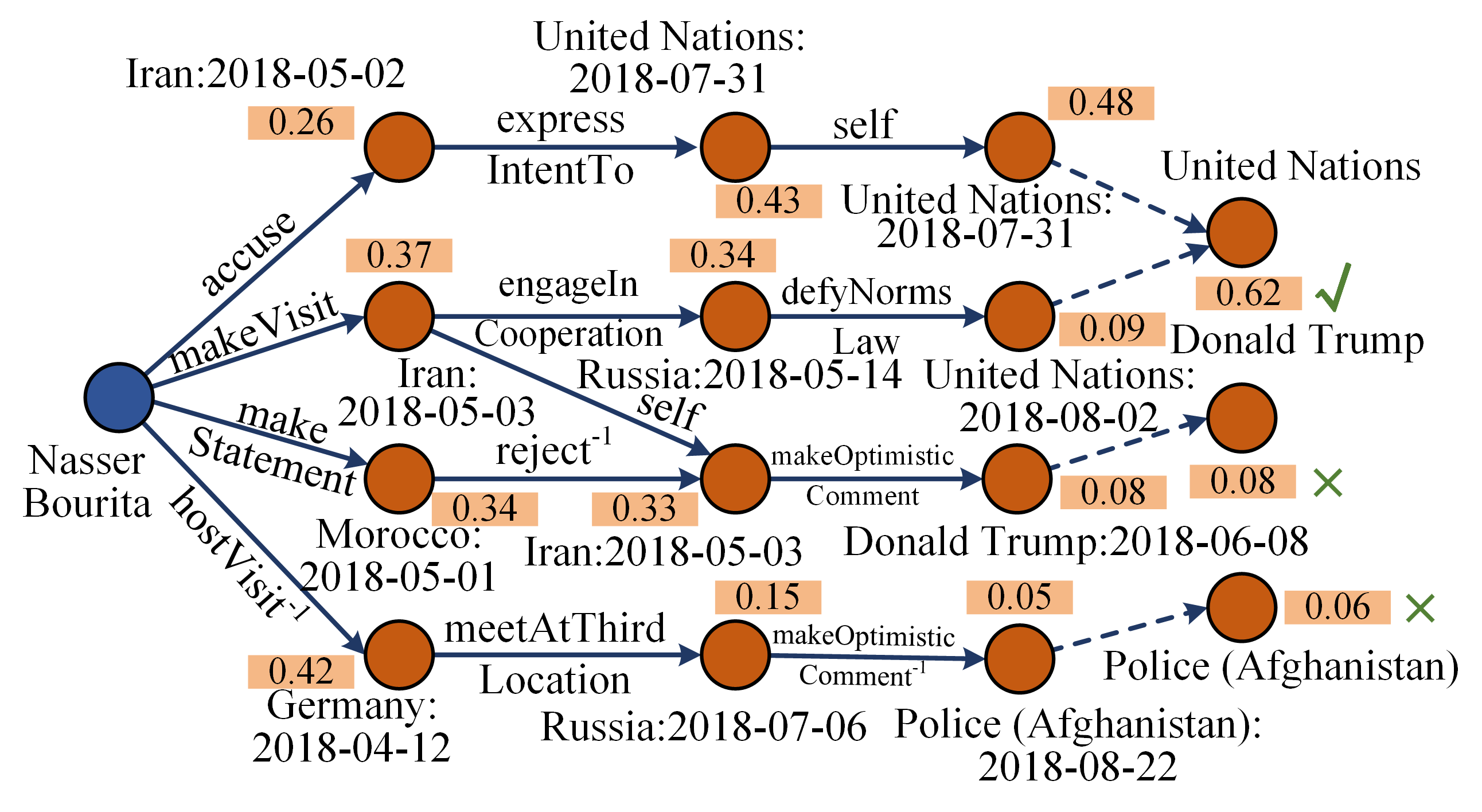
The diagram depicts a network of interactions between entities (countries, organizations, individuals) with labeled relationships and probabilistic weights. Nodes are color-coded (blue for Iran, orange for others), and edges represent actions (e.g., "accuse," "engageIn") with numerical probabilities. Dates are embedded in node labels to contextualize events.
### Components/Axes
- **Nodes**:
- **Blue Node**: Iran (central hub).
- **Orange Nodes**:
- United Nations (2018-07-31, 2018-08-02)
- Donald Trump (2018-06-08, 2018-08-02)
- Russia (2018-05-14, 2018-07-06)
- Morocco (2018-05-01)
- Germany (2018-04-12)
- Police (Afghanistan) (2018-08-22)
- **Edges**:
- Labeled with actions (e.g., "express," "defyNorms") and probabilities (0.05–0.62).
- Dashed edges indicate weaker or indirect connections.
- **Legend**: Located at bottom-right, mapping colors to entities (blue = Iran, orange = others).
### Detailed Analysis
#### Node Relationships
1. **Iran (2018-05-02)**:
- **Accuses** United Nations (2018-07-31) with probability **0.26**.
- **Makes Visit** to Morocco (2018-05-01) with probability **0.37**.
- **Hosts Visit** from Germany (2018-04-12) with probability **0.42**.
- **Makes Statement** to Russia (2018-05-03) with probability **0.34**.
2. **United Nations (2018-07-31)**:
- **Expresses Intent** to itself with probability **0.48**.
- **Defies Norms** (Law) with probability **0.09**.
- **Engages in Cooperation** with Russia (2018-05-14) with probability **0.34**.
3. **Donald Trump (2018-06-08, 2018-08-02)**:
- **Defies Norms** (Law) with probability **0.62** (highest in network).
- **Makes Optimistic Comment** to Police (Afghanistan) with probability **0.05** (lowest in network).
4. **Russia (2018-05-14, 2018-07-06)**:
- **Engages in Cooperation** with Iran (2018-05-14) with probability **0.34**.
- **Makes Optimistic Comment** to Police (Afghanistan) with probability **0.08**.
5. **Police (Afghanistan) (2018-08-22)**:
- Receives **Optimistic Comment** from Donald Trump (2018-06-08) with probability **0.06**.
- Receives **Optimistic Comment** from Russia (2018-07-06) with probability **0.08**.
#### Edge Trends
- **High-Probability Edges**:
- UN self-reference (**0.48**) and UN-Trump interaction (**0.62**) dominate.
- **Low-Probability Edges**:
- Trump-Police (**0.05**) and Russia-Police (**0.08**) edges are weakest.
- **Dashed Edges**:
- Indicate indirect or less certain connections (e.g., UN-Trump dashed edge with **0.08**).
### Key Observations
1. **Central Role of Iran**: Iran is the primary connector, initiating interactions with multiple entities.
2. **UN Dominance**: The UN has the highest self-referential probability (**0.48**) and strong ties to Trump (**0.62**).
3. **Trump’s Polarized Influence**: High probability (**0.62**) with the UN but minimal impact on Police (Afghanistan) (**0.05**).
4. **Russia’s Dual Role**: Engages with Iran and the UN but has weak ties to Police (Afghanistan).
5. **Morocco/Germany**: Limited interactions (only with Iran) and no further connections.
### Interpretation
The diagram reveals a geopolitical network where:
- **Iran** acts as a central node, driving interactions with global entities.
- The **United Nations** exhibits self-referential behavior (e.g., "express IntentTo") and strong ties to Trump, suggesting institutional influence or policy alignment.
- **Donald Trump**’s highest-probability interaction is with the UN (**0.62**), but his influence on ground-level actors like Police (Afghanistan) is negligible (**0.05**).
- **Russia** bridges Iran and the UN but has minimal impact on Afghanistan.
- **Low probabilities** for Police (Afghanistan) interactions may reflect logistical barriers, political distance, or data uncertainty.
The network highlights how high-level diplomatic actions (e.g., UN resolutions) correlate with lower-probability ground-level outcomes, emphasizing systemic complexity and fragmented influence.