## Screenshot: Theorem Definition
### Overview
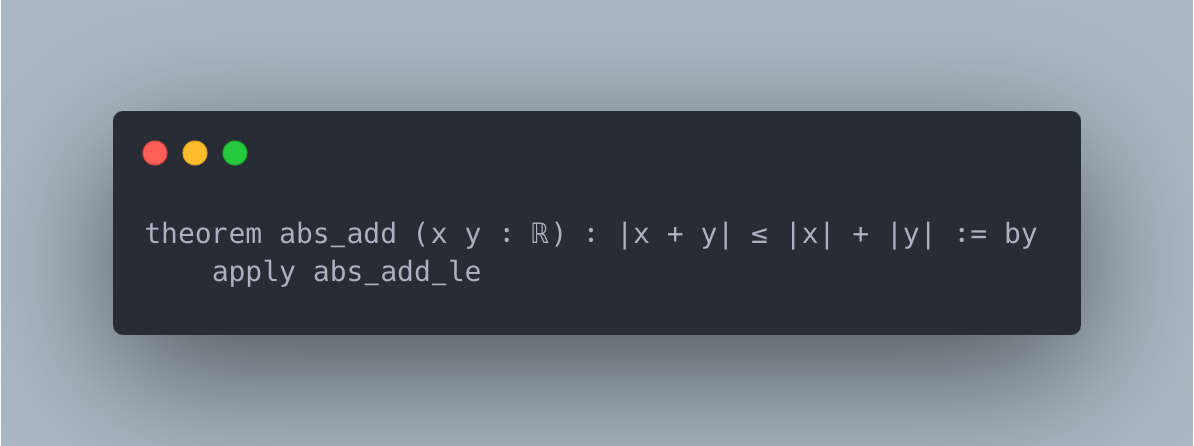
The image is a screenshot of a code snippet defining a theorem named `abs_add`. The theorem states that the absolute value of the sum of two real numbers x and y is less than or equal to the sum of their absolute values. The code snippet also includes a command to apply a lemma named `abs_add_le`.
### Components/Axes
The image contains the following text:
- `theorem abs_add (x y : R) : |x + y| ≤ |x| + |y| := by`
- `apply abs_add_le`
The top-left corner of the window contains three circles: red, yellow, and green.
### Detailed Analysis or ### Content Details
The code defines a theorem named `abs_add`.
- The theorem takes two real numbers, `x` and `y`, as input. The type of `x` and `y` is `R`, which represents the set of real numbers.
- The theorem states that the absolute value of the sum of `x` and `y` is less than or equal to the sum of the absolute values of `x` and `y`. This is represented by the expression `|x + y| ≤ |x| + |y|`.
- The `:= by` part indicates that the theorem is being defined by a proof.
- The `apply abs_add_le` command applies a lemma named `abs_add_le` to prove the theorem.
### Key Observations
The code snippet defines a fundamental theorem related to absolute values and real numbers. The theorem is proven by applying a lemma.
### Interpretation
The code snippet demonstrates the definition and proof of a mathematical theorem within a formal system. The theorem `abs_add` is a well-known result in real analysis. The use of `apply abs_add_le` suggests that the proof relies on a previously established lemma, `abs_add_le`, which likely provides a more specific or foundational result related to absolute values.