## Diagram: Multi-Agent System Architecture
### Overview
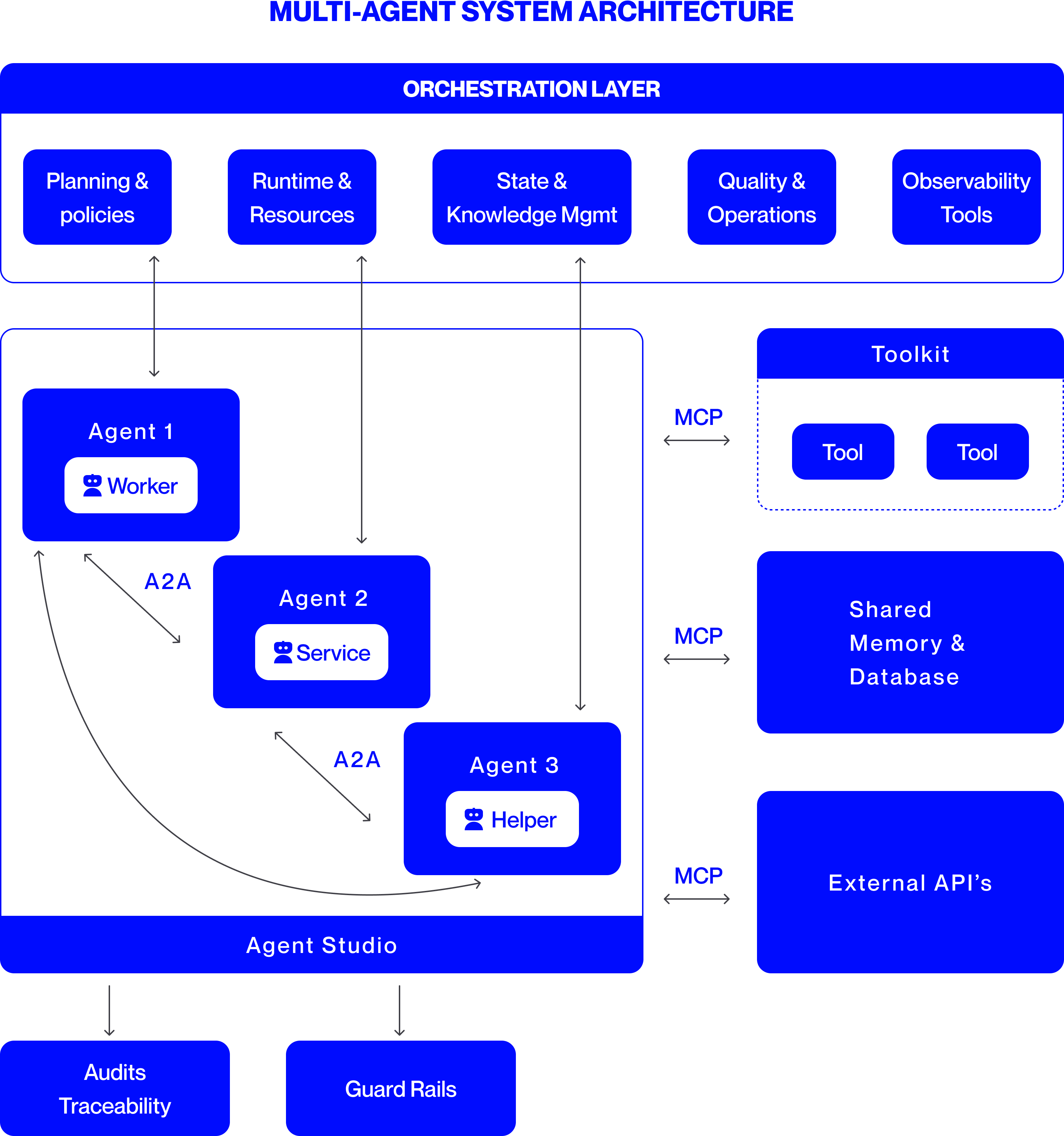
This image is a technical architecture diagram illustrating the structure and components of a "Multi-Agent System." It depicts a layered design with an Orchestration Layer overseeing an Agent Studio, which contains multiple interacting agents. The system connects to external resources and includes governance components. The diagram uses a consistent visual language: blue rounded rectangles for components, white text for labels, and black arrows to indicate communication or control flows.
### Components/Axes
The diagram is organized into distinct regions and components:
**1. Title:**
* **Text:** "MULTI-AGENT SYSTEM ARCHITECTURE"
* **Position:** Centered at the very top of the image.
**2. Orchestration Layer:**
* **Position:** A large, light-gray container spanning the top width of the diagram, directly below the title.
* **Label:** "ORCHESTRATION LAYER" (white text on a blue header bar).
* **Sub-Components (from left to right):**
* "Planning & policies"
* "Runtime & Resources"
* "State & Knowledge Mgmt"
* "Quality & Operations"
* "Observability Tools"
* **Connections:** Three vertical, downward-pointing arrows originate from the first three sub-components ("Planning & policies", "Runtime & Resources", "State & Knowledge Mgmt") and point into the central "Agent Studio" container.
**3. Agent Studio:**
* **Position:** The central, largest light-gray container in the diagram.
* **Label:** "Agent Studio" (white text on a blue footer bar at the bottom of this container).
* **Internal Components (Agents):**
* **Agent 1:** A blue box in the upper-left. Contains a white sub-box with a robot icon and the label "Worker".
* **Agent 2:** A blue box in the center. Contains a white sub-box with a robot icon and the label "Service".
* **Agent 3:** A blue box in the lower-right. Contains a white sub-box with a robot icon and the label "Helper".
* **Internal Connections (A2A):**
* A double-headed arrow labeled "A2A" connects Agent 1 and Agent 2.
* A double-headed arrow labeled "A2A" connects Agent 2 and Agent 3.
* A curved, single-headed arrow points from Agent 1 to Agent 3.
**4. External Resources (Right Side):**
* **Position:** A vertical stack of three blue boxes to the right of the Agent Studio.
* **Components (from top to bottom):**
* **Toolkit:** A blue box with a dotted-line inner container holding two smaller blue boxes, each labeled "Tool".
* **Shared Memory & Database:** A solid blue box.
* **External API's:** A solid blue box.
* **Connections (MCP):** Three double-headed horizontal arrows, each labeled "MCP", connect the Agent Studio container to each of these three external resource boxes.
**5. Governance & Safety (Bottom):**
* **Position:** Two blue boxes below the Agent Studio container.
* **Components (from left to right):**
* "Audits Traceability"
* "Guard Rails"
* **Connections:** Two single-headed, downward-pointing arrows originate from the "Agent Studio" footer bar and point to these two boxes.
### Detailed Analysis
* **Flow and Hierarchy:** The primary control flow is top-down from the Orchestration Layer to the Agent Studio. The agents within the studio communicate laterally via "A2A" (Agent-to-Agent) protocols. The entire Agent Studio interacts with external systems (Tools, Memory, APIs) via "MCP" (likely Model Context Protocol or a similar interconnect standard).
* **Agent Roles:** The agents are specialized: "Worker" (Agent 1), "Service" (Agent 2), and "Helper" (Agent 3). Their positioning suggests a potential workflow or hierarchy, with Agent 1 at the top-left initiating actions.
* **Visual Coding:** All primary components are blue. The Orchestration Layer and Agent Studio are defined by light-gray background containers. Communication protocols are explicitly labeled on the arrows ("A2A", "MCP").
### Key Observations
1. **Centralized Orchestration:** The system is explicitly managed by a dedicated Orchestration Layer with clear functional divisions (planning, runtime, state, quality, observability).
2. **Agent Specialization:** The three agents are not generic; they have distinct roles (Worker, Service, Helper), implying a division of labor.
3. **Standardized Interfaces:** Communication is formalized through named protocols ("A2A" for inter-agent, "MCP" for agent-to-resource), suggesting a modular and interoperable design.
4. **Integrated Governance:** "Audits Traceability" and "Guard Rails" are first-class components connected directly to the Agent Studio, highlighting the importance of safety, monitoring, and compliance in the system's design.
5. **Resource Abstraction:** External tools, memory, and APIs are abstracted behind a consistent "MCP" interface, simplifying agent development.
### Interpretation
This diagram outlines a robust, enterprise-grade architecture for deploying collaborative AI agents. It moves beyond a simple agent loop to a managed ecosystem.
* **What it demonstrates:** The architecture separates concerns effectively. The **Orchestration Layer** acts as the "brain" or control plane, handling meta-tasks like planning, resource allocation, and quality control. The **Agent Studio** is the "execution plane" where specialized agents perform concrete tasks, collaborating via A2A. The right-side components represent the **"resource plane,"** providing persistent memory, tools, and external connectivity. The bottom components form the **"governance plane,"** ensuring actions are traceable and safe.
* **Relationships:** The Orchestration Layer supervises but does not micromanage the agents. The agents are peers that collaborate. They rely on external resources but access them through a unified protocol (MCP), which promotes loose coupling. The governance components are sinks for logs and enforcers of constraints, receiving data from the agent execution environment.
* **Notable Implications:** The inclusion of "State & Knowledge Mgmt" in the orchestration layer and "Shared Memory" as a resource suggests a strong emphasis on maintaining context and long-term knowledge across agent interactions. The "A2A" protocol is critical, as it enables complex, multi-step problem-solving that a single agent could not handle. This architecture is designed for scalability, maintainability, and operational rigor, suitable for complex, real-world automation tasks where reliability and oversight are paramount.