\n
## Diagram: Multi-Agent System Architecture
### Overview
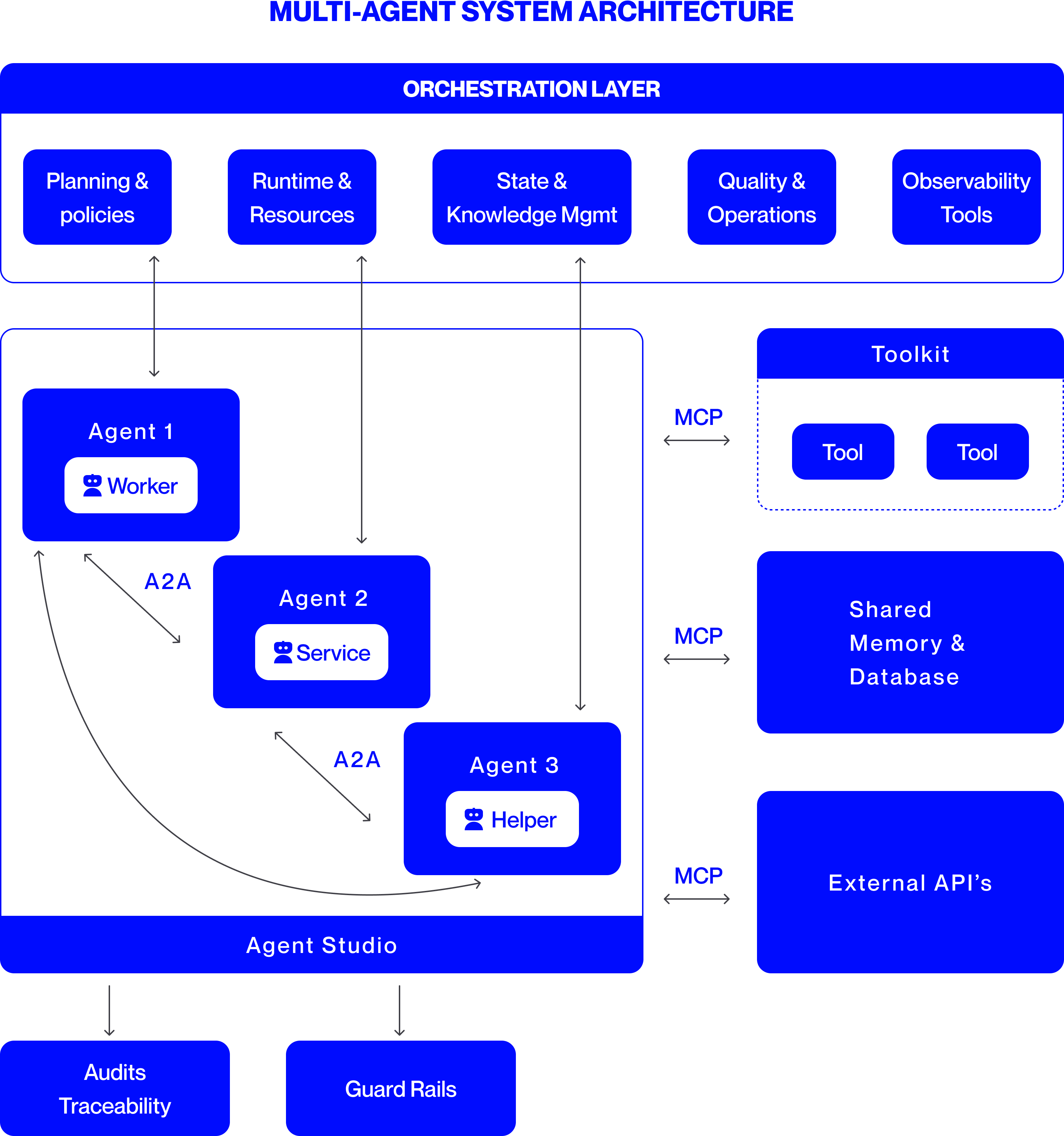
The image depicts a diagram illustrating the architecture of a multi-agent system. It showcases the interaction between agents, an orchestration layer, and supporting components like toolkits and shared memory. The diagram emphasizes the flow of information and control within the system.
### Components/Axes
The diagram is structured into three main layers:
* **Orchestration Layer:** Located at the top, consisting of five components: "Planning & Policies", "Runtime & Resources", "State & Knowledge Mgmt", "Quality & Operations", and "Observability Tools".
* **Agent Layer:** The central layer, containing three agents: "Agent 1 (Worker)", "Agent 2 (Service)", and "Agent 3 (Helper)".
* **Supporting Components Layer:** Located on the right side, including "Toolkit", "Shared Memory & Database", and "External APIs".
* **Bottom Layer:** "Agent Studio", "Audits Traceability", and "Guard Rails".
Connections between components are indicated by arrows, with labels like "A2A" (Agent to Agent) and "MCP" (likely representing a communication protocol or mechanism).
### Detailed Analysis or Content Details
The diagram shows the following relationships:
* **Orchestration Layer to Agents:** Each component in the orchestration layer has a downward arrow connecting it to all three agents. This suggests that the orchestration layer provides control and information to each agent.
* **Agent 1 to Agent 2:** A curved, dashed arrow labeled "A2A" connects Agent 1 (Worker) to Agent 2 (Service).
* **Agent 2 to Agent 3:** A curved, dashed arrow labeled "A2A" connects Agent 2 (Service) to Agent 3 (Helper).
* **Agents to MCP:** Each agent has a bidirectional arrow connecting it to "MCP".
* **MCP to Supporting Components:** Each "MCP" has a bidirectional arrow connecting it to "Toolkit", "Shared Memory & Database", and "External APIs".
* **Agent Studio to Bottom Layer:** Agent Studio has downward arrows connecting it to "Audits Traceability" and "Guard Rails".
Each agent has an icon associated with it:
* Agent 1: A person icon labeled "Worker".
* Agent 2: A gear icon labeled "Service".
* Agent 3: A speech bubble icon labeled "Helper".
The "Toolkit" component contains two boxes labeled "Tool".
### Key Observations
* The orchestration layer appears to be a central control point for all agents.
* Agents communicate directly with each other via "A2A" connections.
* "MCP" acts as a bridge between agents and supporting components.
* The "Agent Studio" provides access to auditing and security features.
* The diagram is highly conceptual and does not contain specific numerical data.
### Interpretation
This diagram illustrates a distributed system architecture where multiple agents collaborate to achieve a common goal. The orchestration layer provides high-level control and coordination, while the agents perform specific tasks. The "MCP" facilitates communication and access to shared resources. The "A2A" connections suggest a degree of autonomy and direct interaction between agents. The inclusion of "Audits Traceability" and "Guard Rails" highlights the importance of security and accountability in the system.
The diagram suggests a flexible and scalable architecture, as new agents and components can be added without disrupting the overall system. The use of a toolkit indicates that agents can leverage pre-built functionalities to simplify their tasks. The "Shared Memory & Database" component enables agents to share information and coordinate their actions. The "External APIs" allow the system to interact with external services and data sources.
The diagram is a high-level overview and does not provide details about the specific algorithms or protocols used within the system. It focuses on the overall structure and relationships between components.