## Diagram: Multi-Agent System Architecture
### Overview
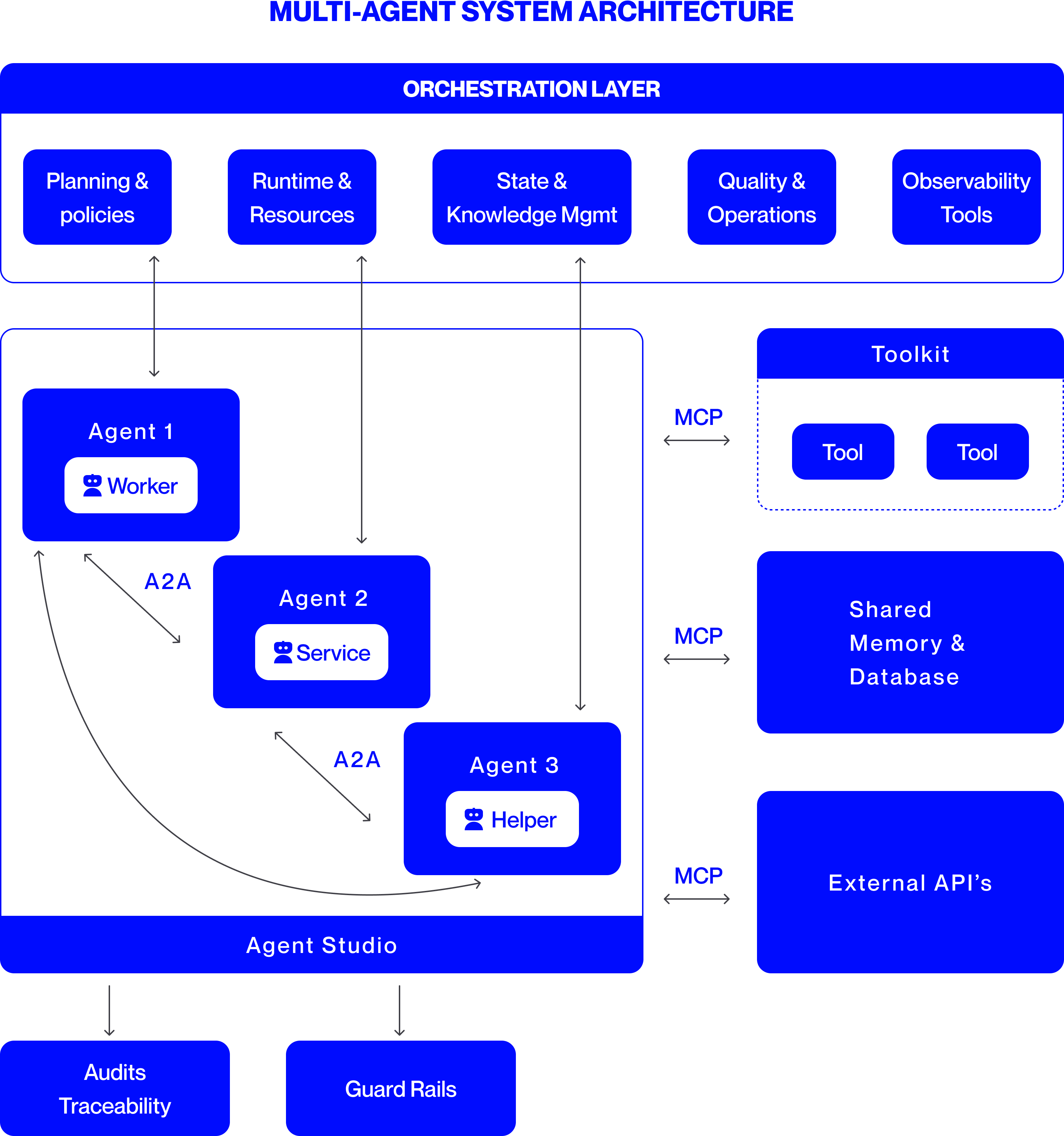
The diagram illustrates a hierarchical multi-agent system architecture divided into three layers: **Orchestration Layer**, **Agent Studio**, and **Toolkit**. It emphasizes modularity, inter-agent communication, and integration with external systems.
### Components/Axes
1. **Orchestration Layer** (Top):
- **Planning & policies**
- **Runtime & Resources**
- **State & Knowledge Mgmt**
- **Quality & Operations**
- **Observability Tools**
- Arrows connect these components to the **Agent Studio** below.
2. **Agent Studio** (Middle):
- **Agent 1 (Worker)**
- **Agent 2 (Service)**
- **Agent 3 (Helper)**
- **A2A (Agent-to-Agent) communication** arrows between agents.
- **Audits Traceability** and **Guard Rails** at the bottom of this layer.
3. **Toolkit** (Right):
- **Tool** (two instances)
- **Shared Memory & Database**
- **External API’s**
- **MCP (Middleware Communication Protocol)** arrows connect the Toolkit to the Agent Studio.
### Detailed Analysis
- **Orchestration Layer**: Centralized management of policies, resources, and observability.
- **Agent Studio**: Three specialized agents (Worker, Service, Helper) with bidirectional A2A communication.
- **Toolkit**: Provides tools, shared memory/database, and external API integration via MCPs.
- **Flow Direction**:
- Orchestration Layer → Agent Studio (top-down control).
- Agent Studio → Toolkit (via MCPs for resource access).
- A2A arrows indicate peer-to-peer collaboration among agents.
### Key Observations
- **Modular Design**: Clear separation of concerns between orchestration, agents, and tools.
- **Inter-Agent Collaboration**: A2A arrows suggest dynamic coordination between agents.
- **External Integration**: MCPs enable seamless interaction with external systems.
- **Security/Compliance**: Guard Rails and Audits Traceability imply governance mechanisms.
### Interpretation
This architecture demonstrates a scalable multi-agent system where:
1. **Orchestration** ensures alignment with policies and resource allocation.
2. **Agents** (Worker, Service, Helper) perform specialized tasks while collaborating via A2A communication.
3. **Toolkit** acts as a bridge to external systems and shared resources, enabling interoperability.
4. **MCPs** standardize communication between agents and external tools, ensuring consistency.
The design prioritizes flexibility (via modular components) and accountability (via audits and guardrails), suggesting applications in complex, distributed environments like autonomous systems or enterprise workflows.