## Chart Type: Line Chart - Average Incorrect Flips per Iteration
### Overview
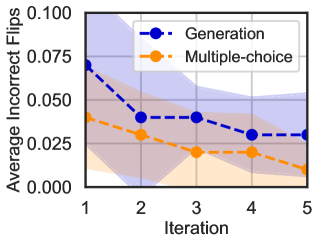
This image displays a 2D line chart illustrating the "Average Incorrect Flips" over five "Iterations" for two distinct methods: "Generation" and "Multiple-choice". Each method is represented by a dashed line with circular markers and an associated shaded region indicating uncertainty or variability. The chart demonstrates a general downward trend in incorrect flips for both methods as iterations progress, with "Multiple-choice" consistently performing better (lower average incorrect flips) than "Generation".
### Components/Axes
The chart consists of a primary plot area with two axes and a legend.
* **Y-axis**:
* **Label**: "Average Incorrect Flips"
* **Range**: From 0.000 to 0.100.
* **Major Ticks**: 0.000, 0.025, 0.050, 0.075, 0.100.
* **X-axis**:
* **Label**: "Iteration"
* **Range**: From 1 to 5.
* **Major Ticks**: 1, 2, 3, 4, 5.
* **Legend**: Positioned in the top-right quadrant of the plot area.
* **"Generation"**: Represented by a dark blue dashed line with solid dark blue circular markers. It is associated with a light blue shaded area.
* **"Multiple-choice"**: Represented by an orange dashed line with solid orange circular markers. It is associated with a light orange shaded area.
### Detailed Analysis
The chart presents two data series, each showing the average incorrect flips across five iterations, along with their respective uncertainty bands.
1. **Generation (Dark Blue Line, Dashed, Circle Markers)**:
* **Trend**: This series starts at the highest point and shows a significant initial decrease, then a more gradual decline, eventually leveling off.
* **Data Points (approximate)**:
* Iteration 1: Approximately 0.070. The light blue shaded area extends from roughly 0.060 to 0.080.
* Iteration 2: Approximately 0.040. The light blue shaded area extends from roughly 0.030 to 0.050.
* Iteration 3: Approximately 0.040. The light blue shaded area extends from roughly 0.030 to 0.050.
* Iteration 4: Approximately 0.030. The light blue shaded area extends from roughly 0.020 to 0.040.
* Iteration 5: Approximately 0.030. The light blue shaded area extends from roughly 0.020 to 0.040.
2. **Multiple-choice (Orange Line, Dashed, Circle Markers)**:
* **Trend**: This series starts lower than "Generation" and exhibits a more consistent, steady downward trend across all iterations, reaching the lowest value by the final iteration.
* **Data Points (approximate)**:
* Iteration 1: Approximately 0.045. The light orange shaded area extends from roughly 0.035 to 0.055.
* Iteration 2: Approximately 0.030. The light orange shaded area extends from roughly 0.020 to 0.040.
* Iteration 3: Approximately 0.020. The light orange shaded area extends from roughly 0.015 to 0.030.
* Iteration 4: Approximately 0.020. The light orange shaded area extends from roughly 0.010 to 0.030.
* Iteration 5: Approximately 0.010. The light orange shaded area extends from roughly 0.005 to 0.020.
### Key Observations
* Both "Generation" and "Multiple-choice" methods show a reduction in "Average Incorrect Flips" as the "Iteration" count increases, indicating an improvement over time.
* The "Multiple-choice" method consistently maintains a lower "Average Incorrect Flips" value compared to the "Generation" method across all five iterations.
* The most significant drop for the "Generation" method occurs between Iteration 1 and Iteration 2. After Iteration 2, its performance plateaus more, with only a slight further decrease.
* The "Multiple-choice" method demonstrates a more gradual but steady improvement throughout all iterations.
* By Iteration 5, the "Multiple-choice" method achieves an average incorrect flips value of approximately 0.010, which is significantly lower than the "Generation" method's approximately 0.030.
* The shaded regions, representing uncertainty, overlap significantly in earlier iterations (e.g., Iteration 1, 2, 3), suggesting that the difference between the two methods might not be statistically significant at those points. However, by Iteration 5, the uncertainty bands are largely separated, with the upper bound of "Multiple-choice" being below the lower bound of "Generation", indicating a clearer performance difference.
### Interpretation
This chart suggests that, in the context of the task being measured by "Average Incorrect Flips," the "Multiple-choice" approach is more effective than the "Generation" approach. Both methods show a learning or improvement curve, as indicated by the decreasing number of incorrect flips over iterations. However, "Multiple-choice" starts with a lower error rate and maintains a superior performance throughout the process, ultimately achieving a substantially lower error rate by the fifth iteration.
The initial steep decline in "Incorrect Flips" for the "Generation" method might indicate that it benefits significantly from early iterations, perhaps by quickly correcting major errors or learning fundamental patterns. However, its improvement then slows down, suggesting it might hit a performance ceiling or struggle with more nuanced aspects of the task. In contrast, the "Multiple-choice" method's consistent, albeit gentler, decline implies a more robust or steady learning process that continues to yield improvements even in later iterations.
The overlapping uncertainty bands in the initial iterations highlight the importance of considering variability; while "Multiple-choice" has a lower average, the performance distributions might still overlap. However, the clear separation of these bands by Iteration 5 strongly indicates that "Multiple-choice" has a statistically significant advantage in reducing incorrect flips in the long run. This data would be crucial for deciding which method to implement or further investigate for optimization, with "Multiple-choice" appearing to be the more reliable and effective strategy for minimizing errors in this specific context.