## Line Chart: Average Incorrect Flips Across Iterations
### Overview
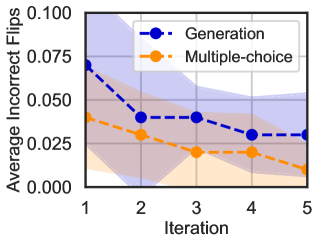
The chart compares two data series ("Generation" and "Multiple-choice") across five iterations, showing the average number of incorrect flips. Both series exhibit downward trends, with "Multiple-choice" consistently outperforming "Generation" in reducing errors.
### Components/Axes
- **X-axis (Horizontal)**: Labeled "Iteration" with markers at 1, 2, 3, 4, 5.
- **Y-axis (Vertical)**: Labeled "Average Incorrect Flips" with values from 0.000 to 0.100 in increments of 0.025.
- **Legend**: Located in the top-right corner, with:
- **Blue dashed line**: "Generation"
- **Orange dashed line**: "Multiple-choice"
- **Shaded Regions**: Gray areas around each line represent confidence intervals (uncertainty ranges).
### Detailed Analysis
1. **Generation (Blue Line)**:
- Iteration 1: ~0.075
- Iteration 2: ~0.045
- Iteration 3: ~0.040
- Iteration 4: ~0.035
- Iteration 5: ~0.035
- **Trend**: Steep decline from Iteration 1 to 2, followed by gradual stabilization.
2. **Multiple-choice (Orange Line)**:
- Iteration 1: ~0.035
- Iteration 2: ~0.025
- Iteration 3: ~0.020
- Iteration 4: ~0.015
- Iteration 5: ~0.010
- **Trend**: Steady linear decline across all iterations.
### Key Observations
- "Multiple-choice" starts with significantly lower error rates than "Generation" at all iterations.
- Both series show decreasing trends, but "Multiple-choice" maintains a more consistent rate of improvement.
- The shaded confidence intervals for "Generation" are wider, indicating greater uncertainty in its measurements.
### Interpretation
The data suggests that the "Multiple-choice" approach is more effective at reducing incorrect flips over iterations compared to "Generation." The steeper initial drop in "Generation" may indicate rapid early improvements, but its plateau at later iterations implies diminishing returns. The narrower confidence intervals for "Multiple-choice" suggest more reliable performance metrics. This could imply that "Multiple-choice" offers a more stable and scalable solution for error reduction in iterative processes.